
Peter Marks secret recordings
Highwire broadcast on 11 Apr 2025

Check out the video here
[Del Bigtree]
[0:00:05]
Have you noticed that this show doesn’t have any commercials?
Introduction and Sponsorship
I’m not selling you diapers or vitamins or smoothies or gasoline. That’s because I don’t want any corporate sponsors telling me what I can investigate or what I can say. Instead, you are our sponsors. This is a production by our non-profit, the Informed Consent Action Network.
[(Unidentified Man)]
So if you want more investigations, if you want landmark legal wins, if you want hard-hitting news, if you want the truth, go to ICanDecide.org and donate now. All right everyone, we ready? Let’s do this.
Introduction to Secret Recordings
Action.
[Del Bigtree]
[0:01:00]
Good morning, good afternoon, good evening. Wherever you are out there in the world, it’s time to step out onto the high wire. I am so pumped for this show today. Every once in a while we get to just break some incredible news or some new footage. Today we are going to be revealing there’s over six secret phone calls that were recorded between Breanne Dressen and Dr. Peter Marks. Their secret recordings of the FDA official are being exposed today. These are interactions with people that were in the trials for the vaccines complaining about their injuries and you get to hear what he was actually saying. We’re going to lay out the timeline when he was saying it, what he was saying publicly versus what he was hearing on these phone calls behind the scenes. It’s really a shocking revelation that you’re only going to get today here on the high wire.
The Jackson Report - International News
But first, it’s time for the Jackson Report.
[0:02:06]
All right Jeffrey, there’s a lot of stuff going on in the world these days. It just doesn’t seem to slow down. So what are we looking at?
[Jeffrey Jaxon]
Yeah, well let’s keep it fast-paced. Let’s take some care of some international business first So we remember just like a couple weeks ago, Trump cut funding to the WHO. Now we see the headlines here out of Reuters. WHO is going to look to maybe cut some of its staff, proposing to cut jobs and slash budgets by a fifth, memo shows. And that’s not all. So we know that the USAID was also cut. A lot of those programs were cut. Well the World Economic Forum received tens of millions of dollars of United States money over the years and one of the things we’re seeing now is guess who’s stepping down? Klaus Schwab is stepping down as the World Economic Forum’s chair. So he stepped down as their lead and now he’s out of there. So if those things are related or not, I’m not sure. But boy, the timing seems really coincidental at this point.
The Jackson Report - Domestic News: Johnson & Johnson and Bayer
[0:03:02]
But right now, let’s move domestically. There’s a lot of stuff happening. There’s massive moves happening right now in America to really turn the health around for our citizens. And one of those things, we’re looking at legal and also state level movements. So one of the big legal stories coming out was Johnson & Johnson. They’re back in the news. This is something we’ve covered for years, you and I, even before COVID. Johnson & Johnson shares tumble as judge rejects 10 billion dollar calc settlement. They basically, Johnson & Johnson said, we’re going back to court to fight these, which seems like a terrible move because they were trying to have like a class action just to settle all of this. 10 billion dollars, put this on the table. They could all go away and the cancer causing, the baby powder is causing cancer, especially for women. But they’re going back to the courts now and they’ve had some big losses in the court. So that’s happening on the consumer base then. But also, our friends at Bayer, Bayer Agriculture, they just had another huge loss in a Georgia court. 2.1 billion dollars is the latest roundup weed killer loss.
[0:04:04]
And again, this was related to the non-Hodgkin’s lymphoma. We see a lot of those court cases centering around that. They’ve been hit, Bayer’s been hit with nearly 200,000 cases. They set aside 16 billion dollars for these cases. But at this rate, it doesn’t look like it’s going to be happening.
[Del Bigtree]
It’s not going to hold up very long.
[Jeffrey Jaxon]
I mean, they’re blowing through it. They’re blowing through it. Absolutely. And they have some massive problems because, so glyphosate obviously is just the one active ingredient, but the entire formulation has never been tested for cancer, for long-term safety effects. And these court cases are just keep coming. And as you talked about, we were in Washington, D.C. We had Zen Honeycutt, the head of Moms Across America. There’s a slew of legislation now in the United States happening. It just started last year. And this is the headline here, because you see those court, you see those court cases, these billion dollar losses. Well, Bayer, Bayer’s effort to block roundup lawsuits kicks into high gear. So they’re modeling this after the National Vaccine Injury Compensation Program, zero liability for the manufacturers, codified in a bill.
[0:05:06]
It says last year Bayer lobbied lawmakers in Idaho, Iowa, Missouri to push immunity bills, but the bills failed to pass. The company then ramped up its campaign heading into 2025. It created the Modern Ag Alliance to promote farmer support for the bills and began a cross-country ad blitz. Since the beginning of this year, lawmakers have introduced similar immunity bills in about a dozen states. Bills were defeated in Montana, Mississippi and Wyoming, but they came back and are still pending in Idaho, Oklahoma, North Dakota, Missouri, Florida, Tennessee, Iowa. So this thing is gaining speed in a massive way.
[Del Bigtree]
It’s really amazing, isn’t it? You have a product that’s causing cancer, that’s determined both by these court cases and the WHO ruling that we’ve talked about, IARC back in 2015. But just every time I think about this, the fact that Bayer Monsanto, this gigantic mega corporation, thinks that instead of making a better, safer product, let’s go back to the drawing boards, that their best way forward is to use government to give them liability protection.
[0:06:09]
The fact that anyone would even think that that could work in this country, I think shows you just how far off course we’ve gotten with our government. Obviously, we’re going to do everything we can. And by the way, everyone out there, you better fight like hell right now. We can never allow liability protection of a product like that. That’s just insane.
[Jeffrey Jaxon]
Yeah, it’s time for all those people, the March Against Monsanto people, to reactivate here if you really want to defeat this bill, if people really care about this bill. And we have former Florida Congressman Matt Gates. A lot of people aren’t in this conversation a lot when it comes to this immunity bill, because it kind of came out of nowhere, all these bills in all these states. Well, he took the X because he saw a glimpse of it. And he said this, WTF, question mark, explanation point, why is the Florida legislature advancing a bill to give immunity to pesticide makers?
[0:07:00]
So a lot of people are kind of really now activating, going, wait, this is happening? And it’s interesting, because when you read into these lawsuits, when they lose these lawsuits, there’s always a statement by the company that says we stand behind the science, we stand behind our products, they’re safe, they’re effective. Well, if they are, why the need for these bills? But let’s move forward into the agricultural space, because there’s also a new, there’s complete shift happening here.
The Jackson Report - RFK Jr., Biologicals, and Fluoride
And this brings us into RFK Jr. So this was a Bloomberg, RFK Jr. helps underpin a $25 billion pivot from farm chemicals. There’s a new kind of category called biologicals. And this can be anything from bacteria to old corn husks. But companies are now focusing on this because of the shift away from the herbicides and the roundups and glyphosates to do a more natural based products called biologicals to keep the revenue stream going. So this is a movement that obviously in this article, you go in here and they’re saying, well, we hope Kennedy with his mindset and because that was one of the things he was put into HHS on is his work with the farmers trying to get these pesticides out of farming and off the farmland.
[0:08:05]
So this is a move that may be happening. It’s happening slowly right now, but it seems to be supercharging. And then also on the RFK Jr. kick here, because Utah just became the first state to remove fluoride from the water. We see now RFK Jr. coming forward and telling the CDC to stop recommending fluoride in drinking water as the EPA reviews new scientific information. So he has signaled he’s going to tell the CDC to stop recommending fluoride. So that is a federal level move that is gigantic. And we’re really hoping to see that. Obviously, we have Miami-Dade was the biggest county at this point, waiting for that signature to end fluoridation there. But now let’s move. We’re staying at the state levels here.
The Jackson Report - New COVID-19 Shot Study and State Bans
We’re staying at with the new science, the new movements happening. And there’s a new study that just came out with the COVID shot. And this leads into some of the states now trying to ban this shot. So there’s a lot of reasons that people don’t want this mRNA technology being injected into children.
[0:09:01]
It’s still happening right now because it’s still being recommended by the CDC. But there’s a new study out from Japanese researchers, and they looked at the brain tissue and the cerebral artery tissue of 19 people who suffered a hemorrhagic stroke between 2023 and 2024. That’s the study right there. And what are the results? They said this. Spike protein expression was detected in 43.8% of vaccinated patients, predominantly localized in the intima. That’s the innermost coating, the innermost layers of the cerebral arteries, even up to 17 months post-vaccination. Del, this builds on the conversation that we’ve had before showing the spike proteins almost in the body for two years. And the people that, mostly females, by the way, in this study, which is an interesting point, but none of them had active infections. They were able to determine that. And the researchers said this. We suggest, based on the results of the study, that global replication studies should be conducted to verify the true safety profile of mRNA vaccines. Shouldn’t you have done that before you wrote them out? And here’s where we are.
[0:10:02]
So we have Nicholas Holscher. He works with Dr. Peter McCullough. And he put this post out on X. This is a picture of now Minnesota has become the 11th state. So we have 11 states with legislative efforts to ban mRNA injections. And that is what’s happening. This is a big movement now. It’s a big groundswell. No really signaling at the federal level this is going to happen yet. But states are, again, just taking the ball and running with this.
[Del Bigtree]
That’s fantastic. I mean, that’s what it has to be. The more I look at these things, right, we want the federal government involved. But it really is that localized government. The closer you can get it to you, the more work you can get done faster. You have more power. Your vote matters more. And we’re just seeing this incredible moment where these states are feeling empowered to do the federal government should have done a long time ago. And as we’ve said before, once those states start breaking apart, you create this uneven playing field for the market. And someone’s got to right that ship. They’ve got to figure out how do we get back to a product that works for everybody.
[0:11:01]
Safety testing might be a good place to start. And let’s get these mRNA vaccines, you know, off off the market, get them out of our kids. I know a lot of people are waiting with bated breath to see what Robert King Jr. is going to do about that.
[Jeffrey Jaxon]
Absolutely. You know, it’s about a constant consciousness change as these states move. That’s a signal that the public is being ready for this. The federal moves can be a lot easier at that point. But now let’s we’re talking about at the state level. We go from federal to state.
The Jackson Report - Censorship in the UK and Europe
But let’s talk about literally the words that you and I are talking to each other with or posting online with. This is something that is under distress. In America, we don’t really we’re not really seeing this anymore. During COVID, we saw a lot of censorship top down from the government through social media companies. But we have kind of a reprieve right now. Hopefully this will last for generations. But over in the U.K., over in Europe, they’re still fighting that battle. And it’s actually getting a lot tougher there. So in the U.K., we had the Online Safety Act that went into force in 2023. But their regulations, their actual the burdens of that, it’s called illegal content for people posting what they call legal content.
[0:12:05]
It’s a very nebulous term. That’s something that really went to enforce enforcement in March, just a couple weeks ago. The Online Safety Act and Ofcom, that’s the regulator, is really starting to look at this now. And here’s some of the headlines coming out of the U.K. Hamster forum and local residents website shut down by new Internet laws. And it says dozens of small Internet forums have blocked. British users are shut down as new online safety laws come into effect, with one comparing the new regime to a British version of China’s Great Firewall. It’s not what you want to be compared to. And what’s happening here is these forums, they’re just they’re run by everyday people in the U.K. and they’re shutting down because they don’t want to be fined, because they have to basically monitor and censor speech for the government on their forums and hamster forums, cycling forums. I mean, it’s not these aren’t the hotbed of like political hate speech here, but people are just walking away, which actually is funneling more of these people into the big tech platforms, which is ironic.
[0:13:00]
But what does Keir Starmer have to say? He’s the prime minister of the U.K. He was meeting with Trump and Vice President J.D. Vance in the White House recently. Listen to what he had to say.
[Keir Starmer]
All right. We do have, of course, a special relationship with our friends in the U.K. and also with some of our European allies. But we also know that there have been infringements on free speech that actually affect not just the British, of course, what the British do in their own country is up to them, but also affect American technology companies and by extension, American citizens. So that is something that we’ll talk about today at lunch.
[(Unidentified Man)]
We’ve had free speech for a very, very long time in the United Kingdom and it will last for a very, very long time. Well, no, I mean, certainly we wouldn’t want to reach across U.S. citizens and we don’t. And that’s absolutely right. But in relation to free speech in the U.K., I’m very proud of our history there. Amazing moment.
[Jeffrey Jaxon]
I mean, so just to recap, he’s saying we’ve had free speech for a very long time. We certainly wouldn’t want to do something as crazy as reaching across the U.S. and telling you how to use your own speech.
[0:14:02]
Well, it’s interesting because I remember speaking to you less than six months ago about this headline and this video. U.K. police commissioner threatens to extradite U.S. citizens over online posts. We’ll come after you. So that’s what’s happening there. But here’s what people in the U.K. are dealing with. These are real time headlines. Here’s the first one. Police make 30 arrests a day for offensive online messages. They’re they’re they’re building out this base in England. So when people are like, well, that’s in England or in America, free speech, they’re building out this base in the European Union, in the U.K. and they’re trying to project it clearly trying to project it out into the United States and to affect us.
[Del Bigtree]
It’s one election away.
Discussion on Censorship and Free Speech
You know, it’s really where we’re at. We could have had you know, we could have been right in lockstep right now with the U.K. This is not a political show. I don’t care, you know, what party you’re in. But I grew up a Democrat and the Democratic Party was saying we are going to censor misinformation, which is what this is all about.
[0:15:03]
So we would have been in lockstep with it right now. We have an administration where J.D. Vance on television is calling this out and saying that’s unacceptable by American standards. So, you know, folks, look how terrifying this is. These are just people talking and they’re for the most ridiculous reasons. They’re being arrested. They’re being shut down. This is a global phenomenon. It’s a global authoritarian regime that I think is really just only blocked at the borders of the United States of America right now. And like I said, do not go to sleep, everyone. We have work to do. We’ve got to push back and get, you know, make sure that we’re protected in the future, because like I said, one, you know, one election and this could be our future, too.
The Jackson Report - EU Digital Services Act and Censorship
[Jeffrey Jaxon]
We absolutely have work to do in the U.K. of the Online Safety Act. That’s a world’s first. I mean, if you count outside of China. But then the European Union passed the Digital Services Act, and that was more focused in targeting large providers like X, like Facebook and Meta.
[0:16:04]
And this is the headline coming out of The New York Times. This is the Digital Service Act of the U.K. EU prepares major penalties against Elon Musk’s X. So it says the fine could surpass one billion dollars, one person said, as regulators seek to make an example of X to deter other companies from violating the law, the Digital Services Act. So it’s interesting because these laws are written. They’re very, it’s very, again, I use the word nebulous, these nebulous terms. So they can do this. They can make an example of people if they want to, because it’s a sliding scale of speech. Is it hateful? Is it not hateful? What’s hateful? I don’t know. Your comment was hateful. Trust us. But it’s not just going from there. So we have new U.K. Internet policing laws target U.S. online forums. So they’re now targeting. So all the people in the U.K. that I said, we’re shutting down our forums. They’re also targeting these U.S. forums. And one of them is Gab. This is something that we’ve used quite a bit. This is kind of like an alternative to Twitter at the time and X. It says on here the U.K. government has demanded that Gab submit to their new censorship regime under the U.K. Online Safeties Act, threatening massive fines, 18 million euro or 10 percent of their annual revenue for not policing speech.
[0:17:12]
This is what Andrew Torba said. He’s the head of Gab on X. He said, we will not comply. We will not pay one cent. We will defend our U.K. users right to speak freely and reject any law that compels censorship. Their letter and the response from our legal team is attached. So, again, just like Rumble, just like X, now Gab, we’re fighting this here. It’s a united front, United States, for now. And, you know, it’s our will that is going to and we need to support these organizations and these people in these platforms that are doing this, because this is this is the firewall between kind of authoritarian censorship and going back to the years. And then so people seeing all this right now, maybe if you’re sitting in the U.K. are saying this is too much. I’m going to turn my computer off. I’m going to go down to the local pub and I’m going to grab myself a beer and have a conversation. Well, you may not be protected there either.
The Jackson Report - Censorship in British Pubs
Here is the headline. It’s closing time for free speech in British pubs that they’re talking about is something called the Employment Rights Act.
[0:18:06]
It’s working its way through the U.K. parliament. Third parties, meaning the employers have to protect everyone, including third parties. So not only the people that you employ, but third parties, meaning your patrons at your pub, the people, you know, if you’re cutting hair, the people sitting in your hair, you have to protect them from this hate speech. And the hate speech can’t cross lines of race, religion, sexual orientation, gender reassignment. It’s all in the bill. No one can really say anything about that that is considered negative or hate speech or hateful. And so that’s what’s happening. I hate to laugh, but I mean, you can’t even tell a joke.
[Del Bigtree]
I mean, I would imagine telling a joke now of any kind that pressures any sort of social norm, you know, could get you fined and have your pub shut down. I mean, no joking allowed. Don’t get too drunk. Don’t get too funny. Don’t make fun of the incredible authoritarian pressure we’re living under here.
[0:19:01]
Amazing.
[Jeffrey Jaxon]
Wow. And we got a lot of pubs that are actually shutting down in the U.K. because they see this coming. They don’t want any part of it.
The Jackson Report - Keir Starmer and Globalization
And then you have Keir Starmer just recently came out, and this was in response to Trump’s tariffs, but it’s kind of a veiled conversation, a veiled headline. Starmer to declare end of globalization while Trump’s tariff war wages. So this censorship, this kind of, again, full push towards net zero, this is all globalization. It’s all under that heading. And so for him to come out and say that globalization looks like it might be over, that is a symbolic win as well as everyone is kind of now focusing on the E.U. and the U.K. as the new hotbed for censorship. So here in the U.S., we have their eyes on them. We’re not going to let them off. And for the people in the U.K., we’re working on your behalf. We’re going to keep yelling this at the top of the mountain, and we’re not going to let them get away with this, with the censoring of speech. So we’re on your side, and we’re hopefully going to stop this. We have a government now that is actually behind us and that’s willing to work for us and to keep our speech free.
[0:20:00]
So this is what’s happening here in the United States.
Conclusion of Jackson Report and Highwire Protocol
[Del Bigtree]
Absolutely. Well, it’s what we have been fighting for. You and I, Jeffrey, you know, all through COVID, you know, all these years, the writing’s been on the wall. We have been, you know, standing for what this show represents, our ability right now to be able to tell the truth on this show, a truth that, and to have the high wire protocol, which I want to bring up right now, because we don’t just make the statements we make. We provide all the evidence, all of the articles that we talk about, all the science that we talk about is provided to our viewers so that you can check our work. We’re demanding that everybody in media do the same thing, but if you want to receive all of the information that we are reading from or the videos that we’re playing, you need to sign up. We just need your email. You just scroll down. If you’re on the page, down in the middle of the page, type in your email. It’s that simple. It’s no charge. It’s one of the greatest tools we have so that you don’t have to say, oh, the high wire said, or Jeffrey Jackson said, or Del Bigtree said.
[0:21:01]
You can say the CDC said, or the FDA said, or there’s a peer reviewed study, or here’s a video you can play. We put all of that in your hands so that you can be a part of spreading the word on these very important issues like censorship. If we lose our first amendment right, Jeffrey, we’ve lost all rights. We cannot fight for any other rights that we may have. Incredible reporting, Jeffrey. Thanks for standing side by side with me all these years. It’s still so critically important. It’s like you can see a tidal wave building all around the world. It’s coming to slap at our borders. We’ve got to remain strong. Thank you.
[Jeffrey Jaxon]
Absolutely. It’s been an honor. I mean, the work starts now. Thank you, Del. Absolutely. All right. I’ll see you next week.
[Del Bigtree]
Normally, this is the time where I would say, you know, we have a legal update or something we want to share with you and all the reasons that you should be donating to help us make this show possible.
Call to Action: Funding for Lawsuits and Investigations
But I just want you to think about this segment that’s coming up right now, all the way through it, who is able to fund lawsuits to go in or even bring in attorneys to help someone like Breanne Dressen, who is in these meetings after having been injured by the vaccine, talking to one of the heads of the FDA.
[0:22:13]
What do I do? What can I legally do? Can I record it? All of those things. We send Aaron Siri in to be involved so that we can do a show like we’re about to do today. All of this, you know, whether it’s doing the great productions that we do, the international investigations that are always going on that contribute to the great work that Jeffrey Jackson does during his segment. And of course, Aaron Siri, probably the greatest constitutional attorney of our lifetime, won back the religious exemption in Mississippi. Just absolutely brilliant work. It’s ongoing. And today you’re going to see yet another byproduct of the legal work that we do, of the media that we do, and bringing you a story that is breaking here today. So to get it started, before we even really get into these incredible recordings, there’s already a documentary that is making waves.
Follow the Silenced Documentary
[0:23:10]
And I want you to imagine that you’re a filmmaker. You’re in California, you’re living there, and suddenly it so oppressive that the people around you start hating the work that you’re doing, the movies that you’re putting out. You’re revealing dangers of authoritarianism coming into inside of our borders, or talking about the vaccine issue, or talking about the COVID issue. And you run out of California and say, let me go to Texas and start making my movies there. But then as COVID clears and you make a spectacular documentary that may be one of the most revealing of times, you say, you know what? Let’s launch it in Los Angeles. Let’s go back to the belly of the beast and see where we’re at now. And then imagine winning awards there. That is what happened just two weeks ago for Follow the Silenced.
[0:24:00]
This is the trailer.
[(Unidentified Narrator)]
The first question was, why isn’t the United States looking in our own backyard for our data?
[(Unidentified Man)]
Madeline, hey honey, it’s daddy.
[(Unidentified Narrator)]
But they were. They just weren’t telling us what it said.
[(Unidentified Man)]
Maddie? Maddie?
[Breanne Dressen]
Most of you have never heard of me. I did my part. I got it. And most likely have never heard of most of us here.
[(Unidentified Man)]
I would like to introduce, I’m proud to introduce, Ms. Breanne Dressen.
[(Unidentified Woman)]
I don’t know where to go. Her car’s a death. Her actual car’s a death. It’s not a car, it’s a death. Thanks for attending my call.
[(Unidentified Man)]
And I did not want to be the one to hear from you on the phone.
[Breanne Dressen]
The worst part was I could not walk.
[Keir Starmer]
Couldn’t move my arms or legs. No response from my legs.
[(Unidentified Woman)]
I couldn’t think about moving my legs.
[Keir Starmer]
I couldn’t move.
[(Unidentified Woman)]
[0:25:00]
I can’t feel my legs. I can’t feel anything. You know, I don’t want to die. I want to still live for my kids.
[Breanne Dressen]
The truth is not out there. And it’s thanks to these guys.
[Del Bigtree]
These are safe and effective products.
[Peter Marks]
For these mRNA vaccines, there is incredible BS out there about thousands of people dying, etc. That just ain’t true. There is no bad time to get your second shot.
[(Unidentified Woman)]
This stack of patients are patients that are stuck.
[Stephanie DeGary]
There were 50 to 100 reports going missing. VAERS IDs being disappeared.
[(Unidentified Woman)]
We started having in-person Zoom calls with the FDA.
[Breanne Dressen]
We’ve got thousands of people that are having issues.
[(Unidentified Woman)]
Neurological side effects to the COVID vaccine.
[Peter Marks]
None of us are denying that there are these reports of neuropathy and that there’s potential vaccine injury here.
[(Unidentified Man)]
How many studies do you run where you take the placebo group and give me the vaccine too? We don’t have any secrets here.
[Paul Offit]
I told my family that I was going to end my life.
[(Unidentified Man)]
[0:26:01]
It broke my son to hear that his mom wanted to die because she had gotten a COVID vaccine. You think I’m going to kill my baby? I’m not going to stop the fight.
[(Unidentified Woman)]
I am not speaking out because of my injury. I’m speaking out because of what happened after my injury.
[Stephanie DeGary]
Facebook says it’s working hard to fight misinformation.
[(Unidentified Man)]
Lies about vaccines.
[(Unidentified Woman)]
The base of this story, the very center of this story is love. We can’t give up. Let’s get you someone for your life back, okay? And we can’t give in. I won’t sleep until this war is done.
[Breanne Dressen]
I know that I’m on the other side of the country, but I promise you you’re not alone.
[(Unidentified Woman)]
Without validation, without love, without acceptance, healing cannot happen. So that’s what this story is about. It’s about love. I’m not going to give up. I’m not going to give up on these people.
[Del Bigtree]
[0:27:10]
Well, just two weeks ago, Follow the Silence won the Santa Monica Film Festival.
Interview with Follow the Silenced Filmmakers
What an amazing accomplishment there to go in the belly of the beast and win with this very important and incredible film. It’s my honor and pleasure right now to be joined by the executive producer, Mickey Willis. Thanks, Dale. Good to see you. And the director, Matt Guthrie. First of all, congratulations.
[Mickey Willis]
Thank you.
[Del Bigtree]
I mean, you and I have been through it with media. Vaxxed, of course. Got kicked out of Tribeca Film Festival. Dragged through it on that, toured the country. And then the Plandemic series, probably the most censored set of films in history. And then to see it come full circle, are you worried about a sense of censorship around this film?
[0:28:01]
Or do you feel like we’re living in a different time right now?
[Mickey Willis]
I’d say we’re living in a different time right now. There’s a lot of things that we were very concerned about last year. And we’ve already noticed that, to some extent, the restraints on the throttle have been released. And there are already things, except for the fact that I found out recently that Plandemic is the most censored word in the world. And so that’s kind of why we ended the series also, because our last couple of films, people couldn’t find them because you can’t even, there’s no hashtag Plandemic. And so I don’t know how to undo that once the technocrats set that in place. But there’s definitely been a, it’s a new era. A lot of, you know, just the fact that, as you mentioned, the belly of the beast, that we’re invited to be right there in the heart of Hollywood, at the Directors Guild of America. And to, you know, to sweep the festival. It really shows that there’s people even within that organism that are ready and wanting the truth.
[Del Bigtree]
What was that like, I mean, you’re in Hollywood, were there like real Hollywood liberal types coming up and praising the film?
[Matt Guthrie]
[0:29:06]
Yes, I mean, that’s what was really unexpected. You know, like we built every piece of this movie to speak to the people that would be predisposed to turn it off, right? Which is a lot of this audience. And I told them when we got up and had a panel and I said, you know, guys, I just want to, if you’re a liberal person, and I hate, you know, like you, I hate the definitions between them, but if you feel that way, this is a story that should appeal to you. This checks every box for all of the things that you care about. These people should be people you care about. But after the film, myself and Mickey and a variety of other people, Tyler, people came up to us and just said, hey, look, man, I didn’t come here to watch your film. I just wanted to check out a movie at the festival and I’m walking away a different person. I’m walking away open-minded. And just to see the look on people’s face, I mean, it worked exactly as we intended it to.
[Mickey Willis]
And beyond that, there were several moments that was brought to our attention that family members had arrived with injured or with the doctors who might’ve been in the movie.
[0:30:04]
And after the screening, they apologized to them. They said, you know, after all this time, I now see that you had a few things right here and we’re sorry. And so that’s, I’ve been saying this is the movie that ends the debate. And it’s really hard not to watch this movie and walk away with an understanding of what happened to these people. Because the origins of this film was that because of the pandemic series, there were a lot of people that were calling me saying, hey, are you tracking all of these injured people? Because they were first in line for the trials. And now they’re in wheelchairs and they need help breathing and they’re having seizures and buzzing sounds in their heads. And I was in the middle of producing, I think at the time, pandemic two or three. And so I said, these calls were mounting. And I thought we have to do something about this. And so then that’s when I reached out and found Matt and said, can you come in? Because I’m already directing two projects.
[0:31:00]
But this can’t wait. We need to give these people a voice because I really felt for them. Because you and I know what it’s like to be attacked from one side, right? So the pro-vaxxers attack us. These people were attacked by all sides.
Analysis of Secret Recordings
[Del Bigtree]
At the heart of this, I think the power of documentary is it’s not a fiction. You’re not making it up. It’s not a podcast where we’re sitting here and this is my opinion. What you have is real footage. And at the heart of this story really is this guy, Peter Marks, who is the Center for Biologics Evaluation. And he is doing these Zoom calls with some of the people, Breanne Dressin and others, asking what’s going on with you checking in with them. When you first saw that footage and started looking through it, I think there’s like seven.
[Matt Guthrie]
Seven calls in total.
[Del Bigtree]
Seven calls. Six of them are on video. Yep. One is just audio. Yeah. What’s it like?
[0:32:00]
What was running through your head? Because it’s one thing to hear someone tell a story, but then to see these interactions with someone that is overseeing the trials is supposed to be throwing up a red flag if there’s a problem, because you’re about to say, let’s give this to the entire world. And when you imagine that this is the pre-data before anyone in the world is going to get it, you’re watching these calls of people making these complaints to this guy. What were your thoughts?
[Matt Guthrie]
Well, the first thing that I got was, I had to get Bre’s trust, obviously, first before she felt like she could entrust me with these recordings. The first thing that I got were transcripts. And I read through those transcripts. I was actually on the plane out to fly and film with Bre, and I was reading all of these. And I’m on the plane just highlighting everything, right? Because that was the thing that was, you take away from this immediately is how much of this stuff is so important. But the thing that you need is context. You need to understand why this stuff is so important, because it can sound like a lot of jargon unless you understand the overview around it. But it was incredibly eerie, because it’s very, very obvious that you have a group of injured people, mostly physicians, right?
[0:33:07]
They want to be taken seriously.
[Del Bigtree]
So they want to go get people that have- So it wasn’t just people in the trials that were in these calls. It was also physicians. Physicians. They were saying, I’m a doctor. I have been treating this. I got the vaccine. And I’m telling you, I’ve been injured.
[Matt Guthrie]
Yeah, and not only are they injured, but they’re also seeing this in their own patients. So they’re seeing injuries happening in their hospital system. They’re also injured themselves. They’re seeing the same mechanisms in that illness within their own body, as well as their patients.
[Del Bigtree]
Just think of the math on that. We hear like one in a million, right? Oh, it’s one in a million injury. It’s like, no, not if I’m injured and the people I’m treating are injured. And it’s all around me in the hospital, and the nurse with me, and many of us are sick and injured all inside of the same. There’s only a couple hundred of us in this building. The evidence is so crystal clear that they had a problem. Yeah. What did you, you know, in the editing process, as you’re trying to choose what of this stays, what goes, was it hard to cut the film down?
[0:34:02]
Oh, incredibly.
[Matt Guthrie]
So somebody, I’m not gonna say who, would not let me release a three-hour movie. But I would, I tried. But no, it’s, you know, there was, that was one of the things that was, the hardest thing for me to cut out of the film was the safety signals around MIS and how clear that is, which you guys will get into a little later in the segment. But that was, that is- MIS is? Multisystem Inflammatory Syndrome. In children and in adults. And that’s, you know, again, that’s just something that COVID causes this illness. And even in the studies from the CDC, in children, by the way, right, before they’re gonna approve this for children, they know that there is a causal relationship between the kids getting the vaccine and this. And this is an illness that is extreme. Like this is, you go to the ICU. It’s not take some ibuprofen and you’ll be fine. This is a very lethal illness. Like Ernest Ramirez, for example.
[Del Bigtree]
Had a little baby.
[Matt Guthrie]
Yeah, Ernesto’s heart was four times its size when he died.
[Del Bigtree]
What, 16, 17? Yeah.
[0:35:01]
He was in the age group. The five-year age group. Yeah, if this thing can kill, you know, a child that big, what chance is an infant or a baby? We have one of the edits that, so the Zoom calls we’re talking about, so people will notice. So why don’t we just take a look at this piece of this excerpt.
[Peter Marks]
Good afternoon, wherever you’re located. Thanks. Everyone wants to just introduce themselves. It might be helpful. And then we can introduce who’s on from the FDA.
[Breanne Dressen]
After we got these meetings set up with the FDA, thankfully through my home senator here, Senator Lee.
[Peter Marks]
So I’m Peter Marks, director of Center for Biologics.
[Breanne Dressen]
Peter Marks, head of biologics, is the guy that is supposed to evaluate the safety and the efficacy of these vaccines. As you can tell, we’ve got thousands of people that are having issues with the neurological side effects to the COVID vaccines. We’re currently involved with research at the NIH, but the research at the NIH has been kind of mired and slowed.
[0:36:05]
I confirmed with Janet Woodcock, the head of the FDA, as well as with the researchers that we were working with at the NIH, that they knew, that I knew, that they were talking to each other. And after that, NIH went radio silent. I wanted to make sure that they got a perspective from medical professionals. One of these physicians is a critical care physician. She’s trying to hang on to her medical license and going to protect her identity.
[AI Voice (Critical Care Physician)]
Thank you, Bree, for inviting me. And Dr. Marks, it’s really wonderful to meet you. As you know, the physician community holds FDA guidance in incredibly high esteem. After the FDA communications about myocarditis came out, both the ER and cardiology teams were tuned to look for it. Our patient care dramatically improved, all due to the FDA advisory.
[Breanne Dressen]
They disclosed myocarditis to the medical community, and the medical community was given the green light to actually identify myocarditis and look for it and help their patients and also report myocarditis.
[AI Voice (Critical Care Physician)]
[0:37:09]
So the FDA is not naming additional adverse reactions to the vaccine because the passive surveillance systems aren’t displaying it, but the passive surveillance systems aren’t displaying it because physicians are blinded to the adverse reactions in their patients and thus aren’t reporting them. And it’s resulted in a negative feedback loop. And I believe that this loop is the reason why we are having a hard time getting recognition from the FDA regarding our neurologic reactions. So we are really hoping to have a conversation with you that has more specific details with how the FDA has looked into things such as small fiber neuropathy, dysautonomia, and general neuropathy.
[Peter Marks]
It’s not like we can just cluster neurologic symptoms in general. So is the majority of folks with this, is it dysautonomia? What would you say are kind of the top three? It doesn’t have to be just one, but what are the top couple of things that you think we should be looking for?
[(Unidentified Man)]
[0:38:03]
It is obvious from that question, they have not looked specifically for any of these things.
[AI Voice (Critical Care Physician)]
There’s 88 distinct search terms on VAERS when you curate to indicate a neuropathy. So I’m hoping we can look at all of them.
[Peter Marks]
Yes, please feel free to send that to us. Yep, that’d be helpful.
[Breanne Dressen]
Ask a preschool teacher and a critical care physician for 88 terms of neuropathy. We’ll hand it over. We’ll get that to you.
[Peter Marks]
You know, in the meantime, I hope that things get better for you both and we’ll continue to look into things. Thanks.
[Del Bigtree]
Well, that’s gotta be really assuring as you’re sick as hell and the giant FDA head there is saying, well, I hope things get better for you.
Reaction to Peter Marks’ Responses
Magically, you know, no plan. We’re gonna send doctors. We’re gonna send scientists. We’re gonna get a team together and figure out what’s going on with you. Like none of that, just good luck with that. I mean, who imagines when you go on a trial for a product that had done poorly in animal testing for 20 years, couldn’t get this thing online onto the market, you rush it, you spend billions of dollars to warp speed it onto the market.
[0:39:13]
And then you say, you know, we need you for the trials. We’re gonna take care of you. And these people like Brianne is calling and all she gets is good luck with that. I mean, it’s so incredibly shocking.
Discussion on the Silencing of Injured Individuals
[Mickey Willis]
It’s one of the most endearing parts of the narrative of this movie for me personally, because when you see that these people were completely shut out, you know, they trusted the science, which is why we call it follow the silenced. And then when they came out to say, oops, you know, something happened to me. And two hours after my shot, I collapsed. I had a seizure. Something’s not right. They had their accounts shut down, their social media accounts. They were completely silenced. They couldn’t use their voices. And so they band together.
[0:40:00]
That’s one of the most beautiful aspects of this film. These injured people band together because no one else would help them. And you see Brie lying down on the couch there. She’s not chilling out. She’s too sick to sit upright. Yet she’s managing this group of people that are fighting, even when they don’t have the strength to get out of bed. They’re still on calls every day. They’re flying to DC. There were several trips to DC where there were promised that they would have a face-to-face meeting. It turns out they had to flip open their laptops and meet these people in the same format they’d meet them at their home. They just avoided them. And then you see through the movie, you see a lot of back and forth where it’s, you know, hiding things through emails in the back. And then they get on video calls and say, we have nothing to hide here as they’re hiding stuff, you know? And it’s just, it just really shows, I know there’s always been that question of, is this incompetence or corruption? That always comes up. And as you’ve always said, it’s both. And, but to really learn that the heads of these departments, it’s beyond corruption.
[0:41:00]
I mean, it is corruption and it is beyond incompetence because in many cases, they knew what they were doing and they were just giving them lip service. And in the meantime, trying to shut these people up so that it didn’t ruin the rollout plan.
[Del Bigtree]
Matt, when you were going through this, I mean, so you have seven of these calls, they all, how long are they? Roughly 30.
[Matt Guthrie]
Around about an hour.
[Del Bigtree]
An hour, so seven hours of footage, just right there. How much, you know, ends up making the film?
[Matt Guthrie]
Oh, a tiny, tiny, tiny fraction of that.
[Del Bigtree]
So we, I was talking to Brian just last week. We saw that Peter Marks was stepping down and she said, I want, I want the world to see all of these calls, like the whole thing. The movie’s amazing, but there’s so much detail here that couldn’t fit in. So, so we’ve taken the footage and you’ve worked with us. You helped us pick out like some of the best selects. I’m sure things that you wished had made it into the movie, but also the timeline on this. Our legal team put together a really comprehensive timeline that goes with the footage that makes all of this make sense.
[0:42:02]
Of course, Aaron Seary was involved with Brianne through this whole thing. So he’s been a huge part of it. So it’s legal, it’s media, it’s entertainment, it’s truth being released to the public. I want to thank you for making this, this all happen today. Well, it’s our honor and thank you so much for helping us get the word out. Appreciate it. Absolutely. Best of luck. When is, when is the film premiering?
[Mickey Willis]
Premieres, Texas premiere is May 15th. Okay. And then, and then it goes live right, right there on the spot. And you guys will be one of the ones to the high wire. You can find it on highwire.com. You can find it at followthesilence.com. You can follow it at plandemic.com. All right. It’ll be out everywhere in the world. Just like all of our series. We’re going to let this one go for free because it’s, it gets stuck. When they get stuck behind a paywall, it doesn’t reach the people. And so this one is being given to the people so that we can really get the truth out and give these people a voice. They deserve it at the very least.
[Del Bigtree]
Well, I’m really proud of you guys. Congratulations once again. And thank you for being a part of this epic moment and part of like real media, real press.
[0:43:00]
This is what it’s about. You’d never find this on CNN. So keep up the good work. Thank you for all right. Absolutely. Thank you. Okay. Before Brianne got into this Zoom call conversation with Peter Marks and others, she first appeared on the stand at a Senator Ron Johnson hearing in Wisconsin. It looked like this. Take a look.
[Breanne Dressen]
They blamed MS. They blamed anxiety. They blamed migraines. Anything but the vaccines. I thought I was dying. And after months, I wanted to die. The human toll is real. This is not some benign reaction. This thing overtakes your body and you have no choice but to hold on and hope that you survive. We have been robbed of our cognitive abilities, our physical abilities. We cannot work. We cannot care for our families or our children or ourselves. We are struggling to make it through each day. Abandoned by our healthcare teams.
[0:44:01]
We are the collateral damage of the pandemic. We are part of the full picture. Please do not erase us. Please do not make us invisible. To the media, we need your help to start the conversation. To help us end the stigma surrounding the term COVID vaccine reaction. Please hear us. Please believe us. Thank you.
[Del Bigtree]
I’m joined now by the founder of React 19, Breanne Dressen, and our attorney for Informed Consent Action Network, Erin Seary.
Interview with Breanne Dressen and Aaron Siri
Breanne, you know, that was very powerful testimony. It really, I think, you know, sent a shockwave around the world and people started reaching out to you fairly shortly after that, saying I’m having the same issues. Is that sort of how this all starts for you?
[Breanne Dressen]
[0:45:00]
Yeah, yeah. As soon as we had a larger platform through the mainstream media, it was game on. You know, people started gathering faster, but then also mainstream started coming after us. Social media came after us. So that was, yeah, that was quite the moment.
[Del Bigtree]
And just very quickly, you were a part of the trials. Which trial were you a part of? How’d you get into that?
[Breanne Dressen]
I was in the AstraZeneca clinical trial here in the United States and I got my shot in November of 2020. It was a two-dose series. I was injured after the first dose and because of my injury from the first dose, I was dropped from the trial. The drug company decided because of my adverse event, I shouldn’t get the second dose.
[Del Bigtree]
Wow. So they recognized you had an issue right away. Privately, yes. Okay. And Erin, of course, Erin Seary, we’ve done a lot of work with you through Informed Consent Action Network, brought lawsuits against the government.
[0:46:02]
And from the very get-go, we were very worried about these vaccines being warped, speeded onto the market. How did you first connect with Breanne?
[Aaron Siri]
Well, I met Ms. Dressen at the hearings that were held by Senator Johnson. And then at some point, we also spoke about the fact that during the clinical trial that Ms. Dressen participated in, she signed an informed consent document with AstraZeneca. And in that informed consent document, AstraZeneca promised to do various things, including provide various support, monetary assistance, if a participant in the trial was injured. That was a contractual promise. And so we also brought a claim, a federal lawsuit on behalf of Ms. Dressen in federal court against AstraZeneca saying they breached their contractual obligations to her. That stands in contrast to pretty much everybody else who didn’t buy COVID-19 vaccine as everybody who watches the show knows quite well by now.
[0:47:03]
Unfortunately, the federal government made the incredible decision to give immunity to manufacturers for traditional tort liability. But here we have a unique situation and Ms. Dressen might be one of the few people in the country that can sue a pharmaceutical company because they did make affirmative contractual promises to her that they then violated.
[Del Bigtree]
Wow. There was some, you know, a lot of incredible testimony. And again, I want to give a shout out to Senator Ron Johnson for his courage in being the first to really bring attention to this, to have multiple hearings on this over the last couple of years. But tell me a little bit about Maddie Degary who you’re close with, Breanne. How did you first meet Maddie?
[Breanne Dressen]
Well, Maddie and I, we met in, I want to say it was March or April of 2021. It was actually, I met her mom first. She was in the hospital and her legs weren’t working. She was incontinent. She was having multiple seizures a day and her mom was overwhelmed and terrified because her child was holed up in this hospital that was beholden to Pfizer because that’s where they were running the clinical trials for the childrens for 12 to 15 year olds.
[0:48:18]
And she wasn’t getting any answers other than this is in her head. And it was something that we had all heard before and we had all been validated by that point by the NIH that this wasn’t in our head, that there was something immunological going on. And from there, we just became close friends and we have continued to help each other and support each other to this day.
[Del Bigtree]
Well, we have the testimony that took place with Maddie’s mother delivering that in the hearing. Let’s just take a look at this very quickly.
[Stephanie DeGary]
All three of our kids volunteered and were excited to participate in the trial as a way to help us all return to normal life.
[0:49:00]
My husband works in the medical field and I have a degree in electrical engineering. We are pro-vaccine and pro-science, which is why we agreed to let Maddie and her two older brothers volunteer for the trial. She developed severe abdominal and chest pain and the way she described the chest pain, and I quote, it feels like my heart is being ripped out through my neck. She had to have an NG tube put in to get nutrition. All of these symptoms are still here today. Some days are worse than others. Over the past five months, Maddie has been to the ER nine times and has been hospitalized three times for a total of two months in the hospital. Maddie volunteered for the Pfizer trial. Why? Why aren’t they researching her to figure out why this happened so other people don’t have to go through this? Instead, they’re just saying it’s mental. All we want is for Maddie to be seen, heard, and believed because she has not been and we want her to get the care she desperately needs so that she can go back to normal.
[0:50:08]
Why is she not back to normal? She was totally fine before this. She did the right thing trying to help everybody else and they’re not helping her. Thanks.
[Del Bigtree]
We had an episode years ago with Stephanie Degary, the mother of Maddie Degary.
Discussion on Maddie DeGary’s Case
If anyone’s interested in really deeply understanding that story, you can search that on our website. But Aaron, why is Maddie’s story critical for us to understand and get context of what we’re about to watch today?
[Aaron Siri]
Well, it’s incredible, not because the COVID vaccine or an experimental product or any medical product injured her, which is not the case. It’s a tragedy. It’s a tragedy for Maddie and her family. But because after she was injured, the people who told her this product was safe and effective, the people who said they were going to properly review the clinical trials before the vaccine goes to the market, completely failed her and failed this country.
[0:51:11]
And at the heart of that was Dr. Peter Marks at the FDA, the person who was the head of the biologics division and effectively ran the clinical trials review at the FDA to decide whether or not to, one, emergency use, authorize COVID-19 vaccines and then license them thereafter. And so the incredible part about Maddie’s story is, yes, she was injured and that was an incredible tragedy, but it was the FDA’s response because Maddie got her vaccine during the clinical trial about six months later when the FDA released its report with regards to the trial. The only thing it really reported as a serious adverse event for the 12 to 15-year-olds was a functional abdominal pain for one of the participants, meaning a tummy ache.
[0:52:07]
And essentially, that is the only thing it appeared they reported with regards to Mary primarily, meaning there was no report of somebody in a wheelchair with a feeding tube. And so it was clear to us that either Pfizer did not disclose to the FDA the injuries that Maddie suffered, which had to be disclosed whether or not Pfizer thought they were related because that’s how the clinical trial works. You record all the issues and then you report them. Or the FDA, for some reason, left it out, which would have been incredible too. So we wrote a letter to the FDA and we said, hey, we’ll give you all of Maddie’s records and it’s clear as day that her injuries are causally related to the COVID vaccine that she received. We wrote letter after letter after letter and the FDA didn’t respond until about over a year later. And when they did, the response was she should file a VAERS report.
[0:53:03]
That’s what the FDA told us.
[Del Bigtree]
Oh my God.
[Aaron Siri]
Now, ironically, first of all, she’d already filed a VAERS report, so they didn’t even bother looking that up.
[Del Bigtree]
Why would you have to file a VAERS report? You’re in a trial that’s supposed to be tracking everything that’s happening to you. You get thrown in the same pool as every other citizen in the middle of a trial that you’re supposed to be the entire purpose of which is to watch you. And then, and so you’re telling me they said they wrote it down as a stomach ache. She’s in a wheelchair. She has a feeding tube. She’s having seizures and they listed as a stomach ache. When this was brought to Peter Marx’s attention, did it get changed? Did you, did we see anything happen as far as, you know, saying, first of all, this is fraudulent. You guys wrote a stomach ache on a paralyzed child.
[Aaron Siri]
Well, that’s exactly what we told the FDA. Pfizer didn’t tell you the truth. And then we sued, and I can’t support this lawsuit.
[0:54:01]
We sued in the Southern District of Ohio for all the internal communications that the FDA had with regards to Maddie to see what the heck is really going on behind the scenes. And when we did, and we finally got those documents, and I can’t generally support it, making that lawsuit possible. What we found was that at some point, the acting director of the FDA, Janet Woodcock, gets an email from somebody that she knows and about Maddie Degary. And so she emails Peter Marx and says, hey, what’s going on with this Maddie Degary story? Peter Marx finally, not based on our letter, not based on the Degary family contacting the FDA, but because somebody who happened to be very wealthy contacted Janet Woodcock, was asking about it, finally asked one of his subordinates at the FDA, hey, can you reach out to Pfizer and ask them what’s up with Maddie Degary? Finally, he takes an interest. And when he does, Pfizer sends back a report. And when you read the report that Pfizer sent to the FDA by Maddie, you’re thinking, oh my God, they’re admitting the vaccine caused her serious injury.
[0:55:07]
But then when you get to the very last line, what you see is that Pfizer says it doesn’t feel, it doesn’t feel that the injuries Maddie suffered was related to the vaccines. And with that, Peter Marx basically goes, hey, see, no problem. Pfizer says it doesn’t feel the injuries are related. It doesn’t do any homework from what we can see, doesn’t look at the documents itself from what we can see. It allows them to find their own self-interested conclusion, which is not even in line with the very narrative and evidence that it itself provides in that report. Now, the amazing part is this. Let’s assume the FDA even believes that in fact, the vaccine didn’t cause the injury. But what about the fact that Pfizer didn’t tell the FDA the truth? Right. What about the fact the FDA didn’t tell them everything? At the least, the FDA should have said, hey, you didn’t disclose to us everything you were supposed to tell us.
[0:56:01]
So now if we can’t trust you on Maddie, how do we know we can trust anything you gave to us? They should have had a full-blown audit. This should have been, alarm bells should have gone bananas. And they should have been invested. Could you imagine a private city? Can you imagine if you, Del Bigtree, or anybody who is looking to actually assure vaccine safety, went and made these kind of misrepresentations to the federal government? Do you know what kind of investigation they probably would open into one of us?
[Del Bigtree]
It’s amazing.
[Aaron Siri]
But when the Pfizer does it, they go because, and I would say, it’s because Peter Marks does not view himself as a regulator. He doesn’t see himself as what he sees himself as a partner with Pfizer in trying to quote-unquote, save everybody.
[Del Bigtree]
And he thinks what’s important to do is make sure that every kid gets this. And Maddie to Gary is a story that’s going to get in the way of that.
Peter Marks’ Public Statements vs. Private Conversations
So let’s just brush it aside and instead put out PSAs that look something like this.
[Peter Marks]
[0:57:05]
We care deeply about the health and well-being of children. So making a safe and effective COVID-19 vaccine available for kids under five years of age is absolutely one of our highest priorities. It’s very troubling to us that only 27% of children five through 11 years of age have been vaccinated against COVID-19. Therefore, it’s critically important that parents have trust in any vaccines authorized by FDA that they will get their kids vaccinated. This requires that relevant data is made available to us and that we carefully analyze the data. Once our reviews have been completed, we will bring the vaccines before our independent advisory committee to have a transparent discussion of the data so that when we make a determination to authorize the vaccines in young children, parents can be confident in their decision to vaccinate. We want to see safe and effective COVID-19 vaccines available to all children.
[Del Bigtree]
[0:58:05]
You know, Breanne, I imagine when you watch a video like that, it has to be in some ways the way you saw your duty jumping up to get into this trial, right? That’s how the image of vaccines, they’re great. They’re great for kids. We got to save the kids. But to know he was running that while you were, you know, talking to him and Maddie and Gary were trying to tell your story, what does it feel like watching that with that perspective?
[Breanne Dressen]
You know, it’s a little bit enraging, to be honest, to know the complete lack of honesty that this man had through his entire career to the public. He has a totally different line that he feeds privately, and we’ll get into that. But it’s just, yeah, it’s hard to sit back and let someone say the stuff that he says without any checks and balances whatsoever.
[Del Bigtree]
[0:59:02]
Aaron, do you have thoughts on that PSA, knowing what you know now?
[Aaron Siri]
A lot of thoughts. I mean, first of all, listen carefully what the man is saying. First of all, he doesn’t say, if we make it available and authorized for children. He says, when we make it, meaning he’s already predetermined his conclusion and his language speaks volume. It’s not an if, it’s a when. It was a predetermined outcome and everybody knew it because that’s what his goal was. Also, his claim that he’s committed to transparency is just ridiculous. Come on. And why do we have to litigate with the FDA to just get the clinical trial documents to the extent that we’ve, and we’re still litigating, as you know, with them with regards to that. He’s not committed to transparency. In fact, it’s precisely the opposite. Dr. Marks does not, again, he does not view himself as a regulator. He is supposed to be, think about it. He’s supposed to be impartially and objectively reviewing whether these products are safe and effective before they’re licensed.
[1:00:06]
How is a person that has gone to the public, put out these PSAs and said, everybody, before they’re licensed, go get the product, go get it. He’s the right, anybody could have done this. They could have hired a cheerleader. They could have hired a celebrity. They could have had the CDC do it. They could have literally had, they could have the surgeon general do it. Anybody they wanted. Instead they chose, he went to himself personally, because he’s a zealot, personally had to go and do these PSAs to promote this product. And what, afterwards, he’s going to go, oh, oops, he’s going to be impartial and objective and say, you know what, remember that thing I told everybody and you didn’t do videos to go get the product. Oh yeah, oopsie, sorry.
[Del Bigtree]
Actually, we need to spend a little more time with it. We’re seeing some things we’re not sure about. We want to do a couple more studies. We’re seeing some, they weren’t set up for it. There’s no way that they saw anywhere down the road that there’d be a way that this would get stopped.
[1:01:01]
So clearly they were driving an agenda, which we’re going to start seeing now. While he’s putting out PSAs, he’s also on a PR campaign. There’s concern amongst athletes. This is a meeting he had with some people from the NFL. Let’s take a look at this.
[Peter Marks]
Now what people, parents really care about is what’s the worst thing can happen. And we do know that for males under the age of about 30, there is an incidence, an increased incidence it appears with the vaccines of a rare side effect of an inflammation, mild inflammation of the heart called myocarditis. That’s happening in a small number of people, somewhere on the order of in males, about one in 5,000. And it’s very mild. Only about 2% have required of that number, have actually required any significant medical intervention. Most are just, they go to the hospital. They’re looked at, observed, given a little bit of ibuprofen, a pain reliever, and they go home and they seem to be doing just fine in follow-up as in the studies that we’ve been looking at.
[1:02:11]
So that’s probably the worst I have to say about this. For these mRNA vaccines, there is incredible BS out there about like thousands of people dying, et cetera. That just ain’t true. And in fact, from all of the COVID-19 vaccines, our folks really care about this. And it’s very hard to find cases of deaths that are directly related to these vaccines. There are perhaps a handful, but in general, the number of lives that are being saved is far, far, far greater.
[Del Bigtree]
Great.
[Peter Marks]
Thank you.
[Del Bigtree]
I mean, that’s, I mean, can we just bring up the VAERS? Do we have the current VAERS as, I mean, this guy’s just left office. I just want to point out, we couldn’t find them anywhere. We’ve been looking, their own VAERS, the VAERS system designed by the CDC, where this would be captured currently 38,541.
[1:03:09]
It’s skyrocketed the moment this vaccine, look at the amount of myocarditis that he’s saying, oh, it’s really rare. One in 5,000, 28,908 reports since this vaccine was delivered. And that’s just the beginning. And that’s a system that nobody uses. Most people don’t know it’s there. And Harvard Medical School has done research on it and showed that they believe less than 1% of the total actual amount of vaccine injuries are being reported to VAERS. There it is. And let me be perfectly clear. They’ve done a lot of studies on VAERS. One thing they’ve never found is that VAERS is over-reporting. Not a single study on the planet Earth has ever said that VAERS over-reports, that people get really sensitive and there’s probably more injuries being reported that are there. That has never happened ever. So let’s be clear on that. 38,000, the only thing we know is that’s an under-reported system. I don’t want to get hung up there. I want to get rolling because when people think, well, how important was Peter Marks to Operation Warp Speed?
[1:04:05]
We had this recording from Paul Oppit that I think gives us some perspective on who Peter Marks actually is.
[Paul Offit]
Operation Warp Speed was one of the greatest scientific and medical advances in my lifetime. I mean, my lifetime includes the development of the polio vaccine. I mean, from the time we isolated that virus and sequenced it in January of 2020, 11 months later, you had two large clinical trials showing that you had a safe and effective vaccine. And those trials were as big as any typical adult or pediatric vaccine trial. So I think that was amazing. Was the name Warp Speed a bad name for the actual rollout of the vaccines? Right, so that name was given by Peter Marks, who’s the head of CBER, the Centers for Biological Evaluation and Research, at the FDA, because he’s a Star Trek fan. And I think Warp Speed means faster than the speed of light. Yeah, I mean, certainly there was concern about whether this vaccine was being made too quickly and that worst case scenario, that safety guidelines were being skipped or ignored.
[1:05:02]
But I think that would have happened anyway.
[Del Bigtree]
What, the rushing it onto the market would have happened anyway? Or the concerns over how fast it was? Warp Speed, faster than light, with a product that had not for 20 years been successful. Suddenly, we know if we warp speed it, pour billions in, it’s going to work. It’s the whole thing when you look at it, it was like a setup from the very beginning. But let’s get to these.
Breanne Dressen’s Perspective on First Meeting with Peter Marks
The first time, Brianne, that you were about to speak with Peter Marks, what was going through your mind? What were you setting out to achieve? And why did you decide to record?
[Breanne Dressen]
You know, we were naively believing that at that point, maybe the FDA just doesn’t actually know what’s going on, right? And the only way that we would know for sure what Peter Marks knew is if we told him ourselves. So we set up these meetings with him. And this was in the summer, in the fall of 2021. If you think about what was going on in the public, the mandates were starting to really kick in from OSHA, which I think was September, October.
[1:06:07]
And we just wanted him to be totally aware of what the NIH was doing, what the clinical trials were like. And that was it. We really thought that we would be able to tell them what was up and they would go, oh my gosh, maybe we need to examine this further.
[Del Bigtree]
And the recording, was that just something you always planned? Was it for archives? What was the thinking on that?
[Breanne Dressen]
At this point, we realized there was something weird going on. We had been to the NIH at this point, researched and duped. The NIH had promised us that they were gonna disclose this themselves and they hadn’t. So by this point, it was kind of like an insurance policy where it was like, okay, look, if this guy’s gonna be making promises, we need to make sure that we’re holding him to what he’s stating, so.
[Del Bigtree]
And Erin, there’s legalities.
Legal Aspects of Recording Conversations
I don’t want people to think you can just turn on a recording, record someone if they’re speaking.
[1:07:00]
What are the legalities around this? Should anyone ever find themselves in a position like Breanne was? How do you know if you can record or how you go about doing it?
[Aaron Siri]
Now, without giving legal advice to anybody for any specific situation, you gotta check for yourself. Just generally speaking, it is legal to record if you’re in a state and the state has a, basically, they call one party consent state, which means if one party knows about the recording, it is legal to record even if the other party doesn’t know about the recording. So even if you have a group of people talking, at least if one of them is participating, that person can record in a one-party consent state. However, if you are in a two-party consent state, which means both participants need to know, you cannot do that. And so there are lots of directors online that will differentiate those.
[Del Bigtree]
Do you just Google that? Am I in a one, is Texas a one-party state? I Google that, will I get there somehow that way?
[Aaron Siri]
You’ll Google that and you will stay in there. So, and most parties, most, excuse me, most states are one-party consent states. The minority of states are two-party consent states.
[1:08:01]
And there’s obviously some wrinkles and some nuances. Obviously, there’s, if you’re a fiduciary, there are different things you do need to consider, but that’s generally the rule.
[Del Bigtree]
Okay. Well, let’s go ahead and just see how the first meeting gets started.
First Meeting with Peter Marks
Just get a sense of the energy around these things. This is the first moment that Breanne Dresden gets to address Peter Marks and meet him in a Zoom call. Take a look at this.
[Peter Marks]
What’s been going on and what you’d like to see from FDA?
[Breanne Dressen]
Well, as you can tell, we’ve got thousands of people that are having issues with the neurological side effects to the COVID vaccines. We’re currently involved with research at the NIH, but the research at the NIH has been kind of mired and slowed in the last, I want to say, last couple of months. And in due, that could be because of the surge of the Delta variant and everybody across the country has spread thin.
[1:09:06]
Unfortunately, because we are not able to get any kind of acknowledgement or communication to the medical community that this is happening, we’ve got a lot of people across the country that are sick and showing up in ERs and medical clinics without any kind of proper acknowledgement or provisions of any sort to help them. Unfortunately, now this is happening to teenagers. And so even just last week, I was on a call in the middle of the night with a mom that was crying because she was in the ER with her daughter who couldn’t lift her head up. And her throat muscles were paralyzed and she was having all kinds of problems. And her physicians there were just refusing to look into it at all.
[1:10:03]
Unfortunately, the NIH has told us, the very select few that have been there, that early intervention is something that definitely could help stop the neurological decline that happens after the vaccination reaction ensues. But because the medical community doesn’t know that this exists, these people are not being afforded that essential medical care. So for me, it’s very black and white that this is an issue.
[Del Bigtree]
I just want to point out for all of us watching right now, it’s really easy.
Reaction to the Complacency in Peter Marks’ Responses
We’re so used to television and documentary. We just sort of kick back. I want you to look at the eyes and the faces on these people. They’re being told for the first time, even those that aren’t, you know, Peter Marks, as they’re sitting there, Brianne says, there’s thousands of me. I’m talking to them right now and representing them thousands. She’s talking about a child whose throat is paralyzed after vaccinations. As we go through this today, try to like retune in with that blood that moves through your heart.
[1:11:02]
And imagine what would I be reacting if I had made a product and the entire purpose was to protect people and make them healthy and safe. How would I be taking in this information? These people look like they’re listening or that are concerned that they recognize that these were trials and the entire purpose of a trial is if there’s a problem to stop that product immediately, make sure that we don’t release it to billions of people because we have an issue. I just, when you see the complacency in their faces, it’s just shocking right there, Brianne. I mean, I don’t know if you want to add in.
Breanne Dressen’s Experience During the Calls
I don’t mean to steal your thunder there, but it’s infuriating for me to watch.
[Breanne Dressen]
It’s hard to look at those. One, obviously I was laying down and I was laying down for a good reason because I myself was really, really, really not in a good place. You know, I had severe brain fog. You can tell in how I’m talking to him. I can’t sleep at all at that point.
[1:12:02]
I hadn’t slept in months. And we literally were just trying to send up the alarm to get some kind of help. And, you know, the stone cold expression back that we got every single call, it became all too familiar to all of us. And just felt like we were, you know, a broken record.
Discussion on the Critical Care Physician’s Testimony
[Del Bigtree]
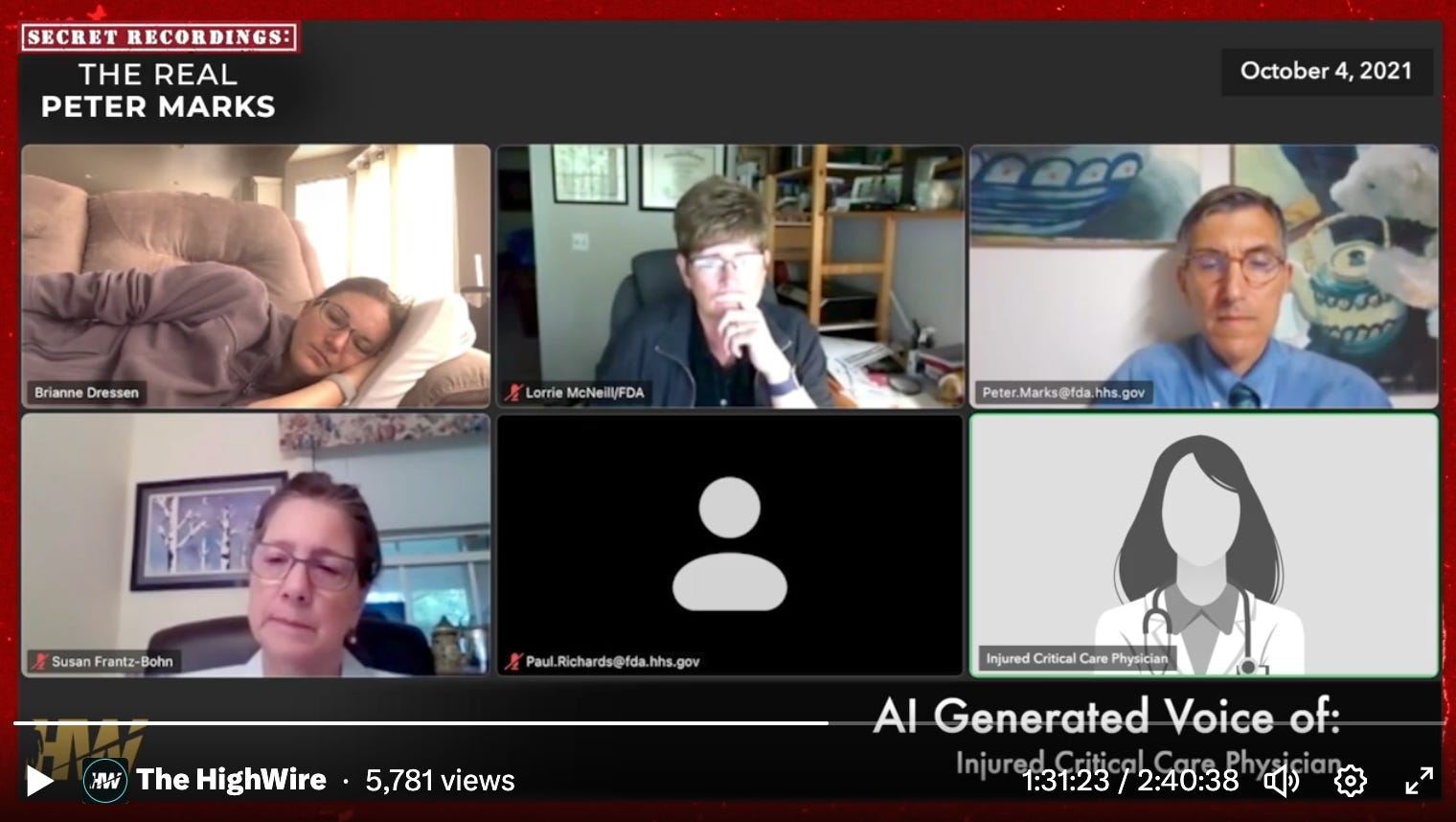
So. So to tell me about on this call, we see in the bottom corner, there’s a, we wanted to hide the voice. You wanted to hide the voice from somebody in the release of this video. They didn’t want to know who they are. But describe for me this critical, she’s a critical care nurse. Is that correct?
[Breanne Dressen]
She’s a critical care physician. So she was staffed in the ER. Yeah, she was staffed in the ER and in the ICU. She too was injured by her COVID vaccine. She too went to the NIH. But because of her experiences as a physician on the front lines, she made several VAERS reports before her own injury.
[1:13:02]
She identified and helped Peter Marks identify the importance of identifying and, you know, really collaborating on these side effects. But she, it was really heartbreaking to hear her story for the first time. Because like me, she was young. She was just married. And she was about to start her own family when she got injured. She was the only person in her entire hospital that could do this specific procedure that was life-saving during the pandemic. She made decisions every single day during the pandemic that still haunt her to this day. And she was the perfect person to bring in to talk to Peter Marks because she understood what the VAERS system was supposed to do and what it was not doing. And she also had the perspective of, you know, physician. She had the perspective as a patient. And she also had the perspective of being involved with thousands of others in these support communities and was able to portray their experience as well to Peter Marks.
Analysis of the Critical Care Physician’s Testimony
[Del Bigtree]
[1:14:02]
Well, while we watch this, everyone, now imagine you, maybe Peter Marks doesn’t know who Breanne Dressen is. She’s a regular person in the trials. Maybe she’s not a medical doctor, doesn’t know how to describe it. Now you’re about to hear from a medical professional that’s been doing VAERS reports and then finds themselves getting injured. Would that like set off a light bulb? Let’s see if you see a light bulb go off. And remember, this is an AI voice to protect this individual who’s speaking right now. Take a look at this.
[AI Voice (Critical Care Physician)]
What we have found in the form of neurologic injuries in particular is that for us as individuals, it starts with a clear temporal relationship with getting the vaccine. For both Bre and I, it’s glaringly obvious. It started within an hour of getting the vaccine and we’re both young and we were totally healthy before getting the vaccine. We then interacted with others that this happened to and it led us to identify the same pattern, the same neurologic injury pattern in thousands of others. And our data shows that it occurs predominantly in the young and previously healthy women.
[1:15:02]
And these are less injuries. They’re life-altering, severely disabling neurological injuries, neurologic injuries to the point that people have committed suicide because of it. By us being injured and by us, you know, connecting with so many others, it puts us in a unique position where we can see the pattern and the incidents beyond what a single physician or a single researcher or health organization can see.
[Peter Marks]
So just in terms of what I can say that we’ll do here, I mean, I’m very happy to go back to our, and then it seems for us to make some kind of a statement publicly, we’d have to have, we’d have to find the data in our database that says that in a group of vaccinated individuals versus a group of unvaccinated individuals or comparing pre-vaccination, post-vaccination as we sometimes do in intervals, that we have some type of signal.
[1:16:00]
Now, it sounds like if you say that there are thousands of people that have been injured in this way, we were able to, these are relatively uncommon diagnoses. And we were able to pick out, you know, we pick out, we routinely have picked out, you know, higher incidences of things like Guillain-Barre or thrombotic, thrombocytopenia syndrome in the case of the Janssen vaccine, doesn’t have to necessarily be as common as myocarditis. So, which is also still a relatively rare event. So we’d want to try to go back to our databases and see if we can tease these out using additional key terms and see where we get to, because that’s how we generally work. We work based on data showing that even small safety signals here should be detectable.
Aaron Siri’s Analysis of Peter Marks’ Responses
[Del Bigtree]
Aaron, we do a lot of work here.
[1:17:00]
He says, well, basically, thank you for telling us about the thousands of people that you’ve witnessed and that you’re involved with and you’re a doctor, and I appreciate that. Just so you understand what we can do here in order to make a public statement warning anybody about what you’re dealing with, we’re going to have to find a vaccinated and unvaccinated group to compare with. Oh, wait a minute. Now, that group doesn’t exist because we got an emergency hospitalization and we erased our control group by vaccinating them all weeks after the final dose was given. This is how the game is played every time, right? What is he going to go back to? Where are you going to find the vaccinated versus unvaccinated comparative group? You erased it.
[Aaron Siri]
That’s not even how they do their studies. First of all, you’re exactly right. When you, when the Dell Bigs for yours, anybody who has actually concern about vaccine safety, not Peter Mars, or when Brianne raises an issue, it says, look, we need to compare an exposed to unexposed group.
[1:18:05]
That is basic science. That is how you determine causation. Exposed to unexposed group. What do they say? Oh, it’s unethical. That’s what they’ll tell you, Brianne. That’s what they’ll tell you, Dell. That’s what they’ll tell me in the letters they send us back. It’s unethical to do that. Right. But then the minute you really pin them on it and you have somebody and you have actual evidence of harm, in this case, a series of case reports, a series of doctors all claiming neuropathy. He says, well, that’s anecdotal. Now we have to compare exposed to unexposed. But when you say that it’s unethical to do it, but then do they do that? No, they don’t. When you look at the litany of studies that CDC puts out, what do they do? They do nonsense. Like they’ll look at, they’ll say, OK, we’re going to compare the incidence rate 14 days after the vaccine to the incidence rate from day 15 to day 28. Why don’t you just compare maybe the people like before the vaccine to after the vaccine, if you’re going to do it that way?
[1:19:02]
They don’t do that. They’re always designing these ridiculous, retrospective epidemiological studies in a way to actually typically never do what you just said. And that’s in part because they’re, you know, like one of you said earlier, their focus is always on vaccine hesitancy. They don’t want to put anything out that shows a concern. They think at the end of the day, no matter how many people they kill with these products, no matter how many people they harm, no matter how much suffering they cause, they believe, and it’s a belief. It’s a faith.
[Del Bigtree]
It’s a religion.
[Aaron Siri]
They believe that they are saving more people than they’re hurting, and therefore it’s OK for them to play God and to hide the ball because they’re doing good.
[Del Bigtree]
Unfortunately, you cannot tell if you’re doing more harm than good because you don’t have an unvaccinated control group to compare the numbers to. You’re vaccinating everybody, just saying they would have died anyway. They would have been sick anyway. Breanne, neuropathy is coming up in this conversation.
Discussion on Neuropathy
[1:20:02]
Is that a term? What does that mean? Is that a term you were focused on before you were injured? And what is it referring to? What does neuropathy actually mean?
[Breanne Dressen]
I didn’t even know what that term was before I was injured. You know, it’s not something that females that are healthy even have to worry about. You know, it’s something that happens with men 56 and older or people with diabetes. This is not something that people should be getting from a vaccine. Little did I know, this is something that has been on the product label for multiple products that are vaccines. It’s on the Hep B label. You guys would know better than I at the other ones. So it’s shocking to me to think that for some reason these guys are going to not even like have an inkling of intuition that, oh, oh, we’ve got a bunch of people reporting neuropathy from this now. Maybe there’s something to this, right? And instead it was like, no, there’s no way. There’s no way that neuropathy is being caused by this.
[1:21:01]
So basically what the neuropathy is from the COVID vaccines, I suspect it’s similar etiology to the others is the immune system kicks on with the immune activation from the shot. And instead of attacking the antigen or, you know, the thing that your body needs to clear from the invader, the vaccine, it goes after your nerves instead. And the glycoprotein is the most prominent protein in the body. And the immune system, it doesn’t take very much for the immune system to be trained just off, just enough to, instead of going after the invader, to go after the glycoprotein or in this case, the, you know, the spike protein, they look very similar. So it essentially is your immune system kicking on, going after your nerves all the time. And nerves are everywhere. People think that your nerves are just kind of, you know, in your skin and they, you know, go down your spine. They line your heart. They line your GI tract. They’re in your brain. So if there’s something attacking your nerves, your small fiber nerves in particular, you’re going to have problems all over your body.
[1:22:07]
You’re going to end up with heart rate dysregulation. You’re going to end up with GI motility issues. So, you know, the gastroparesis, you’re not going to be able to eat. You’re going to need a feeding tube. You’re not going to be able to sleep because your nervous system can’t turn off and engage your system to rest. It’s a nightmare. And I could never imagine in a million years giving this to people and knowing that there is even six people dealing with this and not doing something about it.
[Del Bigtree]
And to be told that it’s not possible the vaccine could do that when there’s already vaccines that have that written as one of the warnings, which means you would assume with a brand new vaccine that is skipping testing because it got emergency use and we’re going to look at the postmarketing surveillance that the things they would have been looking at would have started with every single injury, every other vaccine is known to cause
[1:23:00]
that’s written on the warning labels.
Discussion on Small Fiber Neuropathy and Paresthesia
This is the video where we get into neuropathy in this conversation.
[AI Voice (Critical Care Physician)]
From our perspective, I think the easiest place for the FDA to start would be the small fiber neuropathy. And the reason I think that is when you look at the published incidents of small fiber neuropathy, it’s low to begin with. But the study that’s out there, the Neurology Green Journal, talks about it being a male predominant disease of an average age of 56. And what we found in our own data of the injured is that we have a percentage of women, 85% women, is who we’re finding. And 80% of them are in an age range of 20 to 49. But I do think small fiber is probably the easiest one to start with to show that there’s a signal of a problem.
[Peter Marks]
Even small safety signals here should be detectable. And, you know, safety signals in relatively small numbers of people when they’re relatively unusual things like small fiber neuropathy. I mean, that’s not a common diagnosis.
[Breanne Dressen]
So what about paresthesia? Paresthesia is a pretty good one. And I’ve noticed in the VAERS system that one’s pretty significant.
[1:24:03]
And actually with the Canadian COVID Task Force on their tracking database, with their severe reactions, they have paresthesia is actually number two above headache, myalgia. And I have noticed that at least with the paresthesia, that’s definitely one of the, you know, I want to say five symptoms that people are complaining about the paresthesia.
[Peter Marks]
And that’s on an ongoing basis or just shortly after getting the vaccine. It’s continuing months after.
[Breanne Dressen]
Yeah, I still have it. And it’s it’s severe enough that it keeps me from being able to function like at a normal level, like my body just feels like it’s biting itself all the time because the paresthesia is that bad. There’s internal tremors as well. But I think people are lumping that into the paresthesia as well. And then especially because now this is happening to youth, that’s been incredibly disturbing for me to see those, you know, those parents come into these groups now and they’re terrified for their little kids.
[1:25:10]
And the crazy thing is, is we’ve had a couple of kids for quite a while that their ability to get medical care has not progressed at all because the subset of specialty, as you know, for pediatrics is incredibly small when you start looking into neuropathy in kids and dysautonomia in kids. And so we need to make sure that there’s some kind of plan or anything. I mean, even just people being willing to recognize it before this keeps happening to more kids. These kids definitely deserve to have some kind of protocols or even physicians that are willing to look at it before, you know, their lives get ruined.
[Peter Marks]
We take all adverse events very seriously.
[1:26:00]
And especially if they’re really impairing people’s lives. In order for us to make some broader statement, we need to try to understand them better. And I think probably by going through our databases appropriately, that may be a helpful start. So I will go check with our statisticians and our epidemiologists to see whether we’ve actually looked through. Because we may have looked at some broader search terms instead of the more specific ones that you’ve given to see if we can see anything in terms of a neurologic signal here.
[Del Bigtree]
Very quickly, Breanne, what is paresthesia?
Explanation of Paresthesia
We’re talking about neuropathy.
[Breanne Dressen]
Paresthesia is, yeah, it’s the precursor for neuropathy. It’s pins and needles, numbness, burning. It’s basically, yeah, it’s basically your nerves firing off at the very beginning before they die.
[Del Bigtree]
What I find incredible about this, Erin, is there’s a real human being there.
[1:27:02]
Breanne, there’s this medical professional that’s weighing in, telling their story. Breanne’s saying, I have a thousand people that are suffering, or thousands, that are calling every day. It’s getting more and more every single day. And Peter Marks is like, well, we’ve got to go back to, we’re going to just do some data searching, word searching terms. Did you ever have him say, could you bring those thousand people to me? Could we get them into clinics right away? Can we study them? Can we figure out what’s going on? Was there ever one moment where they said, this is important. We want to make sure we’re not really destroying people’s lives. Do you have phone numbers? Can we talk to them too? Can we maybe bring them in? Did that ever happen?
[Breanne Dressen]
No, no. And we actually asked them to do that a couple of times. And the answer was still, well, we need to find it in our systems. The systems that we all know, and they do too, are not functioning how they should. But that was their convenient loophole, right? So at this point, we knew that we were going to have to play their game.
[1:28:02]
So they were like, well, we need to find a couple of terms, just a couple of simple terms that will help us identify this. So that’s why we went after neuropathy and paresthesias. And later on, we’ll talk about MIS. It’s because the rate of incidents in the groups that we have, those are extremely high. And so we were trying to get them to identify a couple of things that will capture the majority of the people that are suffering, which those are in this group. It was neurological events.
[Del Bigtree]
I want to point out to everyone watching, these are trials we’re talking about where we had 35,000 people, I believe, in one, and was it 45,000 others?
Discussion on the Design of the COVID-19 Vaccine Trials
Somewhere in there, tens of thousands of people, half got the vaccine, half got a saline injection. That actually was supposed to be another vaccine. But Airmen Series submitted a demand by us saying, we do not recognize another vaccine as a proper safety trial. So they stopped down phase three and added in the saline placebo. So we did get a placebo trial, but they pulled out, as I said early on, with the emergency use authorization, just bailed on it.
[1:29:06]
We got no long-term information, then went ahead and vaccinated all of the control group that had not been vaccinated. So all we were left with was post-marketing surveillance, as they call it. This is that VAERS system, Vaccine Adverse Events Reporting System, hoping that the doctors will report what they’re finding, and then we’ll just study that instead of the group we actually had in a room that we could follow. We got rid of that. Now we’re just going to be out in the wide world seeing what doctors capture. This is where this medical professional points out the problem with that approach in VAERS. Take a look at this.
Discussion on the Limitations of VAERS Reporting
[AI Voice (Critical Care Physician)]
The problem that I find with VAERS is that we are encouraged to report a reaction immediately. So when we report a reaction, it’s not neuropathy that we’re reporting. It’s paresthesia because it’s too soon. You have to have a continuing paresthesia over time to have a neuropathy. So as a result, with the neuropathy diagnosis, we’re not encouraged as a public to go back and update our VAERS report.
[1:30:04]
And I know that when I tried to do that on the website, it says, email this email address and we’ll give you a code to update it. And it never happened. And it wasn’t until my six-month V-safe check-in that they told me to put in a separate VAERS report on which neuropathy still wasn’t my diagnosis yet. So one of the things that should overcome that weakness is what’s published on the CDC website. The contractor for VAERS is supposed to request health records for everybody that has a serious reaction. And it clarifies that a lasting disability is a serious reaction. But we polled our people and other people who put in a VAERS report. 78% of them never had any follow-up. So I’m concerned that the reason why you’re not seeing it is because VAERS is not set up to recognize this exact rare entity.
[Peter Marks]
Well, we also have the best database which uses claim databases and electronic health records, which is in many ways more powerful for us to be able to detect signals so we can query that.
[1:31:12]
As well, and that may be helpful.
Discussion on the Requirements for a Decent VAERS Report
[Del Bigtree]
I mean, Aaron, what is required for there to be a decent VAERS report? And, you know, if the CDC and the FDA is telling every doctor essentially this thing’s perfectly safe, it’s amazing, you can give it to kids, multiple doses, are doctors even looking for it? I mean, if they’re staring right at somebody saying, well, we don’t really, we’ll have to go look to see if there’s a signal. I’m not even going to recognize that you’re telling me right now before my eyes you’re having an issue. We’ll go back and have to see if somebody wrote about it. Who’s going to write about it if the entire idea is that there are no issues? Don’t the doctors need to be guided that we are looking for these specific issues? If you see it at all, immediately file a VAERS report.
[Aaron Siri]
[1:32:02]
My experience is that doctors do not file a VAERS report unless they believe it, the actually vaccine caused the harm. Otherwise they don’t do it. It’s an arduous, time-consuming, laborious process to file a VAERS report. It’s not simple. It’s not like an automated thing. It takes a long time. And so doctors that do it, in my experience, they don’t do it unless they really think it’s related to them. They really call it the vaccine. The other thing, interesting thing about VAERS, they tell you to trust the doctors. You know who submits most VAERS reports? The pharmaceutical companies and doctors. That’s where most VAERS reports comes from based on the historical data. Right. But yet, Peter Marks is very happy to rely on doctors and pharma companies when it fits what he wants, but he doesn’t give VAERS virtually any accord. And it’s not like VAERS does not have a lot of reports of harm. It has an incredible number of reports of harm. And people are not, you know, they like to point out the one or two random reports that, you know, look like they’re not legitimate.
Discussion on the Issues with VAERS Reporting
[Del Bigtree]
[1:33:00]
But that’s like a car accident. They’ll say, well, there’s car accidents in there. I’d like to point out that syncope was such a massive problem that they started making people wait inside after being injected. Used to be 15 minutes, now wait 45 minutes because so many people are tanking and dropping to the floor. What happens to all those people that left after 15 minutes? How do they know to keep them for 45 minutes? I don’t know. How many people were driving down the highway when all of a sudden they passed out and had a car accident? So there’s no way in the world. Car accidents are ridiculous. Why is a car accident in VAERS? These are the types of things that drive me crazy, Aaron. Let’s put it this way.
Aaron Siri’s Analogy of Peter Marks’ Approach
[Aaron Siri]
Peter Marks is the type of person who walks into a cemetery and says, I can’t see any dead people, so there’s no dead people here. OK, so nothing to look at. There’s no dead people here. Look, I’m looking right now. I don’t see any dead people. So they’re in the ground, buddy, but he’s not going to do that. I mean, this is the way they conduct science, quote, science, so to speak, over at the FDA. He’s not going to find any quote, unquote, safety syndrome because the reality is he’s not really looking. And you don’t need to know.
[1:34:00]
And the proof that he’s not really looking is from this timeline that compiles letters that, you know, recordings that Brianne and her group recorded of Dr. Marks of other recordings from other individuals who recorded speaking to him about COVID-19 vaccine includes all the letters that we sent them, the responses, internal emails.
Analysis of the Timeline of Events
I don’t think I don’t think Dr. Marks ever thought in a million years that anybody would take the time to literally take every single recording, email communication, including many obtained via FOIA, many that various folks and put it all together in a timeline. And when you do, when you look at that full timeline, it is very clear. He is saying one thing to the public and he is saying something else in private and they don’t matter. And when it comes to neuropathies, which absolutely you’re you guys said it very well. This is not this is not an out of the blue situation. The fact that a vaccine can cause damage to nervous system and nerves is well known.
[1:35:00]
What do you think Guillain-Barré syndrome is? What do you think transverse myelitis are? It’s your immune system after a vaccine attacking what? Your body’s nerves. Those are well established, as well as numerous other forms of issues where the body, immune system attacks nerves. Now they recognize those because they just can’t hide from it. And by the way, I don’t want to go on a tangent, but the fact that a vaccine could damage the nerves in your extremities, right? Like GBS and go continue up or transverse myelitis are fine. Why can’t it damage nerves in your brain? If the vaccine, if the vaccine can cause your immune system to make antibodies to self, right, you could do it. And you’re right. But let’s put that issue aside because vaccines do not cause those issues. Right.
[Del Bigtree]
Let’s not go there.
Discussion on Vaccine Injuries and Their Severity
[Aaron Siri]
We’re not going to go there.
[Del Bigtree]
But with that said, I’m kidding, by the way, for all you parents out there that have been through that. Let me not joke about that. You know, obviously, autism, obviously, you know, you’ve got brain swelling.
[1:36:00]
We know it happens. That’s written as a side effect from vaccines across the board. Encephalitis. So I don’t mean to joke about that. It’s a very serious issue. And covid this vaccine, Brianne, all of your work is bringing to light for so many parents, for so many parents that were gas lit. We knew I mean, Erin and I, we talked about this. This is going to be a different scenario with covid because this is going to be adults. This isn’t an infant. This isn’t a child that can’t speak for themselves. These are going to be adults like you that were running track. We’re skiing, we’re athletic and suddenly cannot walk. That’s going to become obvious. Doctors like the one that’s reporting and saying I not only was treating people that were injured, I was injured myself. Now I’m trying to figure out. You’ve got to know there’s thousands of these people that are coming through our hospital. Me, my friends, people around me. You’re saying one in a million. It can’t be one in a million injuries because I and the patients here and others in this hospital around me are all having these injuries. These numbers have got to be catastrophically high.
[Aaron Siri]
When you look at that timeline, I’m just going to put out three data points and obviously the public should look at the whole thing.
Aaron Siri’s Analysis of Peter Marks’ Responses
[1:37:04]
But one of the data points, for example, and you heard a piece of that recording is you’ve got about six people on this call with Dr. Mark saying, hey, we suffer neuropathy, five of whom, at least, were doctors, physicians saying they suffer neuropathy from a vaccine on that call. What’s Dr. Peter Mark saying? He’s saying, well, we have a very sophisticated system. You know, when there’s we even picked up TTS, when you have thrombosis with thrombocytopenia, meaning you’ve got, but it doesn’t matter where it is. You’ve got this rare, basically clotting condition. OK, and he says, we picked that up with VAERS and somebody astutely on the call with him says, hey, there’s literally six of us on this call for that have neuropathies. And so, yeah, you picked up TTS with six reported cases of VAERS, but we’ve got six people on this call telling you. Most of us are physicians telling you it causes neuropathy. That’s not good enough for me. Here’s why.
[1:38:00]
Neuropathies happen for other reasons, OK? And so when the FDA and the CDC and this we have seen long before COVID, when they can hide a vaccine injury into the background rate, they do, they’ll ignore it. But when there’s something like TTS, they really can’t hide from it. Then they have to recognize it or even keep GBS or trans my life’s right. It’s hard for them to hide from it. But most of the things that they can. And that’s what he means.
Discussion on Peter Marks’ Search Terms
As long as he can hide it in the background rate, he won’t find a signal. That’s really what he means, frankly, when he says that. And the fact that he’s not really doing the search should be evidenced by yet another segment from that you can see in the timeline, which is when he says, OK, we’re going to look for, you know, this issue. How does he come up with the search terms? He’s got he’s got the whole FDA. He asked Miss Dressen for the search terms. So think about that. He’s got PhDs, MDs, scientists galore. And he’s asking a school teacher, Miss Dressen.
[(Unidentified Man)]
Yes.
[Aaron Siri]
You know why?
[1:39:01]
Because the truth is a school teacher really is more competent to say the science that is needed. That’s the truth.
[Del Bigtree]
Yes.
[Aaron Siri]
To figure out vaccine injury at the FDA. Miss Dressen is more competent than all the PhDs and MDs at the FDA combined. The most junior person at my firm knows more about vaccine injury and how to analyze and diagnose it and study it properly.
Aaron Siri’s Analysis of Peter Marks’ Final Call
Yeah, I would say, oh, that’s the FDA. And I’ll end with one last thing on this timeline. And I’ll stop, which is in the very last call that Miss Dressen has with Dr. Marks. When you listen to it, it’s an incredible call. It’s now been six meetings, I believe, in which she’s met with him and recorded it. And every time she’s saying, you’re going to do the study of neuropathy. You’re going to do the study. You’re going to do the study. And here you are. And the sixth call all this time later, at this point, you’d expect him to say, of course, we did the study. Here it is. Here’s what I found. Instead, he goes, well, I think we did the study.
[1:40:01]
He’s still at, I think we did the study, right? They’re just not sure. But one thing he is sure. Listen to that call. He says, but I’m confident that it showed there’s no issues between the vaccine and neuropathy.
[Peter Marks]
I want to say that they actually did this. I think when they did this, they found no increase of observed to expected. But let me let me make sure we get you the right information.
[Aaron Siri]
So the man is saying he doesn’t know if it was done, but if it was done, he knows the conclusion. That’s an incredible power. I don’t know how I don’t know any living as a psychic.
[Del Bigtree]
Yeah, that’s amazing.
Discussion on Dr. Lee’s Role
Right. I didn’t realize when you’re at the FDA, you realize that how they actually do the studies.
[Aaron Siri]
OK, that’s when he’s on those recordings and he’s on those PSAs and he’s promising the public we are. We take vaccine safety seriously. We study it carefully that the timeline of Dr. Marx’s calls and what he did to actually study neuropathy.
[1:41:02]
It’s crystal clear that is and I don’t use this word lightly. That is a lie. Unless the man has serious. Memory issues or he has serious cognitive issues or he’s on some serious mind altering drugs. He must be lying.
[Del Bigtree]
Tell me about Dr. Lee. What’s the importance of Dr. Lee in these recordings?
[Aaron Siri]
Oh, Dr. Lee.
Aaron Siri’s Explanation of Dr. Lee’s Importance
Wow. So at the very beginning, after the rollout of COVID-19 vaccines, we had innumerable people reaching out to our firm about injuries from COVID-19 vaccine, including many physicians. But none of them up to that point were willing to put their name to a letter and send it to the FDA and the CDC and let them know about the issue. I mean, because at the end of the day, as you know, as everybody knows, we couldn’t bring a lawsuit. We can’t bring a lawsuit. I mean, that’s how we seek justice. That’s how we get the truth out. Without that tool, without what are we going to do with a consumer product?
[1:42:01]
You got to go back to the regulator. So we said, hey, will you send the letter or let us send a letter in your name? Now, Dr. Patricia Lee was the first physician who was willing, who had the bravery, the courage to do exactly that. And really, I think I said this at the Johnson hearing that, you know, there’s lots of acts of courage. And at that point in time, just speaking the truth was an incredible act of courage because we know what could have happened to her. And, you know, and she did. She wrote a letter to the FDA and she said, hey, listen, look what I’m seeing. I am seeing incredibly harms after COVID-19 vaccine, including paraplegia, brain bleedings and other serious issues. As she explained, no one physician, it’s statistically improbable that one physician would see all of these harms after this product. It just it just shouldn’t happen. It can’t be. And so she wrote them the letter and she was public about it. And she even had a call with Dr. Marks about this issue.
[1:43:03]
I guess I’ll have a look.
[Del Bigtree]
OK, yeah, well, let’s go.
Dr. Lee’s Testimony
Yeah, let’s go watch this video. This is Dr. Lee.
[Patricia Lee]
My name is Patricia Lee. Like I wrote in my letter, I graduated from USC and got my postdoc trainings at Georgetown and Harvard Affiliated Hospitals. I currently work in the Bay Area, California, San Francisco Bay Area. And I’m sure the panel is wondering why a relatively obscure Dr. Lee works in the ICU would decide to write such a public letter. In April of this year, I took care of my first vaccine injured patient. And in May, my second. And I recognize them as vaccine injured patients because they had a very distinct temporal relationship to the vaccine.
[1:44:09]
They were previously healthy. They got vaccinated and they became ill. Second, I just simply couldn’t explain the illness any other way than the vaccine itself. In addition, many times the illness had a very atypical presentation and disease progression. I made sure VAERS reports were filed. In fact, I put my mailing address on the VAERS report, hoping to get a response. And I didn’t get a response. I waited and waited and waited. So then as time went on, my third, fourth and fifth patients came in.
[1:45:05]
And then in the meantime, one of the original two patients that I recognized as vaccine injured passed away. The patient is in fact a 36 year old woman who was 22 weeks pregnant at the time of her COVID vaccine. Like I described in the letter, she developed transverse myelitis. She became quadriplegic, blind and had a tracheostomy place. When she was conscious, she would interact with us. She would talk to us. And at times she would cry. The nurses thinking that she was in pain would try to reposition her so that she wouldn’t be in pain. A lot of times she would say, no, it’s not my body. I have painful thoughts.
[1:46:03]
When the baby was near term, she underwent a C-section. Postpartum, however, she developed hemorrhagic shock. She bled and bled and bled. I was actually on that night and I resuscitated her. I remember that night very, very well. Then about a month later, when the baby was one month old, she, because of her disease activity, she became unconscious again. So the family at that point decided that she just wouldn’t want to live like this anymore. That this is not how, this was not how she would want to live. So they decided to withdraw care. We gave her lots and lots of morphine. We disconnected her from the vent. She died within minutes.
[1:47:00]
The night that she passed away, two of my nurses went into nervous breakdown. We actually had to call a psychiatrist in the middle of the night to speak with the nurses so they could stop crying and finish their work. It was around this time that the California Department of Public Health issued a vaccine mandate for all healthcare workers in the state to get vaccinated. Like I said, the third and fourth and fifth patients with a vaccine injury started pouring in during this time as well. I felt like I needed to catch your attention and I knew filing various reports wasn’t going to be helpful. So after weighing my options, I decided to write the letter. So now that you’ve had my letter for more than three weeks, I am here to answer any questions that anybody may have.
[1:48:10]
Nobody has questions for me? All right. In that case, I do have a question for the panel. Now that we’re seeing these warning signals, what would you, what do you plan? What kind of changes would you plan to implement so that we can avoid future tragedies like these?
[Peter Marks]
So Dr. Lee, let me just start by saying I’m very sorry to hear of what happened with that patient and with any other patients.
Peter Marks’ Response to Dr. Lee’s Testimony
Obviously, any medical tragedy like that is really sad to see. I don’t know that we can actually infer causality here. I know you believe there’s causality, but we can’t infer causality.
[1:49:03]
And that’s why we have large database systems and why we have experts at CDC and FDA who look and who are evaluating for safety signals. Transverse myelitis is one of the things that’s being looked for here, along with other neurologic, other cardiovascular, and other issues that might be seen in excess in individuals who are vaccinating. We take vaccine safety extremely seriously. And that’s why it’s actually an overlapping responsibility between Centers for Disease Control and Prevention and FDA. I think the important thing to just stress here is that we do take safety signals very seriously. It’s a matter of sorting through them and understanding what is truly causal and truly associated versus things that happen to be coincidental.
[1:50:02]
All of the vaccines have been judged to have a benefit that greatly outweighs any risk.
[Del Bigtree]
I mean, that moment where this doctor goes out of her way, I was so traumatic what I was seeing that I knew I couldn’t trust the Bayer system. I needed your attention. I wrote a letter. I’m now here. I’ve told you this incredible story about a mother that is no longer with us. We’ll never know, you know, child, the whole future that she was dreaming of disappeared. Does anyone have any questions for me? Oh, but tell me just later on, we take vaccine injury and these alarms so seriously that we can’t even ask you a question. Why, why are you so passionate about this? Go ahead. No, go ahead.
[Aaron Siri]
It’s not even like they just, it’s not even like they just scheduled this call with her.
Aaron Siri’s Analysis of Dr. Lee’s Call
She waited a full week. She did follow up emails and they still didn’t respond. We sent a legal letter to them and only after we sent the legal letter did they finally then set this up.
[1:51:05]
It was because they felt threatened. You know, legally they felt that it wasn’t like a call even because they got her letter like, oh no, we really need to be concerned. They got her letter. They probably threw to the side, but when they got a legal notice, then they finally felt they needed to have this call. As you can see, just to listen, to pretend like they did something.
Peter Marks’ Public Statements vs. Private Conversations
[Del Bigtree]
Yeah, it was. And what was he saying publicly while all this was going on? Everybody, while he’s, no one has a question for a mother that’s died, but let’s make sure we rush to the television and put out this BSA.
[Peter Marks]
The COVID-19 vaccines work. The current vaccines are highly effective at preventing COVID-19. And it’s really clear that they help prevent the worst outcomes from COVID-19. Even fully vaccinated people may get infected. That said, for people who have received both the primary series and a booster, the symptoms are often much less severe and people are much less likely to develop severe complications, including hospitalization or death.
[1:52:04]
The available information also shows that getting a booster shot when eligible provides further protection against COVID-19. Getting vaccinated and getting a booster shot can save your life and protect you and your family and friends from getting seriously ill and spreading infection. So make an appointment today. If you have questions, talk to your healthcare provider.
[Del Bigtree]
I mean, it’s hard to watch and by the way, if one shot wasn’t dangerous, go out and get two.
Peter Marks’ Public Statements vs. Private Conversations
We’re really recommending a second shot now because the vaccine is, you know, get your boosters, your third booster, your fourth booster, your fifth booster, because obviously this thing isn’t doing anything except injuring people. Anyway, you know, so Erin, you FOIAed for an email that we have that I want to bring up right now that we can read through. Four days ago, a young adult Hispanic male reached out.
[1:53:00]
I feel so hopeless. I feel horrible 24-7. I just can’t take it anymore. This is literally torture. All of my symptoms are getting worse. The head pressure, face and body going numb, extremely bad vertigo and a lot more symptoms. I’ve run out of options. At this point, I’m honestly ready just to go. I can’t imagine feeling like this for six, eight, 11 more months.
[Breanne Dressen]
It’s kind of crazy to see that picture in time because I can’t tell you how many people were in that exact same situation at home. Suffering in silence on their own. Everybody was in that same situation. They were like, I can’t imagine having to live like this. And, you know, it’s insane to know that Peter Marks was getting this from not just a few people, but people were reaching out from him from all over the place. All over. And the only way he was responding was when he was forced, right? Lawsuits threatened with us. There were several senators that demanded that he had to speak with us.
[1:54:02]
I mean, it’s. We had to hunt him down to get him to respond.
Reaction to the Email from a Young Adult
[Del Bigtree]
And and to read that email, it’s it’s like it’s like reading what I’ve just watched you say to him multiple times. And everyone’s saying we have a neuropathy where we’re having all of these crazy issues all over our body. He’s still doing search words. You would think that maybe this email would do it like just, oh, my God, here’s another one. They’re everywhere, everywhere. Look yet. I’m sitting here, you know, in this moment, Brianne, and we’ve all heard of myocarditis. We’ve all heard of pericarditis. We have all heard, you know, about thrombocytopenia at some level. We recognize there’s anaphylactic issues, but I still can’t think of a single conversation I’ve heard on the news. Oh, all of a sudden, you know, it does look like neuropathy is an issue, too. I mean, they’re lining up by the thousands.
Discussion on the Lack of Public Warnings about Neuropathy
And Aaron, was there ever a warning added for publicly? Because I haven’t heard about this. Yet it looks like all everyone’s complaining about is this same crazy nerve pain. My stomach’s not working.
[1:55:00]
My throat’s frozen. My, you know, my arms are giving me shock treatment and I can’t walk. I can’t move. And yet he’s still there. Like, I can’t seem to find it in my search word terms.
Aaron Siri’s Perspective on Vaccine Injuries as a PR Issue
[Aaron Siri]
Vaccine injuries are a PR issue for the FDA and the CDC. They’re not a issue to be dealt with on a human level, to be dealt with on a science level or a data level. They’re a public relations issue. So unless it makes it into just like you pointed out, like myocarditis, pericarditis became a PR issue. So they addressed it. Even tinnitus did, like ringing in the ears. But neuropathy has never really made it into that level, despite the fact that, frankly, it’s the number of people affected is incredible. Because Peter Marks is not listening. You know, you asked earlier, what is going through Peter Marks’ head when he’s doing these calls? And if you want a little window into it, one is a week, one week after he had that call with Dr. Patricia Lee, he signed an authorization made for the COVID-19 vaccine all the way down to five years of age.
[Del Bigtree]
[1:56:05]
Oh, my God.
Reaction to Peter Marks’ Actions
[Aaron Siri]
Clearly had no impact on it. And I want this guy in jail.
[Del Bigtree]
I want this guy in jail, Aaron. Did he get exonerated? Whatever, was he protected by Biden on his way out?
Discussion on Potential Prosecution of Peter Marks
[Aaron Siri]
Will the DOJ prosecute him? That remains to be seen. Right. But, you know, when he says, I feel, I feel, I feel. We got actually in this timeline that’s being put up about the communications. One of the emails that’s now being made public for the very first time is an email we actually, I think we got through a FOIA request. And in it, he describes how he what he really means when he says, I feel right. And he’s talking about Matty DeGarage to go all the way back to Matty. Right. And he says, quote, and this is an email he sends in March 9th, 2022. So this is after all these calls. He’s gotten all the information for all the injuries. And he says, quote, I feel for Matty twice over.
[1:57:01]
Once for whatever truly is causing her condition, still won’t accept the vaccine. That clearly was. But also for the exploitation of what most likely is not a vaccine related condition by these attorneys, presumably referring to me, my firm, in pursuit of their anti-vaccine cause. Meaning he really sees it as a war. He sees Matty. He sees Brianne. He sees anybody claiming a vaccine injury and anybody trying to help them as the enemy. OK, and even in his own email, it’s contradictory. He says truly once for whatever truly is causing her condition, meaning he’s saying it’s not the vaccine. And later, he says, most likely is not a vaccine related condition. I mean, it’s this is all belief. It’s all he’s reached his predetermined conclusion when he’s listening to these calls.
Aaron Siri’s Analysis of Peter Marks’ Email
It’s all PR. It’s all thinking about how can PR around this issue? Not really doing any studies or sciences. It’s clear when you listen to all of that.
[Del Bigtree]
[1:58:00]
Let’s be perfectly.
Discussion on the Scale of the Human Trial
Let’s be perfectly clear, Matty and Brianne. These are trial subjects. Everything that’s happening, by the way, since you skipped out of your trials and you’ve turned the entire population of the world into the biggest human trial that’s ever taken place. And that is the problem with this system and where it’s at. And this guy, while people are writing in and saying, I’ve got patients that are suicidal, even I’m suicidal. You know, people writing in themselves. What this guy decides is, you know what I need? I need to get out and get on top of this. And really, I’ll get to the bottom of that. Let me put out a PSA.
Peter Marks’ Public Statements vs. Private Conversations
[Peter Marks]
Importantly, getting a booster will give you peace of mind by getting a booster. You’ll also protect those who can’t get vaccinated because they’re too young to be vaccinated or because they have a health condition that prevents them from receiving the benefits of vaccination. So please make your appointment today.
[Del Bigtree]
The same lifeless eyes that are lying to you in that PSA telling you that you will protect your neighbors, your children, everyone around if you get the vaccine.
[1:59:05]
Absolutely not true. We all know that because everyone that’s gotten 10 of these vaccines has still been sick three or four times, seem to be getting sicker and sicker. They knew that the emergency use authorization knew that. I mean, this guy, and, you know, same lack of emotion, whether he’s hearing about injuries or celebrating getting you to get out as many of these shots as he possibly can.
Peter Marks’ Response to Breanne Dressen’s Concerns
But I think this moment coming up right here, Breanne, where essentially with all this going on, with all of the testimony that you’ve brought, all of the people that you’re talking to, I’m assuming React 19 is growing, that you’re taking in this information. You’re trying to represent all these people. He wants to let you know one thing’s for sure. There’s nothing to see here. Take a look at this.
[Breanne Dressen]
This is what happened with the vaccine injured. We had a huge problem after the FOIA release, data release. So obviously you guys know that you have a huge stack of documents that have been, you know, mandated or required that you guys have to release them.
[2:00:06]
And you guys are going through and you’re requested 50 years. So if you can imagine for the vaccine injured, that was like a big kick in the pants for them to hear that, that the FDA, who approved this vaccine after five months of review of the data, is now requesting 50 years to release the data that very well could hold some of the keys to getting them better.
[Peter Marks]
And then the other thing is, I’ll let me just, I’m going to have to get off, but I will assure you something. This I will assure you of, having the biologics license application for the Pfizer vaccine or the Moderna vaccine or any other vaccine, that’s not going to help here. I can just say that with absolute certainty, because that’s not, that’s not what’s at, that has manufacturing information. It has clinical trial information that will have to be redacted. What really is here is what we’re seeing is, and it’s what I believe, is what we’re seeing is what happens with vaccines in the real world.
[2:01:06]
And so we have to look at the data that we have now in front of us, such as the case series that you’ll hopefully connect us with and make sense out of that. That’s what we really need to do. We’re not trying to stonewall. Believe me, if I could expedite that quickly, there’s nothing to hide there. It’s just that I’m just telling you that that’s a rock that you’re looking under, that I think that once, even if we could produce it, and I’d be happy if I could instantly, I don’t think that you’d actually find the answer to the problems that are going on.
[Breanne Dressen]
They kind of did. And that’s kind of why I’m wondering if someone could dedicate some time to that one, because in a post-marketing report from Pfizer, it covered the first two and a half months of their world data. And so they don’t understand it. So what they’re seeing is everyone has found, they found their syndromes in there that they were told for months don’t exist. And then they found it there in black and white. And for them, it’s been devastating to see their syndromes there in black and white in the Pfizer reports.
[2:02:06]
Every one of them are in there. It’s very detailed. It’s broken down. And the strange thing is, is the information that Pfizer published, it really mirrors the demographics and the syndromes I’m really sorry, but I’m going to have to, I’m going to have to, I think we have a path forward here.
[Peter Marks]
I’m sorry. I do have to go, but I don’t, I’m not sure that I, I, you know, I think we’re pretty confident and I, you know what, it’ll come out in the wash and you’ll see, I don’t think there’s anything being hidden here in the clinical trials that explain what’s going on here.
Reaction to Peter Marks’ Final Call
[Del Bigtree]
It sounds like you’re starting to get under his skin. I feel like in many ways he sounds like he’s cornered. It’s obvious there’s an issue here and this guy has just, he’s had it. It seems like he’s just over listening to this. He’s going to push this vaccine.
[2:03:00]
What did that feel like? That was a different tone than we’ve heard up until this moment.
[Breanne Dressen]
You know, he couldn’t be bothered with the truth. He was, you know, he was too busy taking care of other things, doing other things. And it was very obvious at that point that we weren’t going to get anywhere with him.
[Del Bigtree]
And when I, you know, Erin, you know, listening to that, I mean, he’s basically saying what I find so shocking is, I mean, even if it was true, it takes time.
Discussion on Peter Marks’ Responses
We need time to be able to suss this out, to get a sense of what it is. Like that’s not what they told us when they said we could jump out of the emergency use authorization and that we would have a robust system that would catch any issue immediately and be able to jump right on top of it. Trust us. We know we’re rushing this. We know we’re leaving the safety trials, but we have systems in place that can get to the answers very quickly. He’s saying the exact opposite here. What he just described is not a system ready to go ahead and put the entire planet at risk.
[Aaron Siri]
And what he’s also saying is, hey, look, oh, you want to see all the clinical trial documents?
Aaron Siri’s Analysis of Peter Marks’ Responses
[2:04:03]
You want to see that? You mean you want to see the underlying documents to the thing we always point to to say, don’t worry, we had a clinical trial. It’s safe and effective. And the moment that you actually want to see this document, you heard what he said in that call. That’s not really what’s going to tell us whether it’s safe and effective. You’re looking under a rock, Brianne. We got to look at the real world data. We got to look at the post licensure. So when you want to see the documents in the trial, he throws the trial under the bus. That’s just garbage. I just go. Yeah, look, the real world data. And then when you want to look the real world data, they say, oh, that’s not you can’t show causation for that. That’s all retrospective epidemiological data. You can never draw causal conclusions from that stuff. You know, you got to look at the clinical trial data, which we just told us. I mean, this is the circular game you get from these folks because they’re not they. He is a partner with the pharmaceutical company. In his mind, he is he thinks that he is saving the world with these products.
[2:05:01]
And his job is to get them out to market as soon as possible, as quickly as possible. And the impediment are the is actually what he’s supposed to do, which is be a regulator, which is why I’ll stop with this, which is why you can never rely on the government ever when you’re making a decision whether or not a product is safe and effective, whether you’re buying a car, whether you’re buying anything. What you need to rely upon is the market forces that the company has the interest, the self-interest to make sure it’s safe, because if the company doesn’t have that interest to make sure it’s safe, they’re just not going to do it. They don’t have they don’t have a duty to do it. They don’t want to lose. They’re there to make money.
Discussion on the Lack of Self-Regulation in the Industry
[Del Bigtree]
This guy won’t do it. Why would the industry itself do it? I mean, come on, like we’re making billions of dollars. We’re not going to get in the way of that. This guy’s not even making the billions of dollars, at least not that I know of. Brianne, I’m so sorry. While sitting here imagining, you know, you know, it’s got me incensed. But to imagine you’re in pain, you’re going through these calls, you’re trying to be understood and you’re just getting this runaround.
[2:06:04]
Is it that runaround isn’t bad enough?
Breanne Dressen’s Experience with the Runaround
Like, can’t you just go out and get help? What’s the big deal? Take a look at this, everybody. This is outrageous.
Discussion on the Difficulty of Getting Medical Care
[Breanne Dressen]
We see the faces of these people that are being impacted and can’t get medical care because there is a question mark on what the root cause of their neuropathy is. You know, if MIS was at play initially in their disease and so.
[Peter Marks]
Could you explain to me a little bit more why they can’t get medical care? I’m really trying to understand that because as somebody who’s practiced a lot, you always treat the patient in front of you. So I don’t understand why they’re not. People should be getting treated for whatever is in front of them, right? So what’s what’s happening there?
[Breanne Dressen]
So to put this, you know, very straightforward, a couple of classic cases, which this is this doesn’t happen to just a few. This is very, very common.
[2:07:02]
People are going into ERs and they are being told that they have anxiety. We had someone who very clearly had MIS and they didn’t even run the labs to see if there was MIS in her. And they told her it was anxiety. So her husband took her, scooped her up and took her to another ER across town. And they ran the appropriate labs and they found out she had MIS post vaccine. The other issue that we’re having is we really this is where I really, really need to figure out who in an authoritative position can help us out with this, because this is literally putting people six feet under whatever the communication was from the medical boards that says, if you talk about misinformation, if you know whatever with misinformation, then we’re going to review your license. We cannot get medical care. We can’t. So we have people that are like sneaking in to these clinics like my own doctors.
[2:08:03]
OK, so my own doctors after I’ve been to the NIH, after I was diagnosed at the NIH, all of that, right? All of that workup was done. My own doctors still at home, they’re afraid to say COVID vaccine injury or COVID vaccine reaction. They say COVID related illness until we can actually clear the air with these physicians that are on the front line and tell them it’s OK to actually evaluate a patient if they suspect that they’ve had a vaccine reaction. We’re not going to get care. It’s almost like it’s a dirty word. It’s really weird.
[Peter Marks]
I’m just surprised that the neurologist aren’t treating what they’re seeing in front of them.
Discussion on the Fear of Doctors to Treat Vaccine Injuries
But it sounds like the problem is that they’re not getting to the right diagnosis in the first place. And maybe that’s what the problem is.
[Breanne Dressen]
I can’t tell you how many times like I’ve been called misinformation in the doctor’s office. So I wish there was a way that we could figure out how to equalize this before we lose more patients and just kind of set, you know, some kind of precedent for the medical community that, hey, it’s OK to talk to your patient if they’ve got neuropathy.
[2:09:16]
Right. Because at this point, I mean, we can’t have people dying. We stepped up to do the right thing. You know, we were we were on we were on the right side of history. We did our part. And we also did our part with reporting to the government, reporting to the drug companies. We did all that.
[Peter Marks]
So I guess I’m still the one piece I’m still not really confused about for these doctors is why aren’t they treating what’s in front of them? Right. Because whether or not you would say that something is is related to the vaccine or not, they should be treating what they’re seeing in front of them. Right. Yeah, they’re not. They’re not doing that. They’re just saying.
[AI Voice (Critical Care Physician)]
[2:10:01]
They’re afraid. It’s not that they’re necessarily not treating what’s in front of them, like the myocarditis patients. The myocarditis patients are being treated appropriately. For example, I’ve been doing a research protocol that I got through the IRB at my own shop, and I pulled a chart the other day. A patient presented four days after their second dose of Pfizer, and they’re a young male. Got diagnosed with pericarditis and nobody attributed to the vaccine. And it just wasn’t even on their mind. So sometimes if you don’t attribute to the vaccine, it changes how you treat the patient. An example was us with neuropathy. Traditional small fiber neuropathy isn’t treated by IVIG, but certain types of immune mediated, like Sjogren’s, for example, responds well. Or other viruses are known to do it. Influenza has done it in the past. Those respond to IVIG. So if you don’t attribute the right cause, you’re not going to give the right treatment. And that’s also if you don’t know that it’s linked, you’re going to have a delay in diagnosis.
[2:11:01]
And as I mentioned in the last meeting with shock, it is so rare to have a shock that your treatment is IVIG. And steroids. Steroids in the critical care setting is usually more for lung injury, but just shock chronic dysfunction. So if you don’t think about the diagnosis, you don’t treat it. And then the risk is that a child can die, which sounds like it might’ve happened, which is what we suspected in Utah.
Peter Marks’ Response to Concerns about Medical Care
[Peter Marks]
We have continued to do our best here to try to understand things. We do continue to carefully monitor safety. And I will tell you that there is nothing that I care about more than making sure that we have safe vaccines. We will continue to do that and we will continue to look very carefully at safety on these. And we’ll continue to work with people to do that.
Discussion on Peter Marks’ Legacy
[Del Bigtree]
This guy’s going to go down in history. He’ll be down there with Fauci. But you know, Fauci was just a tool out in front of the cameras. I don’t think Fauci was in any of these meetings, right?
[2:12:01]
When we get all angry at Fauci, he wasn’t listening to the injuries. He wasn’t getting the reports. He wasn’t the one in charge of, you know, seeing how these trials were turning out and checking in with you, saying to you in the middle of a trial, well, why aren’t you getting the treatment you need? Well, because my doctor is not even allowed to say the word, this might be a vaccine injury. Everyone is terrified to discuss what this actually is. And Brianne, I just think like how tragic for all of these people that are suffering like you are now tens of thousands, probably hundreds of thousands, if not millions across the world. And there’s probably some great doctors out there that are figuring out ways to deal with it. But they can’t advertise, hey, if the COVID vaccine injured you, I’m on to something here. Come see me. If they say that, they’re going to lose their license from guys like this. I’m getting, I can tell I’m getting heated. I’m surprised my team haven’t since calmed down a little bit. It’s infuriating.
[Breanne Dressen]
It’s been very eye opening to walk through this firsthand.
Breanne Dressen’s Reflection on the Experience
[2:13:02]
We went from trusting the system so much so that we signed up in the clinical trials. You know, we trusted what the media said. We trusted what Peter Marks told the media and the public. And then to learn the hard way, being red-pilled in the worst kind of way, that these guys were lying through their teeth. And then they were lying to us privately, straight to our faces over and over and over. And then they’re pretending like they aren’t aware, even though they literally have asked us the same question at least three times. Wait, how come your doctors can’t treat this? We’ve already had this discussion. We’ve had this discussion with you multiple times. And so to me, it was a teaching, learning opportunity for myself. These guys were in it to see what they could get out of us and figure out, okay, where are the barriers that we need to shore up, right? I mean, we submitted them researchers. Multiple batches of researchers that they were supposed to go and follow up with.
[2:14:03]
And I will tell you the sheer fact is that those research projects that we sent to the FDA, every single one of them got shut down. And that’s not just an oops. And then they are wondering why we are sending people through underground networks of physicians throughout the country still in 2025. We’re trying to get people care quietly, like tiptoeing around the medical system so we don’t set off too many alarms. I mean, it’s the most undignified way to take care of people with a real medical condition. The FDA knows, the NIH knows, and they’re not doing a thing about it. And if anything, they’re enabling this catastrophe that’s going on right under our noses nationwide to this day.
[Del Bigtree]
Erin, what were you going to say about?
Aaron Siri’s Comment on REACT-19
[Aaron Siri]
I was just going to say, in Brianne’s group, REACT-19 has over 30,000.
[2:15:03]
One group has over 30,000 seriously injured individuals with COVID-19 vaccine.
[Del Bigtree]
Really, it’s unbelievable.
Discussion on MIS
There’s a term that came up in that last video, MIS, you were all referring to. What does that mean?
[Breanne Dressen]
So it’s multi-system inflammatory syndrome. Basically, it’s an overrun of the body of the cytokines, and it’s fatal in children. They, the first time that it popped up was from COVID. And so, yeah, we’re going to dig into that and establish very clearly with Peter Marks that this happens from the vaccine too.
[Del Bigtree]
Wow. Well, that comes up in the video. Let’s take a look at this.
[AI Voice (Critical Care Physician)]
I’m assuming we can talk about the MIS cases.
Discussion on MIS Cases
I understand the limitations of small fiber, why it’s difficult for you guys to pick up a signal. But that one, we’re confused about why the vaccine signal has not been picked up.
[Peter Marks]
[2:16:03]
Do you mean from why there’s not this? So this was reported by, I think the best I could say is it’s been reported and it’s been followed by CDC. And we followed it. I think, Narayan, I think it’s the issue is that the number of cases have not risen to a number that leads to a clear differentiation that it’s a signal. But maybe you can explain that better.
[AI Voice (Critical Care Physician)]
With a novel disease that didn’t exist before COVID, how many cases would you need?
[Peter Marks]
Well, the symptom complex of things, I think that’s the question. I mean, I think obviously we need to figure out what’s going on there. So it’s just, I just, I don’t know what you, what we do further until we make a determination that it’s clearly vaccine related.
[AI Voice (Critical Care Physician)]
[2:17:01]
So in that paper, the CDC paper, they have three cases that they acknowledge. They did a giant workup and said the only thing it could be was the vaccine. So I’m curious, how many cases would you need for the FDA on your end to add it to the safety labeling of the Pfizer vaccine?
[Peter Marks]
It’s a good, it’s a reasonable question to ask. And, you know, we generally, we generally look at number of cases over the denominator of doses given strength of associations. It’s something I think we can go back and we can, I’m happy to go back and discuss it with our team again.
[AI Voice (Critical Care Physician)]
I want to go back to the MIS. Last time we had asked how many children or adults need to be diagnosed with that from the vaccine before it would make it to the safety label. And you promised to get back to us about that. Do you have any updates with that? My understanding is MIS did not exist before COVID.
[2:18:02]
So the incident is zero to be expected unless you had COVID. And you had a CDC study published in The Lancet in February that clearly defines multiple cases, primarily in children who had MIS that they deemed they could find no cause other than the vaccine.
[Peter Marks]
So, yeah, again, there’s that case study, I think there’s about 20 cases where there’s some question about what’s going on. And in the absence of having some better way to figure out what it is, they don’t, there’s not a definitive association that our folks feel warrants putting on the label. I’m just telling you the consensus of CDC and the FDA experts.
[AI Voice (Critical Care Physician)]
When you go into the results, there are three children who had the vaccine, but didn’t have blood work to confirm that they had, you know, anti-spike in their body.
[2:19:00]
So they were excluded, which I would argue is inappropriate if you knew they didn’t have COVID and you knew you got the vaccine from a physician. That seems odd. But even so, they had another six children that they said never had COVID. They don’t have an anti-nucleocapsid antibody. They don’t have a current COVID test, but they do have anti-spike antibody. And these kids, you know, they’re days from the vaccine, so it makes sense to be from the vaccine. So now you’re up to nine kids who you don’t have any explanation other than the vaccine. There was another child who had COVID, I’m reading from the study right here, six weeks ago, and within 24 hours of the vaccine has MIS and doesn’t have active COVID symptoms.
Discussion on the Number of MIS Cases
So in nine patients who have no identifiable COVID or the ones that had COVID before, six of them, they could only find nucleocapsid antibodies. So they never had symptoms of COVID, got the vaccine, and a day later have MIS.
[2:20:01]
And then five had COVID, but again, you’re 34 weeks before. So all of a sudden, if you add up those numbers, that’s 20 kids, which then makes an incidence of one in one million, which is the same incidence that you used to stop the Janssen rollout for thrombotic thrombosis thrombocytopenia. You have to understand why I’m upset about it. Why we’re really pushing it, I should say, is you have a meeting coming up soon, right? You’re going to potentially expand the age range for the vaccine. And you just had a third booster dose approved.
[(Unidentified Woman)]
Oh, sorry. I think I missed that. So did the 21 kids in the case report, they all die?
[AI Voice (Critical Care Physician)]
No, they didn’t. But does it matter? They were all in the ICU.
[Peter Marks]
We have continued to do our best here to try to understand things. We do continue to carefully monitor safety. And I will tell you that there is nothing that I care about more than making sure that we have safe vaccines we will continue to do that.
[2:21:01]
And we will continue to look very carefully at safety on these. And we’ll continue to work with people to do that. No one’s trying to stonewall you. No one’s trying to do anything more than do what we can, which is to look at the data we have in front of us. And the fact that it’s slower going than it might is because it’s just challenging. We don’t have data. Data is large amounts of data that people sift through. And they’re trying to do the best to not give you misinformation because we rush stuff. So that’s that’s what’s going on here.
[Breanne Dressen]
In the meantime, our lives are misinformation.
Reaction to the Exchange on MIS
[Del Bigtree]
I mean, this this exchange is like taking crazy pills. They’re saying we have a CDC was a CDC study that came to the conclusion there’s no other explanation in these kids than the vaccine caused this issue that never existed on this planet prior to COVID. They didn’t have COVID.
[2:22:01]
And we can tell that by the titers that what they’re reacting to is the vaccine. It’s what’s in their blood. And he’s like, well, we don’t know what the you know, the background rate is. No, you do know the background rate was zero. This never existed before. Well, how many of these do you have to have before it gets reported as a warning on the warning label? Well, we still want to know what’s the rate of incidents. And, you know, like, I mean, it’s just. I mean, luckily we’re we’re nearing the end of this part is but Brianne, my God, you had to sit with this man this many times and and the level of. Gaslighting, you know, like just just pure bullcrap coming out of his mouth. And I wonder what the tell is every time he gets up out of his chair, is it got to lie to you? Let me just like, let me readjust my chair. I could tell you his tell is tell us that he’s breathing. I’m sorry, he’s breathing at all.
[2:23:01]
He stutters. You know, he’s about to lie when he’s breathing.
[Breanne Dressen]
Yeah, he stutters when he’s lying. We figured that out a while ago. And if you listen to him in his hearings, it’s the same thing every time.
[Del Bigtree]
It’s really amazing. And, you know, but at least at least he wasn’t denying what was happening. You know, he’s he’s been fully forthcoming with all of us. We just wanted to make sure that everyone recognized that that no one is denying this.
[Peter Marks]
No one here is denying what’s going on here.
Peter Marks’ Denial of Denying the Issues
None of us are denying that there are these reports of neuropathy and that there are potentials this potential vaccine injury here. No one’s denying that. No one’s denying that adverse events can occur with them. We just need to understand them. They continue to to query the various databases for neurologic adverse events still have not seen a signal. That’s not to say we’re not no one’s denying that. That doesn’t mean that any given individual might not have had something related to the vaccine.
[2:24:02]
I’m not denying anything here. We never say that you don’t exist. We’ve never said that to any of these. We’re in the business of collecting adverse events and understanding them. No one’s denying. None of us are denying. Not denying. No one’s denying that. But we need to just better understand it.
Reaction to Peter Marks’ Responses
[Del Bigtree]
Sure sounds like denying to me. And Brianne, what is your hope?
Breanne Dressen’s Hopes for the Future
We’re going to be dumping all of this next week. The full length. They can watch clips. They can watch all of it. They can see the emails, a lot of which wasn’t here that we can read the timeline. It’s I think it’s incredible as we sit here that this vaccine is still being given to children. So being recommended for children in this country right now as we speak. There’s so many issues that aren’t being talked about here. Cancer rates. We’ve talked about real concerns of protein contamination. Studies now coming out.
[2:25:00]
You know, Yale, major universities find that it looks like the spike protein is still being produced inside of the body two years later, which has got many, many people concerned that somehow this may be encoding into our genome, into our DNA, which was a concern all along. And you were there in the beginning. And do you feel like, my God, if someone would listen to me, we could have stopped this carnage in whatever future we’re looking at with this, with all these injured.
[Breanne Dressen]
You know, this is kind of part of the reason why we’re doing what we’re doing now. Right. In the spirit of radical transparency, we’re trying to help the public understand exactly what the FDA knew and when they knew it and what they did with the information when they knew it. It’s nothing like what Peter Marks is saying in the mainstream media right now. And what the mainstream media is just blindly parroting back and forth to each other. That’s not the Peter Marks that the people that have been harmed by vaccines know.
[2:26:01]
That’s not the Peter Marks that Aaron Seary and I can know. That’s a completely different person. He’s not a hero in our story. Quite the opposite.
Aaron Siri’s Reaction to Peter Marks’ Resignation
[Del Bigtree]
When you saw him walking out, Aaron, after being involved with this case all these years, wrote a three-page letter, basically saying Robert Kennedy Jr.’s dangerous and I can’t work under this. Scientific integrity is going to die. We’ve got to uphold scientific integrity. All you fight for, I would say, Aaron, is scientific integrity. Should we mourn the loss of this guy walking off? What are your feelings right now as we sit here in this moment?
[Aaron Siri]
I’d like to look forward. I’m hopeful that we’ll have somebody in that position that is actually going to do the job that they’re supposed to do. Not put out PSAs, be a pom-pom cheerleader for industry, but actually regulate industry. Ideally, they should self-regulate again by having liability and they’ll want to make sure it’s safe so they don’t lose money.
[2:27:06]
But if Congress or otherwise we can’t get to there, we should at least hopefully have somebody in there who actually views the companies not as partners, but as somebody they’re supposed to actually regulate. I am hopeful. As for Dr. Marks, I read his letters and I would love to have responded to all the misinformation that somebody actually took over my Twitter account. But with that said, putting that aside, his letters, if you read them and you actually look at the actual, what he actually says about vaccines in those letters, he still has not learned anything really about them other than to believe in them all this time.
[Del Bigtree]
Yeah.
Discussion on the Religious Belief in Vaccine Technology
Well, you definitely see the religion at play there. There’s no information that can penetrate a dream and a desire to rush a brand new technology. I think they’re dreaming and they think we can, we have a vaccine technology and we can make vaccines overnight. We don’t have to guess.
[2:28:00]
We don’t have to grow it in eggs. We don’t have to grow it on things. We just have a computer program, crank it out and zippity-doo-dah. Everyone can get a vaccine for every bacteria on the planet, every virus that’s out there. We’re going to make trillions and we’re going to fight Mother Nature and we’ll continue to just look the other way on anybody that’s having a severe reaction.
Discussion on the Ongoing Health Issues
And I just want to point out at this moment that we still have, you know, we’ve had incredibly high all-cause mortality rates in America. We still haven’t gotten down to before COVID rates. Something is wrong. Something’s incredibly wrong with our health.
Conclusion and Call to Action
But Breanne, first of all, thank you for documenting all this. Thank you for these incredible recordings. You did it when you’re exhausted, when you’re tired. It’s heroes like you that make history happen today. What we’re doing right now and what we’re going to do next week is we put this all onto the database at therealpetermarks.com is to make sure that this lives in history, in the history books, that we never forget
[2:29:00]
what happened here, that we never forget the Peter Marks and all the other people that were on those Zoom calls because they sat there emotionless, not just not caring about your story, but the risk they were putting so many people of this world through because they didn’t listen. Thank you for taking the time, both of you today. This has been incredible. And my prayers are with you. Erin, keep up the great work. Breanne, we’re here. Any way we can help REACT 19. While we’re at it, how do people donate to the work that you’re doing? How do we get involved in helping all these injured people that you are now speaking for?
[Breanne Dressen]
They can reach out at REACT19.org. We’re a volunteer organization. Like you said, we have 36,000 members. To date, we’ve awarded $1.15 million in out-of-pocket medical expense, medical grants to people that are in need. We’re outperforming the government as far as identifying the harms, disclosing the harms, finding medical treatments that are useful, as well as compensating the harms.
[Del Bigtree]
[2:30:04]
Wow. It’s incredible work. I want to thank you both once again. Take care. And I’m sure I’ll see you soon. Look. Wow.
Call to Action: Support for The High Wire
Wow. Do you see what we just did? Do you see what just happened here on the high wire? Do you realize this is the same high wire that won back the religious exemption so that you could opt out of this stupid vaccine in Mississippi if you want to? That exists because of the high wire. What news agency has ever done that? What news agency are you watching that has got all the Pfizer data that they’re talking about in some of these Zoom calls? All that Pfizer data is now in the public record because of the high wire. And I can because of your support. All the Moderna data. That’s right. Because of you and the work that we are doing in a partnership together. The V-safe data. The app that was made by the CDC to track if there was any injuries. Yeah, there were injuries. And you know how we know? We got it released to the public when they tried to hide it. 75 years the FDA wanted to hide the Pfizer data.
[2:31:03]
We got it in a year. We made it happen. But we can’t keep making all of these things happen. We cannot work miracles without you. You are our miracle. You’re the one that funds this. You’re the one that makes all of this possible so that we can keep doing this work. Every other channel you’re watching is just flapping their lips, promoting that you wear your mask, telling you to lock down, telling you to vaccinate. A couple of them might come around and go, oh boy, we kind of got that wrong. A couple of them. Is that good enough? We never got it wrong here. We don’t get it wrong. Because we know how to do the science. It’s of critical importance to get it right. Not first, but right. I want to thank my incredible team. I want to thank the legal team at Syrian Glimstad that made this entire chronology and put it together. It’s amazing. You just saw parts of it. This is going to be something that some of you are going to want to devour. So be, you know, what I want you to do right now is if you want to know when it drops on our website, we’re getting it all together.
[2:32:04]
We’re uploading it. We want to make sure that no one can steal it, that it can’t be taken away, that we can’t get shut down. All of those things are in play right now. So why don’t you just text us to 72022. Text my name, Del, and I’m going to let you know the moment this all drops on our website. Share this show with everyone you know. This is critical. Let’s please not let Breanne and Maddie to Gary. Let’s not have them have done these recordings, these hearings, these Zoom calls. Let’s not let it be in vain. Please let everyone you know. And you’ll be able to find it very easily because we’re going to have its own domain, therealpetermarks.com. therealpetermarks.com. That’s where it’s dropping. Text us. Let us know. Get involved. Give us your email so that you can get not just this amazing dump of information that’s coming next week. Every time we’re bringing information that we’re winning in lawsuits, you’ll be the first to know.
Discussion on the Unfolding Story
[2:33:06]
It’s really hard to fathom what happened here. Every side of this story that we’ve covered from the beginning, from the very beginning, the high wire, you know, we were reporting this doesn’t make sense. Warp speeding this vaccine. We showed you animal trials where the animals were essentially going to die or dying and they were trying to figure out. We saw Peter Hotez step before the Congress and say, you’re never going to be able to rush this vaccine out. We had this disease enhancement problem where paradoxically, this vaccine we’ve been doing, this COVID vaccines, it just keeps making people get more infected. It helps the infection, infect the body, which is exactly what we’re seeing after 15 weeks with this vaccine. It’s negative efficacy. It’s helping the virus infect people. And now people are on dose number 10, all sorts of issues being reported. It’s very, very scary stuff when it comes to, you know, is this actually inserting itself into some people’s DNA, which means they’re going to be these spike protein manufacturing robots, if you will, the rest of their lives.
[2:34:11]
Well, we don’t know how to untangle DNA once it’s all linked together. That’s still a hypothesis, of course, but it’s hard to explain why spike proteins in people for two years. Heroes like Breanne and Maddie DeGarry that went to these hearings just wanted to be heard.
Conclusion and Call to Action
And Peter Marks clearly did not hear them. He could not hear them. He had one goal in mind to hear no evil, see no evil and speak no evil. This was the greatest vaccine ever made. He was the one that thought of warp speed. He was the one that was going to make sure that everyone in the world got it without a proper safety trial, with no sense of how dangerous that could be. Should it be wrong? Should it cause heart attacks? Should it cause, you know, swelling of the heart? Should it cause cancer? Should it cause neuropathy? How many millions or billions would have to be infected?
[2:35:02]
What is our future with this thing? All I can say is this. No matter what we end up discovering with this vaccine, now that Robert Kennedy Jr. is going to finally do the studies we’ve been waiting for since this abomination was dropped on the planet. But no matter what we discover, all I can say is this. If we keep allowing the Peter Markses of the world to not listen to people that are injured, to rush and warp speed a product onto the market without a long-term safety trial, no sense of what is going to do to the human body. Something as brand new as this was that literally is an mRNA technology we’ve never seen. We’re going to rush it out. We’re going to ignore all of the warning signs that are in the trials. And he’s saying, oh, the trials are the trials. We’ve got to see how it happens in the population. What happens if you release a deadly problem? What if you release something that wipes out our ability to have children forever?
[2:36:02]
What if it causes cancer five or 10 years down the road for 90% of us? What happens to the planet Earth when you are recommending this product for everyone on the earth? And then you ridicule those of us that say, you know what? I’m going to opt out, man. It looks like a common cold to most of us that are healthy. My kids certainly don’t need this thing. We’re opting out. Should an intelligent scientist like Peter Marks say, you know what? Good. Someone ought to probably protect our bloodline in case we make a catastrophic error and change the DNA of our species forever. Maybe we want to have someone on this planet that we can go back to study their blood, figure out, can we get our blood back to what we had before we effed this up? This is insanity, what we’ve allowed to happen. This is insanity, what we’ve allowed to call science and what Peter Marks represents right now is the darkest hour of science that has ever happened on this planet.
[2:37:10]
There should be no award for this man.
Final Thoughts and Call to Action
There should be a page in history that should say, don’t ever let this happen again. We’re never going to forget you, Dr. Marks. You’re celebrating how brilliant you were at gaslighting the world, but we don’t do that here at The High Wire. We’re dropping the truth. So watch our website next week. We’re putting all, this is a lot of material. Tell any friend you have that’s a reporter that all of this material is coming, that any newspaper should be reporting on this. Every newspaper should be reporting on this. See if CNN covers it. See if Fox covers it. See if any of the agencies that you watch, that you’re paying your cable bill for, see if they cover this story. Hidden videos, secretly recorded of Dr. Peter Marks, who just went out in a blaze of glory saying that he was walking out and he was taking science with him.
[2:38:10]
If none of your news channels cover this story, then maybe you should withdraw your funding and start helping us do the work that we’ve been doing here. There’s so much more to do. I want to help fund Breanne. I want React 19 to have all the money it needs to give to these people so that they can go out and get the help from the doctor that’s still quietly, secretly saying, I can fix, I’m working on COVID injury, vaccine injuries. I don’t want to lose my license. I can’t put up a billboard and say for all of you millions that are being injured, here we are, come here. I have to hide. I have to sneak around. While guys like Peter Marks jump up and down with their pom poms over what’s been achieved.
Closing Remarks
[2:39:01]
This is the high wire. I want to thank you all for watching today. We’re going to continue this work. We’re going to be relentless and it really doesn’t matter who’s in those regulatory agencies. I hope Robert Kennedy, Jr. can get it all done. I know he’s surrounded by all sorts of people that are gaslighting him. He’s got Peter Marks is running all around him right now, but that’s why we’re going to bring the pressure. We’re going to keep pressuring this agency. No matter who’s there, we are coming for the truth. I hope you’ll stay with us and help us. I’ll see you next week.