
Ron Johnson Senate Hearing on Cancer
3 Jun 2026: Plausible Mechanisms of COVID-19 Injections Causing Cancer and Attacks on Scientific Publications

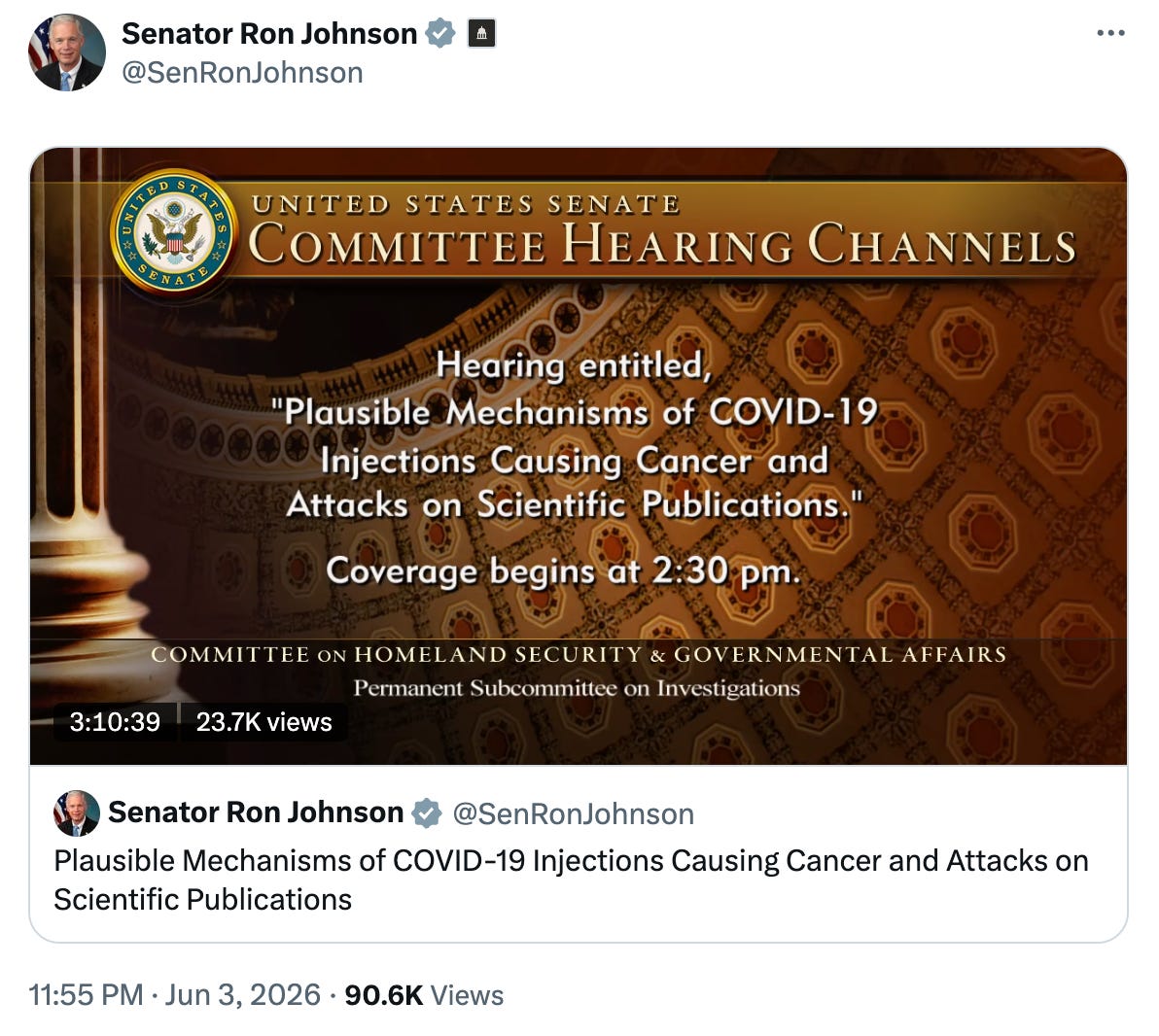
Hearing Convened and Background
[Chairman Johnson] [0:10:39]
Good afternoon. This hearing is called to order. Just brief explanation of how this hearing came about. I met Dr. Sabine Hazen in October of 2021 during really the height of COVID 19 and really related to all the work I was doing in terms of early treatment and then the COVID 19 Injections, injured, that type of thing. And I’m not quite sure how you got on my radar screen, but we struck up we have a good texting relationship. And immediately I was— Dr. Hayes made me aware of how her research, which was conducted with, supported by, guided by, overseen by the FDA, was being sabotaged. And with all the hearings and events I had done, I was trying to figure out some way of how can we hold a hearing on this, ‘cause this is really bad for science to have research sabotaged.
[Chairman Johnson] [0:11:43]
End of last year, Dr. Hazen introduced me to Dr. El-Diri, who probably a poster child for being tormented by, I’ll call ‘em trolls, into science. And so we put together this hearing. It’s kind of predicated on Dr. Aldieri’s work that I think prompted all the attacks. That’s why, that’s why we’re holding this hearing. So let me get into my opening statement.
Opening Statement by Chairman Johnson
[Chairman Johnson] [0:12:13]
I want to thank all the witnesses. I know this is a real imposition, take a lot of time and effort and expense to get here. But today’s hearing is titled Plausible Mechanisms of COVID 19 Injections Causing Cancer. And attacks on scientific publications and research. Although it may seem these are two unrelated topics, discussing them together will help explain why such a large percentage of the public remains unaware of the serious adverse events caused by the COVID 19 Injections. In April, the subcommittee held a hearing and released a report exposing how, how top FDA officials decided to use a safety surveillance algorithm that they knew would and in fact did hide safety signals on extremely serious adverse events, including sudden death. This was a bombshell revelation that unfortunately was dismissed by this subcommittee’s ranking member and completely ignored by the legacy media.
[Chairman Johnson] [0:13:17]
Since 1997, when the Clinton administration made America only the second nation on Earth to allow mass media advertising on pharmaceutical products, Big Pharma has spent billions on TV ads to capture the media and as a result, the narrative. Prior to 1997, there was serious journalism covering suspected vaccine injuries. In 1997, Mike Wallace reported on CBS’s 60 Minutes about swine flu vaccine injuries. By the way, they pulled the swine flu vaccine after about 25 to 30 deaths and 400 to 500 cases of Guillain-Barré disease. They pulled it. 20 To 30, 25 to 30 deaths. We have over 39,000 deaths right now associated with the COVID 19 Injections worldwide from the VAERS vaccine. But I’ll move on. In 1982, WRC-TV’s Leah Thompson reported on the findings of their more than year-long investigation into the safety and effectiveness of the pertussis component of the DPT vaccine.
[Chairman Johnson] [0:14:21]
In 1985, Phil Donahue discussed both the swine flu and DPT vaccines and related injuries during his hour-long show. Since 1997, there have been a few reports on hepatitis B, MMR, HPV vaccine safety. But the, quote, safe and effective, unquote, mantra, combined with the narrative that adverse effects are, quote, rare and generally mild, unquote, has overwhelmed any coverage of the harms. Legacy media is not the only American institution that has been captured and controlled. Big Pharma also hires and financially awards former federal health agency officials and spends lavishly on lobbying and political donations to lawmakers of both parties. It generously funds other members of the COVID cartel: social media, medical associations like the American Medical Association and the American Association of Pediatricians, international health organizations, medical colleges, and medical journals.
[Chairman Johnson] [0:15:25]
The testimony in today’s hearing raises the question of whether Big Pharma might also be funding individuals who troll scientific research that runs counter to its goals and narratives. It should come as no surprise, therefore, that during the pandemic, treatment alternatives using cheap and safe generic drugs were not only suppressed but actively sabotaged in favor of a liability-free and highly profitable experimental gene therapy. And that’s what it is. The fact that all the institutions that benefit from Big Pharma’s largesse actively pushed the experimental gene therapy is also the reason they are now working so hard to suppress the reality of COVID 19 Injections. Testimony given in April’s hearing detailed the safety studies that were not done on the COVID 19 Injections prior to their emergency use authorization and eventual full approval. This list of omitted studies should shock everyone. Again, these were just in testimony.
[Chairman Johnson] [0:16:26]
Drug-drug interactions, cardiovascular toxicity, central nervous system toxicity, other organ toxicity, blood toxicity, genotoxicity, and carcinogenicity. Those studies weren’t conducted. I’m not sure they’ve been conducted even today because it’s approved. Now we just don’t want to know. Well, the legacy media, federal health officials, and the medical establishment continue to ignore and hide the lies told and the harms done by governments in response to the coronavirus, alternate media has been spreading the truth to a growing percentage of the global public. As a result, trust in these institutions is eroding. The only way, the only way to rebuild that lost trust is for the truth to be acknowledged in a process of public reckoning. The hearings I’ve been holding are intended to contribute to that reckoning. They will hear from highly credentialed and experienced doctors and medical researchers who will discuss the Plausible Mechanisms of COVID 19 Injections harms.
[Chairman Johnson] [0:17:33]
They will also describe the attacks they are experiencing on their research and reputations because they have the courage to expose the truth. I want to sincerely thank the witnesses for their courage and the time and effort they put in their testimony and advocacy. Let me just add on this note, in a couple of my public hearings, I, I conclude with the statement that I am truly amazed at the knowledge that mankind has accumulated over the millennia. I mean, it is amazing what we know and how rapidly we’re gaining that knowledge. But in spite of that, I would argue that what we don’t know vastly, and I mean vastly, exceeds what we do. And so in any kind of discussion like this, in any kind of scientific research, I think people involved need to approach these problems with that level of modesty, modesty, and that kind of humility.
[Chairman Johnson] [0:18:34]
So with that, I’ll turn it over to Ranking Member Blumenthal.
Ranking Member Blumenthal Response
[Ranking Member Blumenthal] [0:18:39]
Thank you, Chairman Johnson. I’d like to begin my remarks by reminding everybody watching today that the National Cancer Institute has concluded, quote, there is no evidence that COVID 19 vaccines cause cancer, lead to recurrence or lead to disease progression. That is the National Cancer Institute. Quote, there is no evidence that COVID 19 vaccines cause cancer, lead to recurrence, or lead to disease progression.
[Dr. Asim Maholtra] [0:19:29]
End quote.
[Ranking Member Blumenthal] [0:19:31]
I could conclude there. But I think that this hearing really merits a fuller explanation of what is at stake here, because we need more research into finding cancer cures and more research into preventing cancer in the first place. Cancer causes fear for everyone. And almost everyone, I venture to say, in fact everyone, has been touched by cancer in some way. And so that fear is pervasive. We can’t allow that fear to cause unfounded attacks on the COVID vaccines or any other vaccine. These vaccines have saved millions of lives, and we should all be rooting for similar feats of of science to help people who are stricken with cancer or help to prevent it.
[Ranking Member Blumenthal] [0:20:32]
Cancer data is very closely tracked in the United States, and the idea that a rollout of COVID 19 vaccines has precipitated a surge in cancer is simply not supported. Nor do the vaccines make cancer grow faster, according to the American Cancer Society. Most cancer doctors recommended vaccination against COVID 19 for the cancer patients they are treating. Unfortunately, messages about the safety and effectiveness of vaccination are increasingly deluged by myths and misinformation. Immunization rates are declining across the country. Diseases like measles, are surging. And tragically, also, vaccines have been proven to prevent certain types of cancer. Those vaccines are facing groundless attacks from top public health officials, maybe not surprisingly, because HHS Secretary Robert F. Kennedy initially declined to surrender his financial stake in litigation against the maker of HPV vaccines, and then only under pressure from Congress turned his interests over to his son.
[Ranking Member Blumenthal] [0:21:58]
There’s ample evidence, in fact, that HPV vaccines help prevent cervical cancer, a disease that is projected to kill 4,200 Americans this year. And I’m grateful that we have Tamika Felder, a cervical cancer survivor, here with us today. I really thank her for being here. You’re doing us a great service. It’s stories like yours, Ms. Felder, that remind us of the human impact of science’s great successes. And I’m also grateful to have Dr. Julie Graylow, the Chief Medical Officer of the American Society of Clinical Oncology, who’s here to remind us about the absence of credible scientific evidence linking COVID 19 vaccines to cancer and the safety of these vaccines for people undergoing cancer treatment. Very important.
[Ranking Member Blumenthal] [0:22:58]
And thank you, Dr. Gralow. As just one example of the overwhelming evidence of the safety of these vaccines, I would like to submit for the record a study from the Journal of the American Medical Association involving nearly 30 million people and finding that 4 years after vaccination, people who received an mRNA COVID 19 vaccine were less likely to die from cancer than those who were not vaccinated. I ask that it be entered the record if there’s no objection, Mr. Chairman.
[Chairman Johnson] [0:23:29]
No objection. I wonder if that’s as good as the Commonwealth Fund study you entered previous hearing, but go ahead. No, no objection. Thank you.
[Ranking Member Blumenthal] [0:23:37]
It’s unfortunate that we need Dr. Grillo to appear before a hearing like this one when there are much more pressing threats to cancer patients and cancer research coming from Trump administration policies. And that’s the big issue here. And the reason that I am expanding on what I said earlier, because the administration has put up needless roadblocks that have slowed the flow of grants to cancer researchers. Halts to funding imposed early last year caused the American Association of Cancer Institutes to warn that the Trump administration policies were, quote, “slowing progress against cancer.” And the Trump administration’s obvious animus toward mRNA technology that was used for COVID 19 vaccines threatens some of the most promising research for targeted cancer treatments.
[Ranking Member Blumenthal] [0:24:40]
The studies canceled, the patients excluded from trials, the treatments abandoned. Decisions made today about cancer research will impact us and our children for decades to come. Just days ago, scientists announced amazing results from the study of a new drug for prostate cancer, one of the hardest cancers to treat. These results were possible in part because of work done many years ago at the National Cancer Institute. One scientist who helped with that research said, quote, this kind of basic research is being greatly threatened by current government policies. Basic research is essential. It’s not just COVID vaccines, it’s not just cancer vaccines, it’s all kinds of medical treatment that you will find in hospitals today saving lives, beginning with basic research that is being throttled by this administration.
[Ranking Member Blumenthal] [0:25:49]
And so I hope we can all agree that advancing cures for cancer and stopping the forces that undermine them ought to be a top priority for all of us in Congress. It ought to be a bipartisan cause. I hope my colleagues will take up the mantle with me. Thank you, Mr. Chairman.
[Chairman Johnson] [0:26:09]
Thanks, Senator Blumenthal. It is the tradition of this subcommittee to swear in witnesses. So if you all rise and raise your right hand.
Witness Swearing-In
[Chairman Johnson] [0:26:23]
Do you swear or affirm the testimony you will give before the subcommittee will be the truth, the whole truth, and nothing but the truth, so help you God? Please be seated. Our first witness is Dr. Angus Dauglish. Dr. Dalgleish is Professor Emeritus of Oncology at City, St. George’s University of London, where he has pioneered the immunotherapy of cancer. He is known for his work on HIV and cancer and received the Joshua Lederberg Prize in 2011 for his work developing cancer treatments. He’s been the principal of the Institute of Cancer Vaccines and Immunotherapy since 2000 and a consultant in general medicine, immunology, virology, in oncology since 1986. And by the way, these are very abbreviated biologies or biographies. I mean, each one of these individuals on both sides have much larger biographies that you should take a look at. But I forced them to abbreviate it. Dr. Doug Leash.
Dr. Dalgleish Testimony
[Dr. Angus Dalgleish] [0:27:21]
Thank you very much for asking me to give evidence on this. I’d just like to point out that I have done— as you say, I’ve been in cancer immunotherapy. I’ve been in cancer immunotherapy for over 3 decades and I have made big advances in the treatment of cancer with immunotherapy. So this sets the scene that I then— I became aware in early ‘22 of my patients who’d been stable for years, mainly melanoma patients. They’d had several different types of immunotherapy, and in 6 weeks I saw 6 patients relapse with melanoma. They had they’d been stable for 3 to 18 years. They felt well apart from the relapse. And being investigative, I asked, you know, what was the thing that was common? And the thing that was common is they’d all received a booster vaccine from their general practitioners.
[Dr. Angus Dalgleish] [0:28:22]
Now, I know that these cancers are totally controlled by the T-cell response. So I immediately suspected the T-cell response was being perturbated by the cancer, and initial investigations showed that this was likely to be true. However, there was then a paper published by some doctors in Madrid which— and I quote, the paper is called ‘The Evidence of Exhausted Lymphocytes After the Third Anti-SARS COVID-19 Vaccine Dosing Cancer Patients.’ I mean, this was absolutely staggering. That they showed across hundreds of patients that you get this T-cell suppression. Hard on the heels of this were then numerous reports that the following booster vaccine, we were getting IgG immunoglobulin switching. So you converted the immune system from being aggressive fighting invaders to one of tolerization.
[Dr. Angus Dalgleish] [0:29:22]
So therefore the immune system was tolerating the cancer, and this was the reason that we were starting to see it. However, it is important at this stage to say that we were getting reports after I first reported this of other cancers. And my initial observation that this was all due to T-cell suppression started to fade into perspective, that other actors were at work with the vaccine, as it were. Colorectal cancer was being reported by my patients, by my fellow surgeons, as reporting, as presenting late stage 4, not stage 1 or 2, and early in patients in their 20s and 30s and 40s in a way that we have not seen before. And then in my own practice, as I was looking for patients who had COVID, who’d had other cancers, I noticed that they too had had booster vaccines.
[Dr. Angus Dalgleish] [0:30:22]
And I list them in my report. They go from everything from the common cancers, from breast, prostate, etc., and all the way through to some really unexpected ones, including glioma and more recently, hematological malignancies. Now, looking at the literature as to why this could be, and I’m involved in two big publications, one’s been accepted prior to, prior to changes. And this shows that there are remarkable at least a dozen mechanisms where messenger RNA can insert into the DNA and activate oncogenes genes, and more importantly, and especially the long term, they can suppress the suppressor networks, which means if a cancer is starting to evolve, it would normally be maintained, controlled, and this mechanism is being prevented. And the number of people who’ve shown this is quite enormous.
[Dr. Angus Dalgleish] [0:31:23]
So as an oncologist who are starting to see that it’s not only my patients now, it’s people I know really well who are going down with cancer, and they’re going down more aggressively, and the treatment is not working nearly as well. And I’m used to people saying, oh, there’s no evidence of cancers increasing and that there’s anything to do with the vaccine. But I can assure you from the patients that I have seen, that many have seen, uh, a dozen doctors before. Not one of them has ever asked the vaccine history. So of course they see no evidence. And my full detailed research into messenger RNA vaccines, and I was on the scientific board of a company claimed to be the messenger RNA vaccine, uh, company for 5 years and left 8 years ago. So I know a lot more than the average clinician, and myself and others feel that there is no way you can control this technology, and its use for future vaccines should be banned, and the COVID ones stopped now.
[Chairman Johnson] [0:32:26]
Thank you, Dr. Dalgliesh. You stayed right on time. Appreciate that. Next witness is Dr. Wafik El Dirri. Dr. El Dirri is a practicing physician scientist, American Cancer Society professor, founding director of the Cancer Center at Brown University, and chair of the Worldwide Innovative Network Consortium in Precision Oncology. He discovered a tumor suppressant gene he named WAF1 and a first-of-its-kind drug approved by FDA last year for the treatment of an aggressive brain cancer. Dr. Eldiri.
Dr. El-Diri Testimony
[Dr. Wafik El-Diri] [0:32:59]
Thank you, Senator Johnson and Senator Blumenthal and distinguished committee members for the opportunity. Thank you, Senator Johnson, Senator Blumenthal, and distinguished committee members for the opportunity to speak at this important hearing. I am a physician scientist and cancer researcher with more than 30 years of experience studying how our body normally fights cancer through a major tumor suppressor called p53 and finding new ways of treating it. I’ve also advocated on Capitol Hill since 2005 for support of research funding, which is really vital. My work has, has focused on how cancers develop within— when these normal tumor suppressor mechanisms fail, including discoveries involving how tumor suppressors work.
[Dr. Wafik El-Diri] [0:34:07]
And this has become foundational in cancer biology and oncology research. I’ve also studied how viruses and other biological processes can disrupt our defenses against cancer. So when the COVID pandemic began, I wanted to help by applying our expertise in cancer biology, immunology, and approved treatments to better understand and treat COVID 19. It’s been long understood that certain viruses contribute to cancer development by disrupting tumor suppressor pathways, including p53, one of the body’s most important cancer protective mechanisms. Early in the pandemic, I became concerned that the COVID 19 virus might similarly interfere with these defense mechanisms, making this an important area for scientific investigation. Early in the pandemic, I also expressed uncertainty on social media about the natural origin of the COVID 19 virus, and this is when I first started to experience repercussions of speaking out against the mainstream narrative.
[Dr. Wafik El-Diri] [0:35:13]
What I didn’t expect were the attacks on science itself. By July 2020, my laboratory published findings showing that a class of cancer drugs known as MEK inhibitors suppressed ACE2, the cell surface receptor the COVID virus uses to infect human cells. By April of ‘24, we reported findings suggesting that the spike protein associated with COVID infection or COVID vaccination could reduce the ability of p53 to activate genes involved in suppressing cancer. Based on these findings, we emphasize that effective vaccines against viruses such as COVID 19 should strengthen immunity against infection without interfering with the body’s natural defenses against cancer. These concerns were raised through normal scientific channels, yet the response was not open scientific engagement, but escalating attacks.
[Dr. Wafik El-Diri] [0:36:13]
Instead of contributing to scientific dialogue, the findings triggered attacks on both the research and the researchers involved. Much of this occurred through an online platform known as Pubpeer, originally created about a decade ago to identify fraud and scientific misconduct. Unfortunately, the platform increasingly became weaponized against researchers whose findings challenged prevailing narratives. The platform permits anonymous accusations without meaningful accountability. There’s no disclosure of conflicts of interest, no statute of limitations or citizenship requirements. These attacks are public, amplified through social media, and can continue indefinitely regardless of whether wrongdoing is ever established. This is precisely what happened to us. Although we corrected minor errors where appropriate and continue to do so, none altered the underlying results or conclusions of our work.
[Dr. Wafik El-Diri] [0:37:15]
Nevertheless, our publications became subject of sustained public attacks that damaged reputation and undermined scientific credibility. Despite these ongoing attacks, last summer I agreed to serve on an HHS committee On Immunization Practices Working Group on COVID immunizations. And as an expert, I therefore looked into everything we know about cancer and COVID infection and COVID vaccination. And by the fall found nearly 70 papers ascribing more than 300 reported cancer cases from 27 countries following one or more COVID mRNA vaccines. COVID 19 Injections. The reported cancers occurred near injection sites like sarcomas or lymphomas, right at the injection site within the head and neck region, within and elsewhere, including, as Dr. Deglish mentioned, brain tumors and other tumors.
[Dr. Wafik El-Diri] [0:38:26]
In some reported cases, spike protein was identified within tumor tissue. Our findings were published in January of this year, and shortly afterwards, I was contacted directly by former Japanese Minister Kazuhiro Haraguchi, who reported developing a diffuse large B-cell lymphoma that later metastasized to his tonsil and biopsied, and they found spike protein. There should be no spike in tumors. These observations warrant serious scientific investigation. And as such, a number of unexpected observations have been made with the COVID 19 Injections vaccines that suggest potentially plausible mechanisms and connections to cancer. The attacks on my publications intensified and continue to the present day, despite no findings of fraud, misconduct, or wrongdoing after years of investigation.
[Dr. Wafik El-Diri] [0:39:28]
I am for vaccines that are safe and effective. Both our paper and the journal itself became targets of attacks through pubpeer and related online campaigns. I remain in effect guilty until proven innocent. Patients deserve informed consent. Scientists deserve the freedom to investigate legitimate scientific concerns. There are many open questions, including who is at greatest risk from these vaccines, and there shouldn’t be fear of reputational destruction, institutional retaliation, or professional ruin. Papier needs to be held accountable for making false accusations against physicians and scientists that destroy reputations and careers. Thank you.
[Chairman Johnson] [0:40:15]
Thank you, Dr. Eldiry. Our next witness is Dr. Saskia Mostert. Dr. Mostert studied medicine at VU Amsterdam in the Netherlands. And conducted PhD program on compliance in childhood leukemia treatment in Indonesia. She then worked as a research coordinator of global health and pediatric oncology research programs at Amsterdam University Medical Center and Princess Maxima Center. Her fields of expertise include treatment compliance, the problem of corruption in medicine, and hospital detention practices. Dr. Mostert.
Dr. Mostert Testimony
[Dr. Saskia Mostert] [0:40:52]
Dear members of the American Senate, in 2024, our team published a study in BMJ Public Health examining all-cause mortality data across Western countries between 2020 and ‘22. These were government-reported mortality records routinely used throughout mainstream public health. The peer review process had taken more than 9 months. Our study showed that excess mortality remained evaluated across 47 Western countries, totaling more than 3 million excess deaths. Excess mortality persisted across the overwhelming majority of countries studied after the acute phase of the pandemic. We did not claim certainty regarding the causes of excess mortality. Rather, we asked attention for 3 major events that were non-existent before the pandemic: the COVID infection, the containment measures, and the COVID vaccines. In addition, we acknowledged other overlooked factors.
[Dr. Saskia Mostert] [0:41:54]
We urged governments and public health leaders to investigate the underlying causes and evaluate their policies. During the pandemic, extraordinary measures were justified in the name of protecting human life. Public officials and media emphasized that every COVID death mattered and every life deserved protection. I believed the discovery of more than 3 million excess deaths would prompt the same urgency in investigating their causes. Instead, what followed often resembled what I could only describe as blind fury. What could explain this massive outrage? During the pandemic, health policies were combined with psychological tactics to influence public behavior. Governments and media implemented psychological manipulation and fear propaganda without our awareness or consent that increases conformity and reduces tolerance for reason and dissenting voices, such as tunnel vision, emotional messaging, polarization, and important to distinguish— the distinction between worthy versus unworthy victims.
[Dr. Saskia Mostert] [0:43:01]
So distinguishing between important victims who deserve extensive attention or support and other victims who can be ignored. Censorship and suppression tactics have been used against doctors and scientists questioning the official COVID narrative. I will mention a few. The devaluation tactics: discrediting critics and criticism using labeling such as misinformation. Cover-up tactics: hiding censorship using proxies, fact-checkers, shadow banning, and deplatforming. Reinterpretation tactics: favorably framing censorship. As protection of the public or follow the science, official channel tactics, which gives the censorship the appearance of legitimacy, of justice, and hides political or economic conflicts of interest, and last but not least, the intimidation tactics, using fear, threats, coercion to silence critics and others. Encountered blind and irrational fury after our publications can thus be explained by tunnel vision disruption.
[Dr. Saskia Mostert] [0:44:04]
Not only the worthy victims, the COVID patients, but also the unworthy victims, the lockdown victims and the vaccine injured, were described. Polarization in society between those who followed the official COVID narrative and those who questioned it became visible. Despite a supportive statement from Reuters, media outlets used their devaluation tactics and labeled the publication as anti-vax, conspiracy theory, and misinformation. One affiliated hospital publicly distanced itself from the study and announced a scientific integrity investigation. Institutional responses are increasingly used as official channel tactics to discredit, intimidate, isolate, and silence those raising unwelcome scientific questions. I resigned. Scientific integrity investigations can be evaluated according to confidentiality Transparency, presumption of innocence, and fairness principles.
[Dr. Saskia Mostert] [0:45:06]
To my opinion, all these principles have been trampled on. The institutional confidential report about my co-authors was leaked to a national newspaper and resulted in a hit piece. This example speaks volumes. To be clear, I lost my position after publishing official government mortality data and calling for further scientific investigation into persistent excess death. Science cannot function when legitimate questions become professionally dangerous to ask. When scientists fear professional destruction, the public loses access to honest scientific inquiry. The Institute concluded that scientific integrity was not violated in our study. No plagiarism, fabrication, or falsification took place. Nevertheless, the Institute persists on retraction of the paper for containing misinformation about possible causes of excess mortality. Ironically, the text on containment measures and vaccines was much shorter in the original version of the paper.
[Dr. Saskia Mostert] [0:46:09]
The reviewers selected by the journal had asked us to either delete the text or provide more evidence. As there is evidence available, we included it. All added references concerned peer-reviewed publications from well-known institutes indexed on PubMed. My proposed post-publication revision that included a section on vaccine effectiveness in reducing mortality was ignored by the journal. Right from the start, it was an unequal battle. Our call for investigation of underlying causes had to be censored and erased one way or another. The tunnel vision leaves no room for unworthy victims. Yet the persistent excess mortality remains unexplained. Our case is not isolated. Books have documented the suppression of more than 80 Dutch doctors and scientists, as well as the removal of 60 professors across Germany, Austria, and Switzerland. In recent years, the number of removals for ideological insubordination has increased significantly.
[Dr. Saskia Mostert] [0:47:12]
Similar patterns emerge across institutions. After a media scandal, the university distances itself and starts disciplinary proceedings. The reason given for dismissal is scientific integrity violation, whereas the real reason appears to be dissent. Recently, we established a task force on academic freedom in the Netherlands to investigate censorship, suppression, and systematic attacks on doctors and scientists questioning aspects of the official COVID narrative. Censorship undermines academic freedom by discouraging legitimate scientific inquiry. It narrows the range of perspectives permitted within public debate and stimulates self-censorship among academics. Subsequent false scientific consensus can lead to dis— policies. If we want to restore public trust, we must once again protect academic freedom and the right of scientists and doctors to question prevailing assumptions without fear of professional destruction.
[Dr. Saskia Mostert] [0:48:14]
It is time to return to Voltaire’s Enlightenment commitment to academic freedom. I disapprove of what you say, but I will defend to death your right to say it.
[Chairman Johnson] [0:48:26]
Thank you, Dr. Molster. Next, we go to Dr. Sabine Hazen. Dr. Hazen received her M.D. In Canada and completed residency at the University of Miami. She was the first woman gastroenterology fellow at the University of Florida. And became an expert in the microbiome. She is currently the CEO of a private gastroenterology clinic and a clinical trial drug development company, as well as Progenobiome LLC, a genetic research lab that studies the clinical implications of the microbiome. Dr. Hazen.
Dr. Hazen Testimony
[Dr. Sabine Hazen] [0:49:07]
All right. I’m Dr. Sabine Hazan, a research gastroenterologist. For more than 3 decades, I have done hundreds of clinical trials for leading pharmaceutical companies. My work has contributed to bringing biologics, antibiotics, and vaccines to market. While these advances have helped patients, they have also revealed critical gaps in our understanding of human health, particularly the gut microbiome. The microbiome, your bacteria in your gut, is your immunity. In 2019, I founded Progenobiome, which is a research laboratory. And I say research because the microbiome research is at its infancy and it’s not going to be of my lifetime. My goal was simple, to rigorously study the microbiome in real-world clinical settings. My team and I launched 61 clinical trials to actively understand the gut connection in various diseases, Alzheimer’s, Autism, Parkinson’s, cancer.
[Dr. Sabine Hazen] [0:50:07]
This is precision medicine, taking care to each patient’s unique microbiome signature. Because yes, in the microbiome space, we’re all different. And if we’re all different, there is no normal in the microbiome space. So in 2020, I found myself in a very interesting position. I was taking care of high-profile individuals in Malibu. I had a portal with the FDA that could write protocols and submit protocols to the FDA, and I had a research lab that could look at the microbiome. So this unique position, I felt I was the best person to be looking at the microbiome and looking at COVID 19 Infections 19 Infections, while exchanging information with scientists at NIST, the National Institute of Standards, who were looking at COVID 19 in septic tanks. And by the way, for those of you who don’t know National Institute of Standards, they overlook DARPA, FDA, CDC.
[Dr. Sabine Hazen] [0:51:07]
So with discussions, ProgenoBiome became the first lab worldwide to document whole genome sequencing of COVID virus in clinical patient feces. Our paper was published in Gut Pathogens in 2021 after a 6-month peer review, only to be retracted in May 2025 without any valid scientific justification. Or even notifying the peer reviewers that approved the paper to begin with. I have to point out again that this was a landmark paper that showed COVID in the stools of clinical patients, not septic tanks, but clinical patients. While we were looking at stools, we discovered that hydroxychloroquine and azithromycin reduced the viral presence of COVID In other words, COVID disappeared on these. However, those drugs also killed the microbiome. And that was the important finding during the pandemic, that everybody’s different and everybody needs a different treatment.
[Dr. Sabine Hazen] [0:52:16]
It is also important to note that during the pandemic, I treated under FDA oversight. I actually wrote 3 protocols on hydroxychloroquine versus placebo and ivermectin doxycycline versus placebo. During my whole time that the FDA was watching, we lost no one. No one died on my shift. And by the way, I’ve treated thousands of patients. Doesn’t the public want to know how did I treat? What criteria did I use to, to divide the treatment in patients? Um, we conducted a review of these patients treated and noticed actually that ivermectin-based multi-drug therapy helped severely hypoxic patients. This data was published in 2022 after 8 months of peer review scrutiny and then retracted in March 2025. We also published cardiac safety data from our Phase 2 trial using hydroxychloroquine and azithromycin.
[Dr. Sabine Hazen] [0:53:17]
You will remember during the pandemic that there was a concern about cardiac problem from hydroxychloroquine and azithromycin. My team risked their lives putting Holter monitors on people’s hearts to monitor and capture the QT prolongation. And there were no QT prolongation. We published this data in December 2024. The paper was retracted in 2025, February. These retraction consistently challenged the feasibility of early treatment. Remember, if there was a treatment, vaccines would not have passed. Our most significant discovery, however, was on Bifidobacteria. What is Bifidobacteria, you ask? A bacteria that’s in your probiotics. When you turn your bottle of probiotics, that’s the bacteria. It’s Bifidobacteria. Bifidobacteria is an important microbe that helps you break down your food so that the sugar comes out and goes into the cell, into your mitochondria. Without Bifidobacteria, the sugar’s not going into your cell.
[Dr. Sabine Hazen] [0:54:20]
Ask yourself, how is— how are you going to metabolize? How are you going to have immunity if you don’t have your cells working? So Bifidobacteria was an extremely important finding because we discovered that severe COVID 19 patients lacked Bifidobacteria, while patients that were high-risk exposed had a lot of Bifidobacteria. We also discovered that people with autism, Alzheimer’s, Crohn’s disease, Lyme disease, irritable bowel syndrome, mental health, invasive cancer lack Bifidobacteria. Bifidobacteria appears in the young at a high level and disappears as we get older. We found that vitamin C, bovine immunoglobulin, and ivermectin, a fermented product of a bacteria called Streptomyces, could help increase Bifidobacteria and restore. Is that why we were seeing possibly hypoxic patients improving? I wrote a hypothesis, perhaps ivermectin was improving the Bifidobacteria.
[Dr. Sabine Hazen] [0:55:22]
That hypothesis was published and retracted in 2023. When a hypothesis is retracted, we’ve lost science and medicine. We then presented data on the vaccines and we discovered that the vaccines killed the microbiome, specifically the Bifidobacteria. That abstract won the best research award at the American College of Gastro and reached 18,000 GI doctors. That was never published. If you follow the disappearance of Bifidobacteria in the gut, you start to understand disease. You start to see why the newborns, 1 in 12 kids in California, 12 boys in California has autism. If you look at the data that just came out that showed newborns, only 25% of newborns are born with adequate levels of Bifidobacteria. So if you restore the Bifidobacteria like we did in our lab in kids with autism, you will actually resume speech, which is what we showed in two twins where we restored the Bifidobacteria.
[Dr. Sabine Hazen] [0:56:28]
That abstract won a research award at the American College of Gastro. In fact, ProgeniBiome has earned four consecutive awards at the American College of Gastro, affirming peer recognition of our work. Yet promising observations face problems and persistent barriers when attempting to publish in papers, pass rigorous review, or retracted over minor, easily correctable issue. The main non-medical scientist that criticized my papers has patent on the microbiome. Can you say conflict of interest? So I ask Congress today, should non-physician without relevant clinical expertise review and override medical data from practicing physicians. True expertise must be challenged by qualified peers, not outsiders. Members of Congress, imagine the possibilities if scientists could publish without fear of politically motivated retractions, if we could focus on advancing knowledge instead of defending it.
[Dr. Sabine Hazen] [0:57:31]
The American people deserve transparent, rigorous science, Protecting scientific integrity is not just about my work, but it is about securing the future of medicine for all. Because ultimately, we’re all going to be patients.
[Dr. Angus Dalgleish] [0:57:47]
Thank you.
[Chairman Johnson] [0:57:47]
Thank you, Dr. Hazen. I was hoping we get through all the opening statements before I had to go vote, but I’ve got a quick vote, so we’ll put the hearing into recess, and as soon as we get back, we’ll open it back up.
Recess and Resumption
[Chairman Johnson] [1:12:20]
So I— no further disruptions. Our next witness is Dr. Asim Mahaltra. Dr. Mahaltra is a multi-award-winning, internationally renowned British cardiologist. He served in an advisory role for health policy across governments, including as an ambassador to the Academy of Medical Royal Colleges and trustee of the King’s Fund, a health policy think tank. He was ranked the number one doctor in the world influencing obesity thinking, was named one of the UK’s most influential scientists. Dr. Mahaltra.
Dr. Maholtra Testimony
[Dr. Asim Maholtra] [1:12:56]
Thank you, Senator Johnson. In January 2021, indoctrinated with the unlikelihood of any major harm, I took two doses of Pfizer’s mRNA vaccine, unaware at the time that it was in fact a prophylactic gene therapy product and unlike any traditional vaccine. Although I was at very low risk of serious illness from COVID 19 due to my age and perfect metabolic health, I was inoculated to protect my patients. As one of the UK’s most trusted doctors, I was requested to appear on Good Morning Britain to help tackle vaccine hesitancy amongst high-risk ethnic minority groups. 5 Months later, a personal tragedy triggered a complete U-turn in my perception of the vaccine. We were dealing with a medical product that was actually unsafe and defective. My fit and healthy 73-year-old father, Honorary Vice President of the British Medical Association, who also happened to be my best friend and last surviving member of my immediate family, died after suffering an unexpected cardiac arrest.
[Dr. Asim Maholtra] [1:14:01]
Postmortem findings revealed severe coronary artery disease, and subsequent published mechanistic evidence suggested that two doses of the mRNA COVID 19 vaccine likely caused a massive acceleration in atherosclerosis leading to his sudden death. In 2022, I published a two-part peer-reviewed paper in the Journal of Insulin Resistance calling for a moratorium on these unsafe and defective products. The most damning evidence was a reanalysis of Pfizer and Moderna’s original trials. It determined a frequency of serious harm from the product that was 2 to 4 times more likely than being hospitalized with severe COVID 19. In my view, if the system had been more transparent, this prophylactic gene therapy would likely not have been injected into a single human being in the first place. Although there is now a multitude of high-quality research supporting those analyses, there’s been predictable little to any mainstream media coverage, a symptom of the downstream effects of how big corporations exert their power by controlling the dominant narrative.
[Dr. Asim Maholtra] [1:15:05]
I have personal experience with these downstream effects. Towards the end of last year, at the Reform Party political conference, I quoted Britain’s most eminent oncologist, Professor Angus Dalgleish. He believes that the COVID 19 vaccine likely played a significant role in cancers of members of the royal family. Predictably, I was smeared and misrepresented in the media. Even the British Prime Minister, Sir Keir Starmer, misled Parliament, suggesting that I’d claimed that all vaccines cause cancer. In quotes, “These dangerous conspiracies cost lives,” he said. I also experienced public smears and attacks from influential sections of the medical profession. I’m a grieving vaccine-injured doctor. I’ve been diagnosed with a persistent autoimmune condition related to loss of bifidobacteria in my gut, and advanced blood tests suggested I’m at slightly increased risk of cancer in the short term. Looking at the totality of up-to-date evidence and what you’ve heard from eminent witnesses today, in my view, millions of Americans and millions more across the world may be in clear and present danger of suffering premature cardiovascular disease and cancer.
[Dr. Asim Maholtra] [1:16:17]
Without allowing all scientists to debate this openly, without fear of censure, we will not be able to identify who is most at risk and how these risks can be mitigated. When it comes to making money, multinational corporations have been diagnosed by preeminent forensic psychologist Dr. Robert Hare and law professor Joel Bakan as legal entities that fulfill the criteria for psychopathy. Characteristics include callous unconcern for the safety of others, incapacity to experience guilt, repeated lying and conning others for profit. The evidence presented here today exposes the corporate tyranny underlying public health practice. This profitability over people rooted in the neoliberal economic model has led to trust being at an all-time low in the medical profession. A full public apology from government bodies and medical leadership to the vaccine injured and bereaved is an essential first step to restoring that trust.
[Dr. Asim Maholtra] [1:17:19]
Tyranny emerges when people are afraid to say what they think. When you have something to say, silence is a lie. When everyone lies all the time, the tyranny is complete. To save the health of the American people and to save democracy, it is our responsibility to expose, resist, and dismantle the era of corporate tyranny we currently find ourselves in.
[Ranking Member Blumenthal] [1:17:44]
Thank you.
[Chairman Johnson] [1:17:45]
Thank you, Dr. Maholtra. Our next witness is Dr. Julie Grailow. Dr. Grailow is Executive Vice President and Chief Medical Officer for the American Society of Clinical Oncology. She is Professor Emeritus of Medical Oncology and Global Health at the University of Washington School of Medicine and the co-founder of two nonprofits to support female cancer survivors and promote cancer advocacy and education in developing countries. Dr. Grailow.
Dr. Gralow Testimony
[Dr. Julie Gralow] [1:18:10]
Thank you, Chairman Johnson, Ranking Member Blumenthal, members of the subcommittee. Thank you for the opportunity to share my clinical perspective on this important topic. As you’ve heard, I’m the Chief Medical Officer and Executive Vice President for the Association for Clinical Oncology, or ASCO, a 501 organization established by the American Society of Clinical Oncology in 2019 that represents more than 50,000 oncology professionals who care for people living with cancer. ASCO works to ensure that all individuals with cancer have access to high-quality care, and we’re committed to the principle that knowledge conquers cancer. Through research and education, ASCO works to conquer cancer and create a world where cancer is prevented or cured and every survivor is healthy. We appreciate the opportunities to discuss the critical role of mRNA technology in cancer care. And the unwavering commitment to patient safety that guides its development.
[Dr. Julie Gralow] [1:19:13]
For nearly 3 decades prior to the COVID 19 pandemic, the primary driving force behind mRNA research was cancer immunotherapy. When exploring emerging therapies like mRNA vaccines, oncology professionals rely on well-designed clinical trials to establish clinical efficacy, evaluate unintended consequences, and ensure the benefits outweigh the potential risks. Currently, there is no clinical evidence proving that mRNA COVID 19 vaccines cause cancer or accelerate cancer growth. Cancer is caused by a series of gene mutations and does not develop suddenly. Rather, tumor evolution is a multi-step process that generally takes years or even decades to manifest clinically. The appearance of late-stage aggressive tumors within weeks or months of an injection is biologically incompatible with what we’ve learned from decades of research on the causes of cancer.
[Dr. Julie Gralow] [1:20:13]
In fact, RNA breaks down quickly in the body and doesn’t enter a person’s DNA. In other words, mRNA vaccines do not cause gene mutations. The benefits of COVID vaccination in patients with cancer are supported by a large and growing body of evidence. MRNA COVID 19 vaccines protect patients with cancer who often have compromised immune systems, increasing their risk of negative outcomes if they contract COVID 19. Before vaccines were available, researchers at the University of Wisconsin-Madison found that COVID 19 patients with the current cancer diagnosis were 24% more likely to require intensive care and 58% more likely to die in the hospital compared to after the vaccines became available. In contrast, a 2025 study led by investigators at Vanderbilt University found that cancer patients who received COVID 19 vaccinations had a 50% reduction in their risk of hospitalization.
[Dr. Julie Gralow] [1:21:15]
These data are reinforced by an ASCO study demonstrating a clinically significant relationship between vaccination and survival in cancer patients diagnosed with COVID 19. mRNA technology also represents a really exciting and significant clinical advancement for therapeutic cancer vaccines aimed at treating existing tumors. Unlike traditional treatments such as chemotherapy, which broadly destroys both cancerous and healthy dividing cells, mRNA technology is designed to teach an individual’s body to recognize tumor markers that are unique to that patient’s cancer, encouraging the patient’s immune system to destroy just cancer cells, not healthy ones. While the FDA has not yet granted approval for mRNA cancer vaccine therapies, clinical trials are actively testing mRNA cancer vaccines and have reported good tolerability and promising clinical activity.
[Dr. Julie Gralow] [1:22:16]
For example, just this past week, At our annual meeting, researchers shared the results of a trial that shows melanoma patients who receive a cancer-fighting mRNA vaccine in addition to immunotherapy had better cancer outcomes than patients who received the immunotherapy alone. Additional research led by investigators at MD Anderson found that patients who received the COVID vaccine along with immunotherapy to treat non-small cell lung cancer had better cancer outcomes than those who were not vaccinated. Existing research provides strong indications that mRNA vaccines will likely join approved immunotherapies as new options for patients with cancer facing difficult diagnoses. Thank you for the opportunity to testify on these important issues. ASCO remains deeply committed to advancing safe, evidence-based care for all patients, and I welcome your questions.
[Chairman Johnson] [1:23:10]
Thank you, Dr. Grillo. Our Last witness is Ms. Tamika Felder.
Ms. Felder Testimony
[Chairman Johnson] [1:23:16]
Ms. Felder is a cancer survivor, award-winning women’s health advocate, author, filmmaker, and the founder and chief visionary officer at Survivor— Survivor. Survivor.
[Ms. Tamika Felder] [1:23:28]
Survivor.
[Chairman Johnson] [1:23:28]
Survivor. Survivor. You spell it different. I get it though. Survivor Inc., a nonprofit that specializes in cervical cancer advocacy and support. She currently survives— certainly currently serves as a co-chair on the National HPV Vaccination Roundtable and was appointed by President Biden to be a member of the National Cancer Advisory Board. Ms. Felder.
[Ms. Tamika Felder] [1:23:49]
Thank you so much to you, the chair, the ranking member, and to all of you here for having me and especially for including the patient voice. My name is Tamika Felder, a 25-year cervical cancer survivor. Today I speak to the safety and importance of vaccines for all people and to advocate for the open and accurate sharing of scientific information so that families and communities can protect themselves and future generations. I was diagnosed in 2001 at the age of 25 while working here in Washington, D.C. as a broadcast journalist. The disease forced me to confront the fragility of health, and I endured a hysterectomy, chemotherapy, and radiation, which ultimately led to— the loss of my fertility. Today, as a survivor and patient advocate, I have dedicated my work to education, empowerment, and ensuring that every person has accurate access to health, health medical information, trusted healthcare, and life-saving prevention tools.
[Ms. Tamika Felder] [1:24:49]
I also firmly believe that the HPV vaccine, which would have offered protection against the HPV types most commonly associated with cervical cancer, could have changed the trajectory of my life. The human cost of cervical cancer remains a preventable disease for most people when prevention and screening are accessible and effectively utilized. Too many lives are cut short by this disease. June is National Cancer Survivorship Month, and I’m one of the 18.6 million cancer survivors in the U.S. But I also want to recognize, honor, and mourn the individuals whose lives were also lost to cervical cancer, including Teolita Rickenbacker of Georgia, Jennifer Myers of Pennsylvania, Erica Fraser-Stum of Indiana, and Becky Wallace of California. These are just a few in the United States, an estimated over 600,000 people who projected to die from cancer. This translates to about 1,700 deaths per day, making cancer the second leading cause of death in this country.
[Ms. Tamika Felder] [1:25:53]
Each of these women were more than a diagnosis. They were mothers, sisters, friends, and contributors to their communities. Their stories remind us why prevention, vaccination where appropriate, and continued research are essential to save others from needless suffering and loss. While other countries are nearing cervical cancer elimination, the United States is still behind despite having the tools needed for elimination. Vaccines approved for the use in the United States undergo rigorous multi-phase testing for safety and efficacy before they are licensed. The overwhelming majority of vaccines have favorable safety profiles, and the benefits— reducing the reduction of infectious disease, prevention of severe illness and death, and protection of vulnerable populations— greatly outweigh the risk of rare adverse events. Vaccines are not just about one disease. They are about a standard approach to preventing contagious and deadly illnesses. The safety frameworks apply to vaccines across the board— routine immunizations for children, adults, and special populations, cancer prevention vaccines like the HPV vaccines, influenza vaccines, and vaccines for other preventable diseases.
[Ms. Tamika Felder] [1:27:06]
So science provides the best available evidence and the safety and effectiveness of vaccines. We rely on rigorous research, transparent reporting, and peer-reviewed findings is essential to protect public health. In an era of rapid information exchange, we must commit to sharing factual, science-based information. Misinformation and fearmongering about vaccines undermine trust, delay or prevent vaccination, and leave people vulnerable to preventable diseases. Public health communication should be clear, compassionate, and inclusive. It should acknowledge concerns, provide transparent clear explanations of benefits and risks and connect people with trusted healthcare providers who can answer questions and offer guidance. Survivors and patients must be at the center of conversations about vaccines and cancer prevention. We bring lived experiences with disease treatment and survivorship perspective that matters when designing education outreach and clinical guidance.
[Ms. Tamika Felder] [1:28:07]
As a cervical cancer survivor and advocate, I see both the devastating toll of cancer and the profound promise of prevention. Vaccines, including the HPV vaccine, are powerful tools when used alongside screening and treatment. We can reduce the burden. I want to thank you all for the opportunity to testify. I am grateful for your consideration of policies that protect communities today and for generations to come. And as Lindsay Gillette Lee reminded me yesterday— she’s a 3-year cervical cancer survivor from North Carolina— may our stories pave the way so others don’t have the same story. As much as our stories matter, so do the science. Respectfully, Tamika Felder, founder of Survivor and 25-year cervical cancer survivor.
[Chairman Johnson] [1:28:54]
Thank you, Ms. Felder. Um, I think it’s probably safe to say people on the panel, by most people in this room including myself, I mean, we, we don’t dispute the fact that vaccines can be helpful and save lives.
Q&A and Cross-Examination
[Chairman Johnson] [1:29:08]
I think you can dispute some of the claims. But again, I’ve never been an anti-vaxxer. I think our concern here, and one of the reasons I hold this hearing, is there’s just a denial of the vaccine and the injection injuries. I’ll just— again, you had cervical cancer. We had it at our Voice of the Vaccine injured a mother, Emily Tarso, whose daughter, 20-year-old daughter, died 18 days after she received her third shot of Gardasil. The HPV vaccine. After 8 years of litigation— this is how difficult it is to actually claim compensation through the government fund— quote, HHS conceded by preponderance of the evidence, including challenge, rechallenge, that her daughter died from HPV vaccination. They had no alternative explanation for her death. So again, I’m not a vaccine denier. I’m— we’re battling vaccine injury deniers. That’s part of our problem. But, you know, Dr. Graylow, you mentioned that mRNA degrades very rapidly in the body.
[Chairman Johnson] [1:30:10]
Is it your understanding, belief, that the mRNA in the COVID 19 Injections is that type of mRNA?
[Dr. Julie Gralow] [1:30:17]
That is my understanding.
[Chairman Johnson] [1:30:22]
Have you— so you don’t realize that that’s not true mRNA, that’s modified? It’s modified, is pseudouridine, is that the So it doesn’t degrade. You’re obviously then unaware of some of the studies that show that the spike is, is, uh, in the mRNA is, is circulating the body up to 2 years. We haven’t studied it longer than that, but it’s, it’s staying in this body that, that long attaching to the cells. As long as I’m on this track, was it your belief that the, uh, the injection would stay in the, the arm? We were told that it was going to inject in the arm stay there, create antibodies. The mRNA was going to degrade very quickly, and that’s why it was so safe. Was that your understanding, that the— in your belief that the injection stays in the arm?
[Dr. Julie Gralow] [1:31:08]
I think the effects of the injection are total body, so the immune response, the reaction—.
[Chairman Johnson] [1:31:16]
But I mean the, the actual— so you’re aware the, the modified mRNA was encapsulated in the lipid nanoparticle correct? So do you believe that package stayed in the arm as we were told it was going to do?
[Dr. Julie Gralow] [1:31:30]
I, I can’t reliably comment on, on that.
[Chairman Johnson] [1:31:36]
So again, you’re saying how safe and effective this is, but you don’t know how it works.
[Dr. Julie Gralow] [1:31:41]
I do know how it works. It incites an immune reaction, as vaccines do.
[Chairman Johnson] [1:31:47]
How does it incite that immune reaction? What does it do? What does it actually do?
[Dr. Julie Gralow] [1:31:54]
It brings the immune cells to recognize the COVID protein.
[Chairman Johnson] [1:31:59]
How does it have the— are you aware of the fact that the lipid nanoparticle delivers its modified mRNA to a cell, that mRNA, that modified mRNA is injected into the cell, and then it turns the cell into a factory of the spike protein, which is toxic to the body. Are you aware that that’s how it creates immunity?
[Dr. Julie Gralow] [1:32:24]
The mRNA in the vaccine does get into cells, and it codes for a protein, um, once it is inside the cell.
[Chairman Johnson] [1:32:34]
So are you aware of the DNA contamination found in the— in these vials, that if the mRNA is being injected in the cell, well, gee, gee, maybe some of this DNA, which is way beyond the levels accepted by the FDA, could also be injected in the cell. Are you aware of that?
[Dr. Julie Gralow] [1:32:49]
I am aware that the mRNA that is injected does not get into our own DNA, and I am not aware of reliable data saying that within the vaccine itself that the DNA levels are high.
[Chairman Johnson] [1:33:02]
So you said that there is no clinical evidence proving these injections cause cancer.
[Dr. Angus Dalgleish] [1:33:10]
How would you—.
[Chairman Johnson] [1:33:11]
What would you require for proof? How would you ever prove that?
[Dr. Julie Gralow] [1:33:18]
I believe that we can put some boundaries around how much of an effect could be happening with respect to causing or accelerating cancer, because we have not seen an overall increase in cancer rates in the vaccinated U.S. population. In order to prove it, we would need a randomized clinical trial where patients were equal in both arms. One would have a placebo or no vaccine and the other would get the vaccine. And we would need to follow long term.
[Chairman Johnson] [1:33:54]
So, so observational studies, you know, clinical observation carries no weight, has no evidence.
[Dr. Julie Gralow] [1:34:00]
I think it’s hypothesis generating. I do think there are major differences between people who choose to have vaccines who are more health engaged and those who choose not to.
[Chairman Johnson] [1:34:09]
I was sent apparently a study that’s going to be discussed in the June 8th and 9th President’s Cancer Panel by Chairman Harvey Risch. And apparently the— and I don’t know what this stands for—.
[Dr. Julie Gralow] [1:34:24]
The US SEER, C-E-E-R, Surveillance and Epidemiologic Evidence Registry. Thank you.
[Chairman Johnson] [1:34:33]
It’s actually easy to say. This is what Dr. Risch wanted me to talk about. Leukemias are generally the shortest latency cancers and thus would be the first empirical signs to see pandemic-related effects. USC Cancer incidence data for 2023 were recently released. It is clear that for 2023 there are substantial incidence increases above the trend line for all Both sexes, males, both sexes, for every cohort, they have instant increases above the trend line. These charts appear to be the first US data showing that an association between COVID 19 Injections or vaccination and leukemias may be possible and should be confirmed by additional data as they become available. Again, I think it’s a pretty, pretty balanced statement. But, you know, we have, you know, Dr. El-Diri, who has just laid out Plausible Mechanisms of, you know, concerned. We have Dr. Dalgaish who saw it in his clinic, was highly concerned. Again, I hear from a lot of doctors also see it clinically, observationally.
[Chairman Johnson] [1:35:38]
You know, Dr. Elderry talked about the cancers seen, you know, at the site, in the neck. I mean, wouldn’t that be indications of causation? Is that something that we ought to research?
[Dr. Julie Gralow] [1:35:50]
I do believe that we should research this. I think just because there may be some biologic plausibility, because we’ve seen single cases where cancer is diagnosed immediately after a vaccine or in the region, that doesn’t mean it began developing at that exact point in time. So let’s distinguish between when it developed and when it was diagnosed.
[Chairman Johnson] [1:36:13]
So let me address the, the other belief where you thought it just stayed in the arm. There literally was biodistribution studies in rats that said the lipid nanoparticle would biodistribute all over the body, you know, accumulate in ovaries and adrenal glands, that type of thing. So we do know now that they lied to us, was going to say they are no biodistributed all over the body. And in doing so, then this little package with modified mRNA that wasn’t going to degrade is going to enter cells all over the body. In the heart, turning those little heart cells into manufacturers of a toxic spike protein that— then what does the body do when there’s a toxic spike protein on a cell?
[Dr. Julie Gralow] [1:36:55]
Well, I would first of all argue that what happens in mice is not necessarily what happens.
[Chairman Johnson] [1:37:01]
No, no, no, no, no. This, this happened in humans.
[Dr. Wafik El-Diri] [1:37:03]
Okay.
[Chairman Johnson] [1:37:03]
We— again, they knew it before. They knew that when they lied to us, it was going to say they knew it was going to biodistribute. That’s the point of the, the study in mice. They knew it, and now we know it because this is disturbing. One final question. Does it, does it concern you, as it concerns my other cancer doctors here, oncologists, that spike protein is being found in tumors?
[Dr. Julie Gralow] [1:37:25]
I think we need to further investigate this, explore it, look at how common this is. And I am a scientist. I do believe that we should research, do the research, and have definitive proof, not single cases or population data where the population—.
[Chairman Johnson] [1:37:45]
I would say there is no such thing as definitive proof, and we’ll get to that later after, uh, Senator Blumenthal.
[Ranking Member Blumenthal] [1:37:51]
Thanks, Mr. Chairman. Uh, Dr. Graylow, uh, you are the chief medical officer and executive vice president for the Association for Clinical Oncology, and you’re Professor, you’re a clinician, and your organization represents more than 50,000 oncology professionals who care for people with cancer. And your testimony— and by the way, I’m sorry I wasn’t here personally, but I have read it a couple of times— is that there is, quote, no clinical evidence proving that mRNA COVID 19 vaccines cause cancer, end quote. That’s the predominant view of the 50,000 medical professionals who were part of your association, correct?
[Dr. Julie Gralow] [1:38:45]
Correct. And it’s also a statement on our own U.S. National Cancer Institute’s website, a direct quote from the NCI’s website.
[Ranking Member Blumenthal] [1:38:55]
And your testimony based on scientific evidence now is that RNA, I’m quoting, breaks down quickly in the body and does not enter a person’s DNA. In other words, mRNA cannot cause gene mutations, end quote. Correct. So whatever the need for more research, That’s the science that exists right now, correct?
[Dr. Julie Gralow] [1:39:25]
That is, that is the science.
[Ranking Member Blumenthal] [1:39:28]
And that’s the science that ought to guide clinicians and does now, in fact, guide them in prescribing vaccines for people who suffer from cancer tragically, because COVID 19 doesn’t help them if they suffer from both cancer and COVID 19, does it?
[Dr. Julie Gralow] [1:39:47]
COVID 19 just weakens We, we have good data that cancer patients who are generally more vulnerable, they have weakened immune systems from their therapies, those who got vaccinated in a couple of different registries did better, had better survival than those who did not.
[Ranking Member Blumenthal] [1:40:06]
Um, the tremendous advances that you describe in your testimony, and you’ve just come back from a major conference, so you’re about as up to date as possible, uh, developing individual personalized immunotherapy, uh, based on mRNA as a platform is the result of scientific research that goes back years, correct? Maybe decades.
[Dr. Julie Gralow] [1:40:37]
That’s what led to the development of the COVID vaccines. We were researching mRNA vaccines to treat cancer.
[Ranking Member Blumenthal] [1:40:43]
The developers of the COVID vaccine, COVID 19 vaccine, were standing on the shoulders of that basic research. Correct. So in your opinion, how— I want to ask this as objectively as possible— how impactful is the administration’s decision ending research grants for NIH or other government agencies on basic science to the health of this nation?
[Dr. Julie Gralow] [1:41:13]
I think decreasing research funding is a threat that will slow down progress. It will slow down the United States’ preeminence as the hub for research, a really respected hub for cancer research. Ideas like the— you all heard, I’m sure it was on the front page of the papers— this new RAS inhibitor that’s a a major breakthrough for pancreatic cancer. That started with basic research funded by the National Cancer Institute, then taken into industry, a home run, I called it a grand slam, for pancreatic cancer that’s applicable to lung cancer, colon cancer. That is the kind of basic research, everybody said this Ras target is undruggable. You could have said, then let’s not investigate it, let’s stop, it’s undruggable. But basic research funding from our government is what pushed ahead and found a workaround and find a— found a way that’s going to majorly impact—.
[Ranking Member Blumenthal] [1:42:15]
Stopping it will cost lives, correct? Stopping this research will cost lives.
[Dr. Julie Gralow] [1:42:24]
Absolutely.
[Ranking Member Blumenthal] [1:42:26]
Ms. Felder, I want to thank both you and Dr. Greylow for being here today, but particularly yourself in sharing your personal story. You’ve had the opportunity to watch some of the administration’s shifts in the CDC’s main vaccine advisory panel when it comes to the HPV vaccine. What do you think is likely to happen to cervical cancer rates in this country if these baseless attacks on HPV vaccine continue?
[Ms. Tamika Felder] [1:43:09]
Sadly, more people will die, and when we look at this two decades from now, it will be horrendous. And we also know that that HPV vaccine protects from more than just cervical cancer.
[Ranking Member Blumenthal] [1:43:22]
And you have been through that moment when a doctor says to you, and I can’t claim to quote what your doctor said to you, but in effect, I have some news I need to tell you, and we think you’ll be okay, but this is serious, and here’s the diagnosis. How— How does it make you feel, or how would it make you feel, if you knew that these vaccines that could have saved a lot of lives, including maybe yours, are being attacked?
[Ms. Tamika Felder] [1:44:06]
Honestly, it’s infuriating at some points because no one in the United States of America should die of cervical cancer, but yet, as I read just a few names, people are dying of it. And while we have other countries— Rwanda, Scotland, Australia— who are working towards cervical cancer elimination, Denmark, there’s no reason that the United States of America should be lagging so far behind.
[Ranking Member Blumenthal] [1:44:38]
And there’s no reason we should be in lagging competition with other countries, but most important, that we should forego any kind of treatment or discourage people with myth and misinformation from seeking treatment that may save their lives, correct?
[Ms. Tamika Felder] [1:45:01]
We, we have to really get a handle on the misinformation because misinformation causes more deaths. And we have to stop that.
[Ranking Member Blumenthal] [1:45:10]
Well, thank you very much. I apologize to the panel and, and, uh, Mr. Chairman, to you. I have a hearing of the Veterans Affairs Committee. I’m the ranking member there, and I, I really apologize, but I want to thank you for being here today. Thank you.
[Chairman Johnson] [1:45:27]
Okay, thank you, uh, Ranking Member Blumenthal. Uh, misinformation— let’s talk about one of the great lies told during COVID 19 Injections, it’s been repeated now here a number of times. This is not normal mRNA. This is modified. So of the 5, my 5 witnesses, who’s best qualified to describe exactly what the mRNA was in these injections? Dr. Elidouri.
[Dr. Wafik El-Diri] [1:45:56]
So the, the mRNA is modified with pseudo, pseudo uridine. Actually got that right. This won the Nobel Prize a couple of years ago, and it was a way to make mRNA stable because mRNA—.
[Chairman Johnson] [1:46:15]
Oh, it didn’t degrade. This doesn’t degrade in days. I mean, my staff is just— and we’ll enter this study in the record— showed me the study that I— 700 days it was studied and found still circulating the body. So that’s 700 days. That’s close to 2 years. And they haven’t extended the study beyond that, but go ahead.
[Dr. Wafik El-Diri] [1:46:34]
So I think more, more research needs to be done about the mechanisms of persistence, but it was unexpected along with a number of other things that were observed after the vaccines were rolled out. And so, you know, so you mentioned biodistribution, the contaminants that you mentioned, DNA and some plasmids, including SV40, correct? SV40 origin enhancer sequences, not the full SV40 sequence, but when the SV40 enhancer promoter sequences. If they find their way into the human genome, they can drive oncogenes.
[Chairman Johnson] [1:47:33]
So if they’re contained in that lipid nanoparticle and the nano— lipid nanoparticle allows the transfection of the mRNA into the cell, this DNA contaminant can enter the cell as well, correct? Deliberate. Certainly possibilities. It’s certainly no clinical proof. Talk to me about that. I mean, is there literally ever definitive proof? This is, by the way, this is driving me nuts as we talk to people in the FDA, NIH, CDC that turned a blind’s eye toward the safety signals that were screaming at them. And they always go back to, well, we didn’t have definitive proof.
[Dr. Wafik El-Diri] [1:48:18]
So I will say that a number of different laboratories and scientists, including I think one at the FDA that published a report, and finding the DNA was not very hard. I mean, a bunch of high school students did it over the summer.
[Chairman Johnson] [1:48:36]
They did. It was high school students, correct? It literally was. I mean, they were using high school students.
[Dr. Wafik El-Diri] [1:48:42]
And so, but the other scientists who found this and, and reproduced it in different labs with different vials published papers. Dr. Kevin McKernan, Dr. David Spiker, Dr. Jess Rose published a paper that looked at many vaccine vials over a number of years and documented high levels, and they compared Moderna and Pfizer lots and found much higher levels than the FDA threshold, which was developed or, you know, put into effect decades ago for naked DNA, not DNA that’s wrapped in lipid nanoparticles that will take the DNA into the human cells.
[Chairman Johnson] [1:49:38]
Dr. Delglies, you look like you want to add to something. Trying to address the definitive proof, because if that’s what’s required, we’ll never warn the public about possible dangers, right? I mean, I always thought personally that the FDA’s role was to search for safety signals. That’s why using these incredibly sophisticated algorithms and, you know, this mass database, you know, looking for the small little safety signals so that they could understand that, so they could warn the public, they could warn medical doctors. They denied the safety signals, and then as we talked to them, well, it wasn’t definitive proof, so we, we couldn’t go to the American public without definitive proof. So talk a little bit about that.
[Dr. Angus Dalgleish] [1:50:17]
Thank you very much. The problem is, is that people thought they understood RNA so-called vaccines. RNA is a natural messenger in the body, and it lasts about 20 seconds before it’s gobbled up. So if you were to insert that, it would never be there long enough to induce an immune response. So what they had to do was make it and put a structure in it— that’s the pseudouridine— so that it would last a bit longer. And they told us that it would go to the arm and it would be gone in 48 hours. And just to sum up what we’re hearing, is this is anything but the truth, because the important part here is the LNP, the liposomal nanoparticle, because that takes it into the center of the nucleus whereby it can get inserted. And the thing about RNA, it is like herding cats. You cannot tell it where to go, where to insert. And remember, I sat on the board of a company developing these things, particularly for cancer.
[Dr. Angus Dalgleish] [1:51:22]
And essentially we realized that all the evidence is you will never be able to harness these things because you couldn’t control where it went, correct? Cannot. You cannot control the production. And just to point out how dangerous this is, this spike protein, which every single manufacturer of vaccines chose as their antigen, and which I was the first to point out it will be highly dangerous because it’s 80% homologous to human epitopes. The autoimmune responses would be awful, and 131 have been reported to the FDA. So you have to accept this is an extremely dangerous thing to have pouring out of your body continually, year after year, and you bring forward the chances of every chronic disease you’ve got, which is why those of us who’ve looked at the data years and years of developing and making vaccines safe, etc., have said no, it cannot be done. And I rest my case on that.
[Chairman Johnson] [1:52:23]
But there’s no proof. Now, was this the second medical professional doctor witness that the Democrats have brought in here that did not understand that this was not true mRNA? I just find that shocking. And this is— I knew this from the beginning. I’m not a doctor. I was schooled in what this mechanism was. That’s why there’s no way I was ever going to get that injection. I didn’t need definitive proof that it could cause harm. I thought, this is dangerous. This is something I don’t want to deal with at all. And now we just have these medical professionals that are relying on studies. I want to get to this because the big part of this hearing is how corrupted science has become. Does it surprise any of you who have been attacked because you’ve conducted research as a study that’s outside the narrative that, you know, disproves the fact, for example, that the mRNA is not true mRNA, that the studies that show that it has no problems, those things get funded, right?
[Chairman Johnson] [1:53:29]
Think anybody attacks those? Talk about the Surgisphere study that tanked hydroxychloroquine during the midst of the pandemic when we were just literally— we should have been doing everything we could to treat the disease. Dr. Hazen, I think you’re familiar with the Surgisphere study that totally bogus data, but didn’t really hear much of a human cry in the press, did we?
[Dr. Sabine Hazen] [1:53:58]
No, and in fact It was a fraudulent study that was written by a non-medical, and the media went crazy to destroy hydroxychloroquine and create the narrative that hydroxychloroquine was dangerous when hydroxychloroquine was given to millions of people with arthritis before, and we never had any problems. And all of a sudden, the study comes out of nowhere and starts quoting patients that had COVID 19 in Australia. Australia didn’t even have COVID 19 at the time that the paper was published. So, you know, this is the problem. You have these papers that are coming out, they get into these fancy journals. It was an embarrassment for The Lancet, frankly, because it started waking up physicians that we cannot trust the medical literature. That was the first for me. Remember, I come from the world of clinical trials, you know, and as a clinical trial doctor, my number one thing is Yes, we look at is the drug better than placebo, but ultimately, we also look at serious adverse events.
[Dr. Sabine Hazen] [1:55:00]
And we also look at signals that tell us this is wrong. There were so many things that happened during the pandemic that it changed me as a physician that was doing clinical trials because all of a sudden, I’m listening to this, the vaccine stays in the deltoid. Nothing stays in the deltoid. Especially in the microbiome space, you get to see that anything you put on your skin, you put a topical product on your skin, it has a potential of killing your microbiome. The skin has blood vessels, has nerves, muscles underneath. So nothing that you inject or put topical just stays in that area.
[Chairman Johnson] [1:55:41]
Plus, isn’t it true the lipid nanoparticle was literally designed?
[Dr. Sabine Hazen] [1:55:44]
Yes.
[Chairman Johnson] [1:55:44]
To permeate difficult— it was designed to do that. So they knew that.
[Dr. Sabine Hazen] [1:55:50]
Yes.
[Chairman Johnson] [1:55:51]
And they lied to us. That’s why we don’t have trust in science. Well, that was— By the way, we also don’t have trust in science because of who funds it. Dr. Grela, I have to ask, who funds your organization? Who’s the major funder of your society?
[Dr. Julie Gralow] [1:56:06]
Our society is funded by membership, by registrations to our meetings, by industry sponsorship of our meetings, by our journal subscriptions, from nonprofits and individuals.
[Chairman Johnson] [1:56:20]
And Big Pharma. Millions and millions and millions of dollars from Big Pharma.
[Dr. Julie Gralow] [1:56:27]
It goes to support our meetings.
[Chairman Johnson] [1:56:30]
Right, I know you get millions and millions, just like the media gets billions of dollars from Big Pharma so they don’t do investigative journalism on these vaccine injuries. Now, Ms. Felder, as a survivor of cancer, wouldn’t you like to know if there’s a chemical or something in the environment or a drug or a vaccine that would increase your chances of getting cancer? Wouldn’t you like to know that? Absolutely. So, you know, Dr. Grillo, again, I believe— I just want to do you Do you agree that the FDA and the CDC, their job after giving emergency use authorization for something or approving something, and they’re doing safety surveillance, isn’t their job to look at all the data and try and suss out, try and determine where are those safety signals that we might miss without our sophisticated models? I mean, we’ve got to find those safety signals so then we can put, for example, warnings on the Health Alert Network.
[Chairman Johnson] [1:57:32]
So to warn clinicians, be on the lookout for this, you know, in case we’re seeing more of this adverse reaction to Vioxx or to— okay, shouldn’t it be that way? Isn’t that what the FDA ought to do?
[Dr. Julie Gralow] [1:57:48]
Post-approval surveillance is part of the FDA’s job.
[Chairman Johnson] [1:57:51]
Have you read our report from 4 weeks ago?
[Dr. Julie Gralow] [1:57:55]
I have not.
[Chairman Johnson] [1:57:56]
So let me summarize it for you in the audience. On March 1st, of 2021, Peter Marks, head of CBER— that’s the group within FDA that approves vaccines and then does safety surveillance— was given a briefing by Dr. Anna Sharfman. She was one of their data mining experts who was working with the inventor of the algorithm who worked with Oracle. So he’s given a multi-page briefing, some of his top lieutenants, that their algorithm that they’re using to analyze VAERS was going to hide and mask safety And quite honestly, it’s very easy to see why, because prior to the COVID 19 Injections, we had on average about 280 deaths per year reported to VAERS associated with the vaccine. 2021 Was 21,000. About 10— again, roughly equal. This is just— so let’s say there’s 10,000 deaths associated with the Pfizer vaccine, 10,000 deaths associated with Moderna, and then 280 deaths with all the vaccines. If you look at Pfizer and compare it to Moderna, so 10,000 Pfizer compared to Moderna, 10,280.
[Chairman Johnson] [1:59:02]
Well, they’re equally dangerous, but they’re equally safe. Turn around, look at Moderna, 10,000 deaths, compare that to Pfizer, 10,280, equally dangerous, equally safe. So it’s obvious to me How that algorithm, when you’ve got such an unusual situation, two distinct injections but compared against each other, like comparing arsenic to hemlock, that you’d hide the safety signals. So he was warned that it was gonna hide them. 26 Days later, Dr. Sharsman did a data run with a new algorithm, up to date, that didn’t hide it, did max. It showed that the system they were using had 49 cases of severe masking. Then they show them 25 safety signals. Put up the chart here. This is the first list, okay?
[Chairman Johnson] [2:00:03]
So you’ve got sudden cardiac death, you’ve got Bell’s palsy, you have pulmonary infarction, you’ve got stroke, you got basal ganglia gargle stroke, a lot of things I can’t pronounce. I mean, this is serious stuff. Senior officials of the FDA were shown this for 3 consecutive months. They kept doing more data runs showing more cases of different types of sudden death. So again, I would think the FDA officials go, you know, thank you, Dr. Sharsman, man, thank you, God bless you for alerting us to this thing so we can alert the doctors, the medical establishment. You think that’s what they did?
[Dr. Julie Gralow] [2:00:47]
No.
[Chairman Johnson] [2:00:47]
They told her to buzz off. They told her to cease and desist. It’s not your job. Go away. You’re a pest. And they continue to use that algorithm that they knew were hiding safety signals so they could go to the American public to this day and lie to them and say, well, we just weren’t seeing safety signals. Yeah, they saw them. They just closed their eyes. And now when we talk to them, this was— I’m asking you because you said there’s no proof. When we talk to the people involved in this, that’s their excuse. Well, this wasn’t definitive proof. So, Dr. Maholtra, is there ever definitive proof? I mean, definitive. I mean, absolutely no doubt. I suppose if you shoot somebody in the brain, That’s pretty, you know, there’s definitive proof how that person died. But medically, when you die from all kinds, you have all kinds of, you know, what would you actually die from? It’s kind of hard, isn’t it?
[Dr. Asim Maholtra] [2:01:44]
Yeah, I mean, when you make a diagnosis in medicine, you go on the strength of the evidence. It’s very difficult to get complete and total proof. I mean, look at what happened with big tobacco, smoking and lung cancer. The first evidence that emerged that there was a link between smoking and lung cancer until there was actually regulation curbing tobacco consumption took 50 years. Because the tobacco industry launched a campaign to deny the, you know, that smoking caused lung cancer. They put out research to counter it.
[Chairman Johnson] [2:02:10]
Did the tobacco industry, did they buy a lot of ads on TV?
[Dr. Asim Maholtra] [2:02:14]
Maybe they did, yeah.
[Chairman Johnson] [2:02:15]
Did they possibly fund medical associations? So, so on that— So again, history maybe doesn’t repeat itself, but it sure rhymes.
[Dr. Asim Maholtra] [2:02:23]
But I think on that topic as well, Senator Johnson, I think there’s a few There are a few real truths that people need to understand to bust some myths here. First of all, medicine is not an exact science. We keep hearing this, you know, Anthony Fauci uses this term, trust the science, trust the science. And when I heard that, I thought, that’s the most unscientific statement I’ve ever heard in my life, because medicine is an applied science. It’s a social science. It’s constantly evolving. The father of the evidence-based medicine movement, David Sackett, said 50% of what you learn in medical school will turn out to be either outdated or dead wrong within 5 years of your graduation. The trouble is nobody can tell you which half. So you have to learn to learn on your own. So that’s one thing you have to understand. But what that means is it’s open to manipulation. And if you look at the current status of the medical industrial complex, we have this, you know, misinformation mess. To quote John Ioannidis, professor of medicine at Stanford, the most cited medical researcher in the world, 2017 he wrote this paper, “How to Survive the Medical Misinformation Mess,” and he points out that 20 to 50% of all healthcare activity in the United States it brings no benefit to the patient, is wasteful or harmful.
[Dr. Asim Maholtra] [2:03:27]
And why? What is the main root cause of that problem? Because most doctors are unaware of the poor quality research that drives their clinical decision-making. The pharmaceutical companies, they direct the agenda. They design the trials. They analyze their own research. They then give, you know, summary results of their research to the regulators such as the FDA and in the UK, the MHRA. But the problem we’ve got now is that there’s no open transparency and independence because 50 to 65% of the funding of the FDA comes from Big Pharma. In the UK, 86% of the funding comes from Big Pharma. So what you’ve created is really a misinformation mess with biases all the way through down to the, you know, what happens in the consultation room. And ultimately what happens is you have an exaggerated safety and benefit invariably of almost every single drug, you know, that has come on the market. And that’s the real problem, the root cause of this issue that we’re trying to deal with.
[Chairman Johnson] [2:04:28]
So, Dr. El-Diri, I’m going to put up a chart that was inside an exhibit you presented to us. Again, you’ve been around for quite a few years. Dr. Gravelo, are you familiar with Dr. El-Diri in the cancer field?
[Dr. Julie Gralow] [2:04:46]
Absolutely. And I actually serve on the scientific advisory group for his WIN Consortium for Precision Oncology.
[Chairman Johnson] [2:04:54]
So would you consider him a highly respected oncologist and cancer researcher?
[Dr. Julie Gralow] [2:05:00]
I have always respected Dr. El-Diri.
[Chairman Johnson] [2:05:03]
Well, somebody on PubMed doesn’t. So, Dr. El-Diri, why don’t you quick explain what, what this chart shows? And again, the relationship to when you started publishing things like, oh, maybe the origin of the coronavirus maybe isn’t holding true. Maybe that was man-made. Is that about when that happened, about 2024? And all of a sudden you start getting all these requests for information on your past studies. Just kind of describe the torment you’ve gone through.
[Dr. Wafik El-Diri] [2:05:36]
So back in 2020, a paper was published published in Nature Medicine around April, and it has become controversial in terms of pointing to the origins. That is when attacks started on social media. But we did some COVID research, and right from the beginning, as I said earlier, We know viruses cause cancer. The COVID virus needs to be studied for its links to cancer. And the COVID virus vaccine makes the spike protein. Now, there’s a difference between COVID and HPV. The HPV vaccine—.
[Chairman Johnson] [2:06:29]
Well, it’s a vaccine. It helps people. COVID is literally gene therapy.
[Dr. Wafik El-Diri] [2:06:33]
But in the case of HPV, you’re not vaccinating with E6. E6 targets p53.
[Chairman Johnson] [2:06:39]
But again, address the ramp-up of attacks on you. Give me a timeline in terms of— you publish something, all of a sudden these attacks begin.
[Dr. Wafik El-Diri] [2:06:47]
So 2024, we published some preliminary data that if you overexpress the spike protein in human cells, you attenuate, you block the tumor suppressor, p53. This is the most common tumor suppressor.
[Chairman Johnson] [2:07:05]
And Big Pharma wouldn’t like that, right? So all of a sudden you start getting attacked. I mean, keep going with the—.
[Dr. Wafik El-Diri] [2:07:11]
We said maybe if you want to develop a good vaccine, boost the immune system against the virus, but limit collateral damage to the host defenses. That shouldn’t be controversial. Attacks started and continued. And then by the middle of 2025, I was invited to serve on an HHS committee. I was doing government service to look into plausible links and found a bunch of things that are worth studying more. And the attacks took off. We published that work by January. The journal where the article was published came under a cyberattack. Nobody in the world could access this paper for at least a week.
[Chairman Johnson] [2:08:05]
Again, this is when I was connected with you and I started hearing just your— I mean, I would call it torment. You’ve been tormented. They’re trying to destroy your career. They’re doing a pretty good job of it, aren’t they?
[Dr. Wafik El-Diri] [2:08:15]
I’ll say a couple of things. So all of these mounting concerns look concerning. They’re piling up. What’s going on? Most of them are trivial in my view. I mean, one case was a typographical error in a supplementary table where we were looking at what does the body produce in people who have severe COVID. And we spelled the word intubation, it’s spelled as incubation. If you read that, that’s a concern.
[Chairman Johnson] [2:08:52]
I want to keep going here, but I’m going to enter in the record a blog post by Maryann Demasse that really kind of describes this pretty succinctly, the gory detail of the torment you’ve been going through. Without objection, nobody’s going to object. I also want to make sure I enter in the record that Dr. Harvey Risch, the SEER, whatever that stands for, that study. One thing I’d recommend to anybody watching this, and these all be posted on our website too, there was a, a Substack piece written by a Midwestern doctor today. He’s aware of this hearing. Put up the, uh, put up that one. This is called, again, he’s doing it for this hearing, They Rigged Clinical Trials, or How They Rigged Clinical Trials and the price we all pay for it. I mean, I think that’s the point. Say, listen, I feel sorry for you doctors who are paying a very high price being attacked because you’re trying to convey the truth. You’re trying to do real science, which is skeptical, trying to poke the holes in the consensus, right?
[Chairman Johnson] [2:09:53]
But the people who really pay is patients. We don’t have a clue. I mean, the lies told to the public, that’s why a growing percentage of Americans simply don’t trust doctors. Would avoid the hospital like a plague, which by the way, that’ll be a hearing we’ll have is the hospital protocols. But this caught my eye in this piece right here. This is, what kind of chart is this called? There’s a name for this.
[Dr. Julie Gralow] [2:10:20]
Pardon? A forest plot.
[Chairman Johnson] [2:10:22]
There you go, yeah, forest plot. And so this shows all the different types of drugs that people studied to treat COVID. And what’s noteworthy about this, if you look at everything that has a red circle around it, or a, you know, a red dotted deal, it wasn’t— they were either in the guidelines, or the red dotted rectangles, they were in the guidelines. And what’s notable about them is, I’ll just go down the list, I can’t pronounce them. Casavir, 2,100.Theotherone′s1,200. The next one’s 855.Thenextoneis1,200 then Paxlovid, 529.Sotrovimaborwhatever,2,100. Molnupiravir, 700bucks.Remdesivir—bythewaythat′swhatdoctorswouldnursescallthatisrundeathisnear′causeitknocksoutyourkidneysbutat3,120. Okay last one was $5,000 bucks.
[Chairman Johnson] [2:11:22]
But what’s interesting is that with the forest plot, you get to— actually diet has a 50% efficacy. Everything else below that is below 50% efficacy. Ivermectin’s up there at 62% with 99 different studies, 137,000 patients. But again, this shows the corruption within our medical system. Random controlled trials, who can afford to run those? Dr. Hazen, I mean, you spend a lot on trials. I mean, who can— you do a lot of, I would consider more observational trials, correct? I mean, ones using, you know, n 1 or whatever.
[Dr. Sabine Hazen] [2:12:04]
Well, right now, because I’ve kind of switched my ways into looking more at the microbiome, but I mean, there was a time I was doing clinical trials for pharmaceuticals Pharmaceutical companies, and yes, pharmaceutical companies pay a lot of money to do clinical trials. And what most people don’t know and what the public doesn’t know is that you don’t know what’s in Paxlovid. For all you know, it’s a couple drugs that are off-label on the market, but it’s a trade secret. And the problem with that is that now they can bring that trade secret into the public at a high price. So who controls that price really? If you look at the stock market, you know, you want who’s investing in these pharmaceutical companies, these stocks, you know, it’s all about the price of the stock.
[Chairman Johnson] [2:12:55]
So again, let’s get back to your, you know, so you had published out what I consider pretty important papers, ‘cause, you know, again, we were, you know, I was, you were keeping me up to date in terms of what you’re doing. Pretty amazing stuff. I mean, you literally have nonverbal autistic children are talking. I’ve seen the videos, okay? And we couldn’t do it because we couldn’t pixelate the faces. But you, you’ve got a bunch of patients you’ve treated with different maladies. ALS— you’re keeping ALS patients alive.
[Dr. Sabine Hazen] [2:13:18]
Yes, 4 and a half years.
[Chairman Johnson] [2:13:21]
Um, but yet you’re— you were putting— again, these are FDA basically approved or monitored trials, right? And you write the papers on it, goes through 8 months of peer review, Why do you assume they were retracted? I mean, again, I don’t— there’s probably no definitive proof.
[Dr. Sabine Hazen] [2:13:39]
You can’t—.
[Chairman Johnson] [2:13:40]
What’s your conjecture?
[Dr. Sabine Hazen] [2:13:41]
You can’t make a business out of something that’s published to the public, unfortunately. And, you know, pharmaceutical companies do spend a lot of money on clinical trials and they expect to make their money back on capital expenditures, right, that they’ve spent.
[Chairman Johnson] [2:13:57]
Which, by the way, just to plug the Midwestern Doctor, Read this article because it shows you how they, how they doctor, you know, how they rig clinical trials. This is, this is very interesting read. Okay. So if you’re watching the hearing, read this one.
[Dr. Sabine Hazen] [2:14:11]
I’ve been in the clinical trial business, Senator, for 3 decades. I know all the tricks.
[Chairman Johnson] [2:14:16]
I understand. That’s why I’m asking you to convey a couple.
[Dr. Sabine Hazen] [2:14:18]
Yes. So unfortunately, you know, good drug— I’ve always stood by one thing. Good drugs. Good drugs come out and bad drugs stay out. Okay? When a research is done poorly, it’s time to get that drug out of the market. Okay? I think we can all agree as we still have COVID amongst us, COVID has not disappeared, that these vaccines have not done what they were supposed to do. Right? They have not eradicated the virus. Right? We still have COVID amongst us. So therefore, we have to kind of look at, well, how do we get better? How do we get better as society? How do we stop killing the microbiome and how do we improve the microbiome? You know, science is only as good as science is today until the new technology comes along. But when you destroy the new technology that’s trying to come out, that’s trying to say, “Hey, look at me, I’m the microbiome,” and you’re suffocating that and you’re censoring that, you’re not allowing it to progress.
[Dr. Sabine Hazen] [2:15:20]
And you just stop science. So you just alluded to my two twins that resumed speech after 9 months of manipulating their microbiome to improve their microbiome, to get rid of the bad microbes, to improve their microbiomes. Do you know how many parents are asking me, “Can you publish that?” I can’t publish. Do you want to know why I can’t publish or tell the data? And I have to publish because if I want to convince my peers to do what I’m doing so they can reproduce the data, I have to publish. So I can’t just be on social media and say, “Hey, look at what I need to do.” So why don’t you publish it? I can’t publish. I’ve had 4 papers— you know, science is—.
[Chairman Johnson] [2:16:00]
‘Cause they retract them.
[Dr. Sabine Hazen] [2:16:02]
But it’s a story, right? Science is a story untold, right? Imagine you’re reading a book and you want to know the end of the story, but somebody removed chapter 4 and chapter 8 from your story. It’s no longer a story anymore. You’ve lost the characters. This is a, you know, the microbiome is a story. It’s a story of discovery. It’s a story of finding COVID in the stools. It’s a story of discovering loss of Bifidobacteria in severe COVID patients. It’s a story of noticing that loss of Bifidobacteria happened to be in invasive cancers. It’s a story of the messenger RNA killing the Bifidobacteria. Therefore, you have to ask questions. Is the vaccine killing the Bifidobacteria? Are these people low in Bifidobacteria and therefore possibly getting—.
[Chairman Johnson] [2:16:48]
But again, my question was, why do you think your studies were retracted? I mean, what powerful interests were you threatening?
[Dr. Sabine Hazen] [2:16:58]
Well, it’s—.
[Chairman Johnson] [2:16:59]
Who didn’t want your studies out there?
[Dr. Sabine Hazen] [2:17:02]
People that are benefiting from the price of the stock.
[Chairman Johnson] [2:17:07]
From—.
[Dr. Sabine Hazen] [2:17:07]
From pharmaceutical products developed.
[Chairman Johnson] [2:17:10]
Treatments that aren’t curing the diseases, basically. Yes.
[Dr. Sabine Hazen] [2:17:13]
They don’t want precision medicine.
[Chairman Johnson] [2:17:15]
This is one of the better charts, and this is from way back in 2021. The blue lines— looks like one great big blue blob— those are daily new cases. And you’ll notice they peaked about January 2021, just as we started the uptake of the COVID 19 Injections. Now, the pandemic was definitely, I’d call, say, petering out, right? You would think if the injection was that effective, that would have just continued and pandemic over, right? That didn’t happen. Now, I do remember again contacting all these doctors that there were, there were vaccinologists, immunologists that were saying that the worst thing you can do in the midst of a pandemic is do mass vaccination. It was going to drive variants. And so we had Delta, then we had Omicron. I mean, I don’t— is that what happened? I do know probably the people that were publishing those studies or those papers were probably attacked. They were dismissed, you know, kooks.
[Chairman Johnson] [2:18:15]
But again, does that chart look like success of the injection? You know, Dr. Delglisch, what do you think of, you know, what happened in terms of the different variants?
[Dr. Angus Dalgleish] [2:18:29]
And I, I think that chart says it all. I’d just like to point out that we suffered from people running this pandemic, the response to it, who clearly didn’t understand basic aerosol respiratory diseases. They always go in cycles and in peaks and troughs till they peter out. So each following wave of infection gets less dangerous and sometimes more infectious like Omicron, but less of a problem. And one of the big mistakes that was made in handling of this pandemic is that— so I speak from the English data, which I know well, I suspect there’s parallels— is we introduced lockdown just as the first wave was disappearing. So they gave credit to the lockdown. They introduced the vaccine when the second wave was falling, hence the claim that they saved millions of lives, which is completely utter nonsense because it’s only had that wave continued to go on, and it’s all computer modeling that’s been shown to be completely utterly fallacious.
[Chairman Johnson] [2:19:38]
So let me show you a study that has not been attacked or, or rebutted other than from me. And you talked about saving millions of lives. You know, our ranking member here in a couple, couple of hearings ago, uh, and I’ll enter this in the record, this is the, uh, the study from the Commonwealth Fund claiming that, uh, in 2021, 2022, 3.2 million lives were saved. So I’ve got a series of 3 charts here. So the first chart, uh, shows actual deaths through 2019, uh, compound annual growth rate. This is in the US. A little under 1%. So again, population is growing, we’re aging, so number of deaths per year, but it’s going, you know, 2.4 up to about 2.85 in 2019. Let’s, let’s show what actually happened. So here, actual deaths through 2024. So obviously in 2020 went from about 2.9 to 3.4, about half a million people died during COVID without a vaccine. Now, Again, I would say the vaccine was effective, you know, particularly when new cases have pretty well plummeted by January 2021.
[Chairman Johnson] [2:20:44]
You’d see deaths go down in 2021. That’s how it happened. We ended up with 3.5 million deaths, came down a little bit more in 2022 to 3.3. So again, well, where are all these— where’s the 3.2 million lives saved? Next chart. You would have, in order to make this claim, in this completely BS paper. I mean, again, I’m not a medical researcher. I mean, I’m not a troll on, on Pubpeer. I’m just a lowly accountant who can do simple math and produce some charts. You would have to assume we would have gone from 2.85 million deaths in 2019 and expected 5 million deaths in 2021 and 2022 with a vaccine available that was going to end the pandemic. And this paper still stands. A United States senator used this as proof. You know, no offense, but he brings in doctors who believe that mRNA was actual mRNA and not modified not to be degraded in the body.
[Chairman Johnson] [2:21:44]
Don’t have a clue that it biodistributes all over the body. Really doesn’t understand the mechanism that could cause cancer. But again, they just make these, make these 3.2 million lives. I mean, obviously you knuckleheads that are talking about vaccine injuries, you don’t understand the benefit. 2, 3.2 Million lives saved. How, how can you spread this disinformation? I’m sorry, the disinformation’s from the other side. So I said, I don’t deny that vaccines can save lives. I’ll deny that they save 3.2 million. There’s no way. There’s no way. And again, the point, the point being here, this study, because it conforms to the narrative, I’m sure Pfizer, Moderna love this study. Because they just got approved for another booster without any review of the vaccine, of the injection injuries, not a review, even though Aaron Seary begged them to just look at it. Put up, put up the VAERS chart, one with 21 million deaths.
[Chairman Johnson] [2:22:53]
Yeah, that one. So this shows VAERS, the number of deaths reported to VAERS associated with the vaccine going back to the start of VAERS in 1990. You can see through 2019, on average, about 280 deaths. I talked about that earlier. 2021, 21,000 Deaths worldwide. Currently the number is 39,039, and 24% of those deaths occur on either the day of vaccination within 1 or 2 days. Now, is that definitive proof? Do some of those people die within 2 days of something else other than the injection? Probably, maybe, but that would be something that would concern me That’d be something as a regulator who has had the duty to surveil safety and warn the American public, that maybe the American public should have been warned.
[Chairman Johnson] [2:23:55]
But the American public wasn’t. And again, they published these studies. I mean, it’s actually remarkable that Surgeon General Surgeon General was actually pulled down, but it was so— I mean, the data was completely fraudulent. Listen, I’ve got— I have so many questions that I prepared for you guys. It’s really— again, I don’t know where you begin when there’s— our side gets— you know, I get accused, by the way, there’s not been one thing I’ve said during COVID that’s been proven just wrong. I’ll challenge you, I’ll challenge any, you know, anything I’ve been saying since I’ve been vilified and ridiculed and There’s not one thing— there may be a couple minor mistakes, but the major points I’ve made, all the conspiracy theories that I’m accused of, they’re all true. But yet we get accused of misinformation.
[Chairman Johnson] [2:24:56]
You know? Dr. Daigleish.
[Dr. Angus Dalgleish] [2:24:59]
I just wanted to add in a couple of comments relative to what you were alluding to. But the obfuscation of the real data was an absolute absolute disgrace throughout. The fact that it got approved on being effective on a relatively— relative risk of 95% when the absolute risk of 0.84% was ignored. And as a clinician, I want to know how many people do I have to vaccinate to have benefit, and it was a 1 in nearly 118. I mean, it’s just not worth it. The second thing, when it comes to the side effects, that they basically said, well, We don’t have side effects for the vaccine until at least 14 days because that’s how long it takes an antibody to come. So all the people who dropped down dead after 1 or 2 days went down the list as unvaccinated because they were only included— now I mentioned this because I know it’s how they rig clinical trials, right?
[Chairman Johnson] [2:25:56]
That’s how they rig them.
[Dr. Angus Dalgleish] [2:25:58]
So, and with regards to the claims that there’s, uh, that there’s no link between the vaccines and cancer, which we hear repeatedly, like vaccines have saved millions of lives. There are a couple of things. One, I don’t know any other cancer doctor except for a few colleagues, once they wake up, who actually ask for the link. And we were told at medical school you have to ask for the drugs and the vaccines if you’re dealing with the disease. You don’t want to know. But one of the things which has been pointed out to me, who know about these things, the CDC in 24 actually published— it was on the mainstream media— that there was 18 million people severely disabled by the vaccine in America. I was amazed to see it’s been updated this year to over 30 million. I mean, this is an incredible— it’s continuing to rise, rise, and this is a result of the vaccine. If you really want to know about the cancer and the vaccines, the CDC, I believe— I am informed by people who know about these things— They have separate registries.
[Dr. Angus Dalgleish] [2:27:00]
Surely they should be merged. Then we would have a much better idea.
[Chairman Johnson] [2:27:03]
You’re never going to find proof when you don’t look for proof, right? Absolutely. I mean, that’s the problem, is that they’re not going to fund the studies and they close their eyes. I mean, it was shown them and they still denied it. Talk a little bit about— because I don’t think we got an answer on this— why is it significant that people with biopsies are seeing the spike protein in tumors? You know, why shouldn’t they be there? To me, it’s not obvious. I don’t understand. I’m asking a legitimate question here. Why is that concerning? Why do you find that so odd that there’s spike protein in tumors?
[Dr. Wafik El-Diri] [2:27:35]
It’s completely unexpected. It shouldn’t be there either from COVID infection or vaccine. How does it get there? What, you know, it’s a foreign protein. How does it end up in a tumor that’s an expanding mass where the cells have this spike protein? How does it get there? What is it doing there? Why is it that it is 6 years later and there’s very little forensic evidence? People aren’t looking in the deceased to see what is happening.
[Chairman Johnson] [2:28:11]
And by the way, could part of the answer be because the modified RNA is still circulating in the body 6 years later?, and when a tumor starts, it’s still attaching themselves to cells and expressing spike protein. That might be one plausible explanation, right?
[Dr. Wafik El-Diri] [2:28:24]
You know what boggles the mind? You talk about hepatitis, okay? People get it, but we’ve got tests. We can see the hepatitis antigens, the antibodies, what happens to them. 6 Years later, there’s no test for spike protein, for example.
[Chairman Johnson] [2:28:40]
Again, they didn’t, they didn’t want to know. Talk about, because this is true, It was very rare to have autopsies during COVID right? I know people who had loved ones die and they could not get an autopsy. I mean, who can speak to that? And then, and then also what coroners were seeing in terms of the, the long white clots, the microclotting, you know. Dr. Daghlish, I will speak—.
[Dr. Angus Dalgleish] [2:29:03]
I can speak to that because I saw some horrendous hyperprogression of disease. It’s a term that’s been applied to people with certain checkpoint inhibitors. It’s always— there’s a few of them, but we see this hyperprogression dramatically in patients who’ve had the boosters. And I’ve seen it in friends of mine, and it’s really disturbing. They don’t even respond to classical therapy. And I tried very, very hard to get the tissue checked for spike protein. No coroner would do it, and we went everywhere. No coroner would do this. So they’ve been clearly told from the top down. Now, while we’re talking about a, a test, it is very easy to measure spike protein in the blood. And I have been campaigning is that, you know, the, the damage this continuous spike production does is so dangerous. It’s going to keep going on and the cancer is going to keep getting worse and worse. We need to be able to measure the spike protein, simple test, which they deny and say is not needed.
[Dr. Angus Dalgleish] [2:30:04]
And then you can try some very simple things which we know help dissolve the, the spike protein in the body, which natural processes don’t do. And several of these are available and they’re quite cheap. Things like nattokinase, low dose naltrexone and ivermectin, etc. Why aren’t these studies being done and funded? Because they’re so simple to do and they could save an awful lot of morbidity because certainly in individual anecdotal cases, This works. Giving these things will bring the spike protein down toxicity. So I think it should actually be a national program to check this and sort this out.
[Chairman Johnson] [2:30:43]
So, Dr. Greeley, not to pick on you, but, you know, why don’t we conduct these studies?
[Dr. Julie Gralow] [2:30:49]
Well, I’ll tell you, I had an opportunity to talk to our NCI director, Dr. Tony Littai, this past week, knowing I’d be coming to this hearing, and he suggests suggested— we both support continued surveillance, we both support continued research in this— he suggested that the NCI has an ongoing CONNexT trial with 200,000 Americans who have not had cancer when they enter, and it’s looking at causes of cancer and cancer prevention. There are lots of different cohorts with proposed different potential causes of cancer, and this could be one. They’re collecting blood, they’re collecting tumor. So he is very supportive of studying this in an ongoing cohort of 200 Americans where they know everything about the patient’s history. They’re collecting blood. I don’t know what— they’re probably collecting other things. And then if they get cancer, they’re collecting the cancer. So there is a mechanism that we’ve talked about where we could further study this.
[Chairman Johnson] [2:31:49]
Dr. Moser, I know I wanted to ask you because you You did your study, claimed 3 million excess deaths. I mean, how did you— how did you come up with your numbers? Again, try and keep it pretty high level and so we can understand it and pretty brief and as loud as possible. I really can barely hear you. You got to get the—.
[Dr. Saskia Mostert] [2:32:11]
No, in our study, we assessed excess mortality as the deviation between the reported number of deaths in a country during a certain week or month in 2020 until 2020, and the expected number of deaths in a country for that period under normal circumstances. For the baseline of expected deaths, historical death data was used in a country from 2015 until 2019, and all-cause mortality reports were abstracted for countries of the Western Our World in Database, their reported number of deaths from the Human Mortality Database and the World Mortality Dataset.
[Chairman Johnson] [2:32:55]
And again, all you did is publish your results. Yeah. And say, we’re not saying anything caused, it’s just something— this is something that ought to be looked into. And rather than looking into it, they attacked you and you end up having to resign and find a new career, I guess. Dr. El-Diri, you looked like you wanted to say something.
[Dr. Wafik El-Diri] [2:33:13]
I want to make a couple of points and maybe discuss this with Dr. Grillo about a population signal versus a risk of developing cancer or other diseases. We know in medicine that everybody has different risks. And one of the questions that I think is important to answer is what is a specific patient’s risk of side effects from the COVID vaccine, and what is the risk of cancer, however infinitesimal it is, it would be. You know, the numbers really matter. Many decades ago, my daughter was born and she had a hypoxic brain injury during her birth. And nobody ever told me about what those risks were.
[Dr. Wafik El-Diri] [2:34:16]
Is it 1 in 100, 1 in 1,000, 1 in 10,000? I didn’t know. And I’m a doctor and I have to live with those consequences for the rest of my life. If I knew there was a chance of this that could have been prevented by a C-section, I would have had that done and my daughter could be a beautiful person, functional in society. And so these, these things are really important for the people who are harmed. What are their risks? We know people have very different risks of developing cancer. It’s 6 years later. The things need to be nuanced. What is the relationship with the number of shots? As far as the effects of, of, of the vaccine. We need—.
[Chairman Johnson] [2:35:06]
But again, we’re not getting those studies because the people who just put a simple site, here’s some Plausible Mechanisms of How the Spike Protein Could Cause Cancer, they’re destroying your career. So it doesn’t take a dictator, very, very many people to hang in the, the city square before like people stop behaving, right? And the same thing with the doctors, been attacked, their licenses were threatened, they were fired, they were sued. That’s why you didn’t have very many people treating— doctors treating with ivermectin, did you, Dr. Hazen? I mean, how many doctors do you know whose careers were destroyed because they had the courage and compassion to try and treat patients with— and we showed, I mean, ivermectin was up there in terms of effectiveness.
[Dr. Sabine Hazen] [2:35:51]
Very few doctors had the courage during the pandemic.
[Chairman Johnson] [2:35:56]
Oh, it’s kind of hard to blame him, isn’t it?
[Dr. Sabine Hazen] [2:35:59]
Very few doctors during the pandemic had the courage to treat, and I think partly because, yes, doctors are afraid of losing their licenses.
[Chairman Johnson] [2:36:09]
And, um, and by the way, they often have 200,000,300,000 worth of debt.
[Dr. Sabine Hazen] [2:36:14]
Yeah.
[Chairman Johnson] [2:36:15]
And then you’re looking at— they have a family to take care of. They, they went through all this. They want to continue to practice medicine because they, they wanted people— save people’s lives, like they saved my daughter’s life with transfers to great arteries. So I understand it, but it just shows you how effective the attacks are. It doesn’t take— they don’t have to make an example of too many people like Dr. El-Diri or you or Dr. Molster or Dr. Mohaltra, right? It just doesn’t take many.
[Dr. Sabine Hazen] [2:36:44]
Here’s the problem. In order to reach a cure, we need to have bravery and courage to practice medicine. And if we don’t have courage, we can’t treat. You know, I stood on the front line of COVID 19, unaware really at the beginning. I was kind of scared of the virus. And then I treated my first patient, my second patient, my third patient, my patient number 1,000, 2,000. And I’m still standing. And I learned something. I learned the microbiome. But I realized that I was trained to be in this position. You know, I was trained as a physician to cross those roadblocks, to have courage. Because I work with the FDA on multi— I’ve worked with the FDA on multiple protocols for pharmaceutical companies. So I’ve developed that courage to say, “No, this is a serious adverse event, needs to be reported to the FDA, and that drug needs to be shut down.” But not everybody, every doctor has that training, unfortunately. And it, by the way, for me to do those protocols, of hydroxychloroquine and ivermectin cost hundreds of thousands of dollars, which, you know, we paid, I paid.
[Dr. Sabine Hazen] [2:37:54]
You know, and I ask myself, you know that study of the vaccine pre and post that showed messenger RNA killed the microbiome? That was 2 Lamborghini Countach, right? Or whatever. But the fact is I spent it and today, I ask myself, what if I didn’t spend it? Are we— were we supposed to get a vaccine every 3 months the rest of our lives? Are we a bunch of sheep that are just going, you know, down the road and listening to pharma and nobody’s questioning the data and nobody’s questioning, you know, what we’re supposed to do, how to defend ourselves? I discovered the microbiome during the pandemic. It was the light at the end of the tunnel. It was hope. And without hope in medicine, we have no medicine.
[Chairman Johnson] [2:38:39]
So part of the problem is I’ve seen it over the last few decades here in America, and I think in England it’s been longer with the national healthcare, but we used to have independent doctors. And you know, the doctor has the primary responsibility of the patient, and they used to sit at the top of the treatment pyramid and practice medicine. By the way, I really did learn the meaning of the word practice medicine with my daughter with transposition. She had an arterial, she had an atrial switch versus arterial switch, ‘cause they hadn’t practiced medicine enough to do it the other way. Anyway, so doctors need to practice medicine, but right now they’re being crushed at the bottom of the pyramid because now they’re all hired hands. The hospitals can fire them, they can sue them. They practice protocols handed down, not just by the, but by people like Anthony Fauci, who out of the blue said, no, remdesivir is going to be the standard of care, even though the WHO said you shouldn’t use remdesivir., and the nurses sure didn’t want to use it, but man, was it profitable for the hospitals, for the drug companies.
[Chairman Johnson] [2:39:44]
Again, that’s what the American public has to understand is the corruption of medicine, of medical education, of science, of medical— it’s been corrupted, and it’s awful. It’s got to be fixed, but the only way we fix it is if we own up to it and we admit it, That’s really what this hearing is about. Let’s come to terms with how broken this system is and how you’re only going to get the studies that’s going to confirm Big Pharma and their patentable drugs that have driven up the cost of healthcare. We’re not curing diseases, we’re treating it at a very high profit level. I come from the private sector. When I first ran in 2010, my campaign guys said, “Never say that again.” I said, “What? I’ll defend Big Pharma and Big Oil.” Am I the only one that wants a new life-saving drug? You know, we need medical researchers. We need drug companies to do this. But man, we need first and foremost integrity restored to science because it doesn’t exist.
[Chairman Johnson] [2:40:45]
I don’t think it exists anymore.
[Dr. Sabine Hazen] [2:40:48]
And by the way, that’s the future. The future is actually robots replacing the doctors. So we’ve lost humanity. We’ve lost the ability to hold the hand of a patient. Think about what happened during COVID 19. We were putting gloves on people. People’s hands, because we were afraid— doctors and nurses were afraid of touching these patients, because we instilled fear, because fear sells products.
[Chairman Johnson] [2:41:11]
I talked to a senior surgeon, you know, older guy like me, would be scared to death of undergoing surgery now, because young surgeons, they don’t touch patients anymore. They use robotics and stuff and just don’t— they have— they haven’t got the just depth of skill of feeling what you need to feel to be an effective surgeon. It’s scary stuff. We need to, you know, here’s what’s also scary, and Ms. Felder, you understand this, you know, being a cancer patient, again, having lost confidence, knowing how they sabotage early treatment with cheap generic drugs. There is an observational study, actually Dr. Harvey Risch is one of the authors, as is Peter McCulloch. And it’s apparently 200 cancer patients treated with ivermectin and mebendazole. So I’ve got some oncologists here. I mean, is that something you’re willing to take a look at? Because trust me, I know people have cancer and they are looking for anything other than the poison that chemotherapy is.
[Chairman Johnson] [2:42:15]
Chemotherapy is, you know, might extend your life a little bit, but you know, I know we’re doing— we’re making some progress and stuff, but man, that’s a nasty cure. People are begging for, again, true science. Take a look. I mean, are some of these things effective? I mean, this looks pretty effective, but I’ll go to the oncologist here, Dr. Dalgish. I mean, is that something you think has promise, or are there other, you know, peptides? I mean, I’ve heard all kinds of things here. You know, Dr. I think is Buzinski. Kessler tried to destroy him, but he’s still practicing down in Texas. Just talk about alternate treatments of cancer.
[Dr. Angus Dalgleish] [2:42:49]
Well, one of the things about cancer is that what you can use is very limited to what Big Pharma are going to choose and do. And we know that it’s not done for the net benefit of the patients, it’s done for the benefit of the markets they create. And I’ve heard 3 people from Big Pharma all tell me they’re not interested in cures, they’re interested in the markets. And that brings us to the attention of what the patients actually want. And the patients want sort of cheap, non-toxic drugs that might work. And the most amazing thing is that if you look and scratch the surface, we have an enormous number of them that are really quite effective. And I make no bones about it, I’m very interested in low-dose naltrexone, which seems to enhance people with cancer to any other chemotherapy, immunotherapy, etc. But there are many, many others out there. Artusunate, et cetera, that have been shown to have interesting anti-cancer activity. So they’re being repurposed. And of course, the two big ones are ivermectin.
[Dr. Angus Dalgleish] [2:43:51]
And people forget this. Well, ivermectin, we were told not to use it, certainly during the pandemic. Now we know why, because it was the most effective drug by far, with a few, few competitors. But it was so good. And in two extreme cases myself, I authorized it to be used. People did not want to go into hospital even though they were breathless because they were convinced they were going to die if they went in. And I think they were probably right. But within 24 hours, they were both much, much better. And then Pierre Kory, of course, has written a beautiful book, The War on Ivermectin. Now, it looks like some of these people had cancer and that there is a real role for looking at these anti-parasite things.
[Chairman Johnson] [2:44:37]
But do they have a chance? I mean, I’ll go to Dr. Reed. Do these therapies have a chance? I mean, with Big Pharma again demanding random controlled trials, you know, forget the observational stuff, you know, only expensive patentable drugs.
[Dr. Wafik El-Diri] [2:44:49]
I stay open-minded. I mean, just up the road from here at Johns Hopkins, one of my colleagues has been looking at mebendazole for brain cancer. I mean, these agents do— affect the immune system, and we need to learn about them and study them.
[Chairman Johnson] [2:45:07]
How are we going to do this? I mean, we’re going to make this available to the people who just want to try something different? I mean, again, people are having— I know they can’t get these kind of treatments. They have to go to just a very few doctors who are willing to do it. I mean, the cancer centers won’t do it. Is that largely true? I mean, Dr. Grailow, really not picking on you now. What can we do? I mean, is this something that something that your society is looking at? I mean, would they look at, you know, cheap generic drugs that don’t have the type of toxicity that some of these chemotherapies have?
[Dr. Julie Gralow] [2:45:37]
I think this speaks to the role of the need to sustain federal funding. I agree, industry is not going to do those trials. They don’t have a vested interest in it. These are cheap drugs. These are the kinds of trials that our government should fund.
[Chairman Johnson] [2:45:54]
By the way, I completely agree, as long as that funding isn’t corrupted in some way, shape, or form, you know?
[Dr. Julie Gralow] [2:45:59]
I will tell you that at last year’s big annual meeting, um, we had very preliminary data in a subset of breast cancer looking at an immune checkpoint inhibitor with ivermectin added. It showed there were some responses. It did not prove the responses were any higher than if it was immunotherapy alone, but they proved a safe dose in combination. And that trial, which is federally funded, will continue to try to see if it was more than the immunotherapy alone.
[Chairman Johnson] [2:46:30]
I’ll just tell you, because patients are just begging for it. They really are. They just, you know, a lot of people just say, I’m not going to be treated at all.
[Dr. Sabine Hazen] [2:46:38]
Dr. Azem, you started the Right to Try Act, and that’s exactly why the Right to Try Act was designed for. Unfortunately, the Right to Try Act is very difficult to allow terminal patients to have access to anything. Personally, a person that’s dying should have access to anything they want.
[Chairman Johnson] [2:46:58]
My only concern— The reason it’s not as effective is because we had to water it down so the big pharma wouldn’t tank it. That’s the truth. We had to back it way down, make it pretty exclusive. So the primary benefit, right to trial, is the title.
[Dr. Sabine Hazen] [2:47:13]
Yes, but the paperwork to get that right to trial approved for a patient is very difficult for a practitioner to do. You know, the, the other thing that I wanted to say with these patients is, you know, they have the right, but my concern with hearing about ivermectin and fenbendazole on social media and not having the right research backing it up is patients that have an early cancer tend to want to go the route of ivermectin, fenbendazole, and could have just had a surgery to resect that stage 1 cancer, but now they’ve delayed the cancer and it’s stage 4. So I think this is why we need to do good research and this is why we cannot stop the publications again of research. And we— I want to encourage all these physicians that are out there using ivermectin and, and mebendazole to publish. Publish your data so that we, the physicians that are doing clinical trials, can criticize it.
[Dr. Sabine Hazen] [2:48:13]
It doesn’t have to be retracted. It could stay there So someone else can come in and say, you know what, I proved that person wrong and it didn’t work.
[Chairman Johnson] [2:48:21]
I mean, don’t you think doctors themselves— yeah, you don’t want snake oil salesmen out there, you don’t want, you know, corrupted science, but you don’t want this happening either. Again, I think people admit that PubPeer, the initial The way it was initially run was probably the right thing to do. It was valid, but then something took it over. And now the nickname is Pub Smear. So, again, we’re trying to at least highlight that to maybe stop that abuse. But there’s got to be, I mean, from my standpoint, it’s like publish the papers and have your own reputation be the thing that really guides you in terms of not publishing junk. And if you publish junk, I mean, pretty soon you’re— I mean, I mean, like real junk, not, not being tormented, tormented with a bunch of, you know, spelling mistakes and stuff.
[Dr. Sabine Hazen] [2:49:18]
The medical community is very critical of papers to begin with, and if a paper passes peer review, it needs to stay.
[Chairman Johnson] [2:49:26]
But talk about peer review, because we’ve talked about this. Yes, that’s not exactly pure either, is it? Because you don’t have any control who those peers are, and you’ll get— sometimes get peers that have a different patent or a different drug, and they want to destroy your research. So I mean, that’s part of a problem.
[Dr. Sabine Hazen] [2:49:42]
There’s a problem in that area as well. But I mean, for the majority of peer reviewers— I’ll give you an example. The paper that was in Gut Pathogen that was retracted, the landmark paper of finding COVID in the stools, the journal is now asking me to peer review another paper because I’m considered the expert in the microbiome space. I find it funny that they retracted a landmark paper on COVID and now are asking me to peer review a paper on long COVID.
[Chairman Johnson] [2:50:10]
Funny is probably not the adjective I use. Dr. Maholtra.
[Dr. Asim Maholtra] [2:50:13]
Yeah, I just want to make a really important point here is that, you know, when it comes to randomized controlled trials, when, you know, doctors are making decisions on non-transparent data, the peer reviewers Two-thirds of those trials don’t have access to the raw data. So they’re making decisions on data that isn’t transparent. And that’s— we have to go further upstream, Senator Johnson. In my view, with everything that’s happened over the last few decades, we see the excessive use of medications. We have estimates, you know, the third most common cause of death globally after heart disease and cancer, according to one senior Cochrane reviewer, is prescribed medications because of avoidable side effects. I mean, that is extraordinary. And that can be corrected if in the future we say enough is enough. Drug companies can no— they can develop drugs, but they can no longer test their own products and we just rely on their results. That has to change. Until that changes, you know, medical knowledge will still be under commercial control.
[Chairman Johnson] [2:51:13]
I’ve kind of run out of questions. We’ve covered an awful lot of ground here. I guess what I’ll do is I’ll give everybody a chance. If there’s something that you want to get off your chest here, something we haven’t discussed and you want to discuss, so let’s do it, but keep it reasonably short. But we’ll start with Dr. Dalgliesh.
[Dr. Angus Dalgleish] [2:51:27]
I think we need to just reiterate the great difficulty, the censorship that we’ve experienced. I mean, right at the beginning, my colleagues and I noted that the sequence of the virus clearly had positive inserts into it. And this meant that it come from the laboratory. There could be no other explanation. And we submitted it to the journals and they all rejected it with exactly the same thing. We have no problem with the science. It is not in the public interest. How come Nature, Science, Cell, Virology, and The Lancet all used the same words? It was like they were expecting it and to be buried. My university told me we were not allowed. To research this, the origin of the virus. This was— it’s a suppression of something that I would— I thought we was probably going into Stalin’s communism or something. We were no longer allowed to discuss the truth, to discuss science, even if it was flawed, to discuss with other people.
[Dr. Angus Dalgleish] [2:52:29]
It was completely verboten. I’ve never thought I would ever come to see that, but it has not stopped. It has not stopped. It still continues. We can’t get papers published on things they do not want, they come back and with the peer review, they nitpick absolutely to the point where, you know, what’s the point? They clearly don’t want good data being published. So we must not forget that here we have had people who’ve lost their jobs, we’ve been totally targeted. And the big thing is why? Why? And I must say, when you get into dystopia like this, you have to say, ‘Qui bono?’ You know, who is benefiting?
[Chairman Johnson] [2:53:07]
I can give you an insight. I can give you from our investigations what we’ve seen in talking to folks. Yeah, is a very major goal causing this is you cannot create vaccine hesitancy. So any, anything that, you know, any truth, you know, any injection injury that might alarm the public that just could cause vaccine hesitancy They’ll rely on that. Say, well, no, I mean, okay, we maybe should have warned the public. Okay, but had we warned the public, that would have created vaccine hesitancy. And again, because we saved 3.2 million lives, we certainly can’t deny people that injection because, okay, that’s, I mean, I think that is driving a lot of this. And of course, why don’t you want to create vaccine hesitancy? You don’t put billions of dollars in the big pharma’s pockets because they have no liability for these vaccines. And it’s just a big money-making center. So yeah, they, and they’ve got the money and then they buy the ads and they, you know, they invest in medical journals, medical associations, you know, medical colleges.
[Chairman Johnson] [2:54:20]
That’s the grift that’s going on here.
[Dr. Angus Dalgleish] [2:54:22]
My one-sentence answer to that is it is time to withdraw the 1986 Vaccine Identity Act.
[Chairman Johnson] [2:54:29]
I agree. I agree. Dr. El-Duri.
[Dr. Wafik El-Diri] [2:54:36]
Well, I’ve got a few things I want to get off my chest.
[Chairman Johnson] [2:54:39]
Keep it short.
[Dr. Wafik El-Diri] [2:54:42]
Yes. So in science, we need to be able to think creatively and talk with each other and discuss things in a civilized manner, you know, with mutual respect and not being dismissed as irrelevant or whatever. And that’s a big problem these days. I think some of the issues we’re talking about also have to do with informed consent. A lot of things, I don’t believe we have informed consent for COVID mRNA vaccines. I do want to clarify, you know, the comment was made that we’ve been doing mRNA research for decades. It should be clear to everyone the pseudouridine-modified mRNAs were used for the first time in the population in the COVID 19 pandemic, never before, first time ever.
[Dr. Wafik El-Diri] [2:55:47]
There needs to be more oversight of these things and more modern regulations of what’s allowable as contaminants with lipid nanoparticles. The comment was made about elsewhere about how fast these tumors grow. After the COVID vaccines. And I will say that we’ve known for a number of years, one of my colleagues, Dr. Razelle Kurzrock, one of the premier clinical trialists in the world, noticed that people who get cancer immunotherapy, a small percentage of them, their tumors grow. It’s called hyperprogression. I don’t use the term turbo cancer, but hyperprogression is understood. And there’s also pseudoprogression that happens when people get cancer immunotherapy. And you have to tell the difference between those two because the pseudoprogression is a mass that looks like it’s getting bigger because the immune system is fighting it.
[Dr. Wafik El-Diri] [2:56:54]
And so, you know, some of the things that have been reported of these tumors that seem to be popping up and growing really quickly, that may not all be tumor cells that are dividing. I mean, it’s the immune cells that are going in there. You get these swellings. And in the end, most of us probably carry cancer cells in our body that are being eliminated by our immune system. And so, you know, we just need to understand more. We need to do science. We need to let scientists do science, ask questions. We need to support it. I’m all for support of biomedical research. And, you know, if we want to be America first, we need to do that. But the environment is pretty toxic as far as how people are disparaged. And, you know, there’s certain— you just can’t ask the questions.
[Chairman Johnson] [2:57:51]
Well, I’m glad you brought up informed consent. You know, one of our events, we had Dr. Nana Moon show the package insert for the injection. Great big piece of paper, all was written and intentionally left blank. So yeah, that is not informed consent. You know, you talked about boosting your immune system. I think that’s Dr. Soon-Shiong’s technique with Activa and, you know, trying to boost T-cell production stuff. Again, these are theories. He’s got approval for a certain type of bladder cancer, can’t get approval for some of it, which kind of is crazy to me. So he’s got, I don’t know how many people on the waiting list. They’ve got to go to LA to get treated.
[Dr. Wafik El-Diri] [2:58:27]
So I mean, You know, I, like many of my colleagues, believe the immune system is our last hope if we’re going to cure cancer. And by the way, you know, we discovered a drug. We did basic science that was funded almost 20 years ago. The drug was approved for treating brain cancer, and it boosts our innate immune system, the same type of natural killer cells that Dr. Soon-Shiong is trying to use to help patients. So—.
[Chairman Johnson] [2:58:58]
And most chemo— most chemotherapy knocks out T cells, right? I mean, really harms your immune system, correct?
[Dr. Wafik El-Diri] [2:59:05]
They do. But there’s also data, you know, when people have combined chemo with immunotherapy. And I’ve asked this question, you know, 10 years ago, it doesn’t make sense. And then the answer comes back, but the data shows it works better. So We have to be open-minded about what’s observed and the data speaks for itself. Yes, of course, the immune system is so important. It’s known people who are immunosuppressed are at risk for cancer. People have had organ transplants. You stop there or you take away their immunosuppressive agents and their immune system comes back and can eliminate the cancer.
[Chairman Johnson] [2:59:49]
Okay, Dr. Mollström.
[Dr. Saskia Mostert] [2:59:51]
What I would like to add is that from early 2020, I think there was a major shift in public health policies. In the past, we had a system where the public health was based on weighing costs and benefits, including short- and long-term harms, and disease burden was assessed on estimates of life years lost. Were lost or impaired. And what also was taken into account was that low socioeconomic status was linked to lower life expectancy, especially in low- and middle-income countries, but also in high-income countries. And therefore, at that point, it was clear that we should not implement border closures, lockdowns, no restrictions on health people. And then something changed, apparently, and I think that has to do with the rapid growth of of certain industries that brought unprecedented wealth to a few individuals who have greater assets than some medium-sized companies.
[Dr. Saskia Mostert] [3:00:52]
And the direction of part of this wealth to health through philanthropy, particularly public-private partnerships, I think that is what changed the public health policies that we are facing now. And you have to realize that there are significant conflicts of interest stemming from massive crossover between private wealth investments, philanthropic initiatives, and global health policy directives. So, if you want to change, I think, for the future something, then it’s important to address this influence of public-private partnerships on international organizations, such as World Health Organization, governments, but also very important on the media, who— they sponsor grants to journalism and media outlets, and of course on science with regard to their funding of universities’ research. That’s a major point. And another major point, referring to my testimony, I think what also needs to be learned from the COVID 19 pandemic is that we are in need of legislative and regulatory frameworks to address the psychological manipulation, the fear propaganda, and the censorship that has has been implemented to protect the public in the future and also to assure that science is not adjusted to political ideologies or corporate interests.
[Chairman Johnson] [3:02:20]
Okay. Thank you. Dr. Hazen.
[Dr. Sabine Hazen] [3:02:24]
I think the first thing for me is to stop these retractions because they stop the science, period. I think we need to encourage scientists to ask questions and we need to debate the narrative. A good scientist debates the narrative. A good scientist is humble to know that they may be wrong. And that was me during the pandemic. Am I right?
[Dr. Saskia Mostert] [3:02:46]
Am I wrong?
[Dr. Sabine Hazen] [3:02:47]
I don’t know, but I’m willing to look at it and then I’m willing to speak about what I saw for others to prove me wrong. You know, what we need to realize is chronic disease is increasing. Cancer is increasing. Neurological diseases are increasing. ALS is increasing. One boy out of 12 in California has autism. What is it gonna be in 100 years from now? One in one kid born gonna be autistic? This is why I’m up. This is why I’m here. This is why I’ve done my research. I think we need to stop the destruction of microbes. Our lab has discovered that less than 5% have have good bacteria that help absorb sugar, and 1 out of 4,000 samples that we’ve analyzed have a bacteria that is able to break down calcium to get into the cells. What happens when those microbes disappear? What are we doing? We’re creating an increase in disease, and we’re not stopping to see what we are doing to damage the disease.
[Dr. Sabine Hazen] [3:03:48]
And when somebody comes out and says, “Look, we’re doing this,” and it’s, you know, counter a narrative, they’re being stopped when we should be encouraging the research and the science to see if that person is right and analyzing in depth what are we doing. So I think more humility in science, more freedom of speech to the scientists, more protection to the scientists, and stopping the retractions.
[Chairman Johnson] [3:04:14]
Couldn’t agree more. Dr. Malhotra.
[Dr. Asim Maholtra] [3:04:16]
I just want to reiterate what Dr. El-Diri said really around the issue of informed consent. And I’ll give you one example that a lot of people may resonate with. So, and this is my area of expertise where I’ve done research specifically. Between 200 million and 1 billion people globally are prescribed a drug called statins. These are cholesterol-lowering drugs. Now, if you are a low risk of heart disease, which is most of these people prescribed statins, your benefit over a 5-year period looking at the totality of evidence is 1%. There is a 1 in 100 chance if you take that drug religiously, it’ll prevent you having a heart attack or stroke, but without prolonging your life. If you are older, if you are older than 75, and I use the example, and if you’d allow me to do so, on publicly available data, we know that President Trump is in excellent health. But what I find a bit confusing is the fact that we look at people, somebody like President Trump is over 75 without any evidence of significant vascular disease, no evidence of significant heart disease or stroke, etc., the benefit for someone like President Trump taking a statin is 1 in 446.
[Dr. Asim Maholtra] [3:05:23]
So we have to treat 446 people over 75 to prevent 1 heart attack. He’s also taking aspirin. And I was looking at this recently released data on President Trump, what he’s taking. And again, if you don’t have any significant vascular disease, your risk of a fatal bleed is significantly higher than preventing a heart attack. The point I’m making here, and I’m hoping President Trump is aware of this, but I suspect he isn’t, is no one is immune to medical misinformation, not even the president. So the system is actually more powerful than any individual, and that’s what we’re dealing with. So collectively, we have to sort this out together.
[Chairman Johnson] [3:06:04]
Dr. Greylow.
[Dr. Julie Gralow] [3:06:07]
I think every single one of us on this panel wants what’s best for our patients, and I think our 50,000 members of our professional society of physicians who treat cancer patients want what’s best for our patients. I think we also agree that we need to understand the risks and the benefits of any vaccine, of any drug, of any treatment, and the risks and benefits can be different depending on the person as well. They can be individualized. We believe in shared decision-making, which means a discussion between the patient and the clinician, um, understanding the patient’s goals and wishes and desires. And true informed consent is difficult when you don’t have the numbers You cannot use hypothetical or kind of unproven without numbers kinds of information about either the benefits or the risks. Wearing my cancer hat, I would have to say that the evidence at this point in time shows overall that COVID vaccines have more benefits and they outweigh the risks in our cancer population.
[Dr. Julie Gralow] [3:07:22]
I never got to speak on this piece of the hearing, but But I fully believe that we should have respectful and open scientific discussion. We should be able to disagree, but then back up and do the research or the studies to prove it. It should not be done on social media, and it should not be done in an anonymized way, as has been done.
[Chairman Johnson] [3:07:48]
Thank you, Dr. Grillo. Mr. Felder, you are You’re in the anchor position there.
[Ms. Tamika Felder] [3:07:54]
Thank you all. Um, again, I just want to say the patient voice is really important, and I’m really happy to be here, uh, to represent cancer patients. Um, June 14th is the 25th anniversary of my surgery that I had just up the road at Johns Hopkins. I’m very thankful to the medical team there. I’m thankful to my oncologist and Even though treatment is tough, it’s hard on the body and it does damage cells. I’m very thankful for that advancement because I wouldn’t be here without that treatment. I want science to continue to advance so that we have more options for patients. And I’d like for the federal government to help those scientists and back that science and also the research.
[Chairman Johnson] [3:08:43]
Thank you. I appreciate that.
Closing Remarks and Adjournment
[Chairman Johnson] [3:08:45]
And again, I, It is, it’s about the patients. In the end, it’s about the patients. And as a potential one myself, I don’t know what to believe. That’s part of the problem. It’s like, who do you believe? Who do you turn to? And so, as I’ve said repeatedly, I think the number one job of RFK Jr. is to restore integrity to science. And that’s really the main purpose of this hearing is to just show that there’s been corruption. It’s not good. And I agree with you completely, Dr. Gralow. You— again, I was hoping this could be, you know, as collaborative between, you know, you experts here as possible. And I just find a lot more areas of agreement than disagreement here. And that’s encouraging. And that’s what we need to keep seeking for. But don’t just dismiss, don’t try and destroy people’s lives when they disagree. If there’s a one-word definition of science, I think it’s skepticism. It’s what’s driven science throughout history. You need the skeptic. You need somebody looking like, okay, I know you guys are pretty certain about that, but not looking good to me.
[Chairman Johnson] [3:09:48]
I’m seeing something else. And then, you know, give that person a shot without just going destroy them. And that’s what we’ve seen way too many people destroyed during COVID 19. So again, I truly appreciate this. I know it’s not easier, easy, It’s not cheap to come here. It’s a lot of work to do these— prepare these testimonies and stuff. And, and I truly appreciate it. I think it’s been an excellent hearing. The record will remain— the record for this hearing will remain open for 15 days until Thursday, June 18th, 2026, at 5 p.m. for the submission of statements and questions for the record. This hearing is adjourned.